Children

Conservatives Who Support Immigration Reform Need to Rethink Border Security
The elections have produced nothing short of an immigration epiphany among some conservative commentators and politicians. Spurred by the electoral beating that Republican candidates suffered at the hands of Latino voters, pundits and lawmakers who once advocated an enforcement-only solution to the problem of unauthorized immigration are now talking about a pathway to legalization. While this new-found pro-legalization stance is highly commendable, it is being coupled with distinctly old-fashioned notions of border security. Legalization programs are being proposed along with border walls as the solution for our border-security weaknesses. However, walls which try (and fail) to keep people out of the country won’t make us safer. The real target of border-security measures should be the cartels that smuggle immigrants, money, drugs, and guns across the border—not the immigrants, money, drugs, and guns themselves. Read More
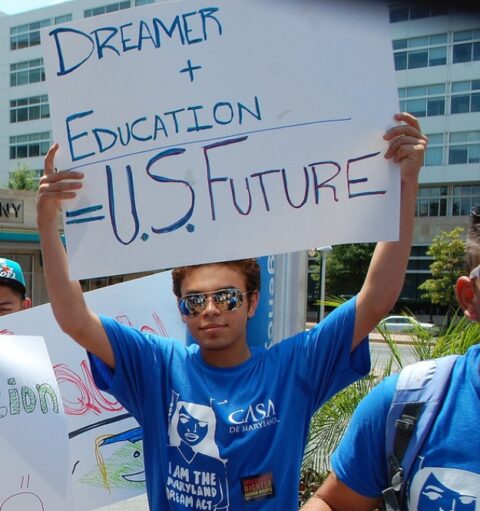
Understanding the Important Symbolism of the Maryland DREAM Act Victory
While much of last week’s energy was focused on Latino voter turnout in the Presidential race— and the subsequent recognition that immigration reform was all but inevitable—there was another major victory for immigration policy that came out of Maryland. Voters in the state supported through referendum their legislature’s decision to provide in-state tuition to undocumented students. This was the first vote of its kind in the nation and one where African-American voters were an important voting bloc in support of the measure. Read More
Silicon Valley’s second-term wish list
The Washington Post November 8, 2012 Silicon Valley contributed more to President Barack Obama’s re-election campaign than Wall Street and Hollywood, according to a Nov. 3 San Francisco Chronicle report. The Valley contributed $14.7 million compared to $14.5 million from New York City and $6.3 million from the Beverly… Read More
The Political Inevitability of Immigration Reform
Bloomberg Businessweek November 8, 2012 Having helped power President Barack Obama to victory over Mitt Romney, Hispanic voters are suddenly the “it” demographic in U.S. politics. Hispanics made up 10 percent of the total vote and gave Obama almost three votes for every one earned by Romney. Obama may… Read More
Elections Demand a New Way Forward on Immigration
Even before the election was called for President Obama last night, pundits and pollsters were remarking on the fact that immigration—or more specifically, anti-immigrant policies—were a death knell for Mitt Romney. Today, the analysis of whether and how the Republican party recovers from its devastatingly poor showing among Latinos—the key demographic group of the 21st century—is also focusing on immigration. CNN’s David Gergen noted that immigration reform would become a reality because Democrats want it and Republicans need it; even Fox news commentators grumpily acknowledged that immigration reform has got to be on the table now. Read More

Could DACA Have Happened Without Public Engagement at USCIS?
Approximately two months after the program opened, nearly 200,000 individuals have submitted requests for grants under the Deferred Action for Childhood Arrivals (DACA) imitative. It’s still too early to assess the overall success of the program or evaluate the grant rates, but it isn’t too early to take note of the important role that preparation played in making DACA a reality. Read More

Tracking the Immigration Agencies’ Actions Amidst Hurricane Sandy
Update (11/2): USCIS has posted this reminder of special services and temporary relief that may be available to individuals affected by Hurricane Sandy, including expedited processing of employment authorization documents and extensions of certain non-immigrant status designations. In its discretion, USCIS will also take it into account requests from individuals who were unable submit evidence or attend an appointment due to the impact of the hurricane. USCIS is also extending the deadline by thirty days for submission of materials for persons who have received Requests For Evidence (RFEs) or Notices of Intent to Deny (NOIDs) with deadlines between October 26th and November 26th. Except for appointments that were automatically rescheduled as a result of USCIS office closures or the automatic extension of certain deadlines, it’s important to note that the burden remains on the applicant to establish that the hurricane affected the need for special services or the inability to meet application requirements. Up and down the East Coast, the impact of Hurricane Sandy is still being felt and its aftermath will continue to affect people and businesses for days. In the past, in some of the most severe storms, such as Hurricane Katrina, the Department of Homeland Security (DHS) immigration agencies have issued widespread information on dealing with the immigration consequences of the storm. Thus far, basic information is available regarding U.S. Citizenship and Immigration Services’ (USCIS) plans; virtually nothing has been said about Customs and Border Patrol (CBP) and Immigration and Customs Enforcement (ICE). Read More

Supreme Court to Consider Reach of Padilla v. Kentucky
In its landmark decision in Padilla v. Kentucky, the Supreme Court confirmed that criminal defense attorneys have a constitutional obligation to advise their clients if pleading guilty to a particular offense could lead to deportation. On Thursday,* the Justices will consider a follow-up question of critical importance for many immigrants placed in removal proceedings on account of bad legal advice: whether the ruling applies to cases that became final before the decision was issued. Read More

ICE Scaling Back 287(g) Program
The 287(g) program has been controversial and criticized for years, and immigrant advocates have demanded that US Immigration and Customs Enforcement (ICE) terminate the program. Section 287(g) of the INA allows the Secretary of Homeland Security to enter into agreements that delegate immigration powers to local police, but only through negotiated agreements, documented in Memoranda of Agreement (MOAs). The task force model deputizes police to enforce immigration laws in the course of their regular activities on the streets, and the jail model places deputized police officers within jails. A recent development raises questions about the future of the program. Read More

Pace of DACA Approvals Quickens, but Will it be Fast Enough?
For the first time since immigration authorities officially launched Deferred Action for Childhood Arrivals in mid-August, the federal government released statistics last Friday indicating that thousands of requests have been officially granted. But while the figures themselves are an encouraging sign, other evidence suggests that most applicants will not have their requests considered until after the next presidential inauguration in January, if at all. Read More
America's story is an immigrant story.
