Undocumented Immigration

Standardizing Guidelines Would Improve USCIS’s Proposed Family Unity Waiver Rule
Earlier this year, USCIS proposed a new waiver rule that would allow some unauthorized immigrants (mostly direct family members of U.S. citizens) who are applying for a green card to apply for a waiver to the 3 and 10 year bar from within the United States, minimizing the amount of time they would have to be away from their families. While many welcome this proposed rule change, there are ways in which USCIS could streamline this process. In addition to previously suggested improvements, USCIS could provide training and guidelines on the extreme hardship standard to ensure that the standard is applied consistently. The “comment period,” which is open to the public and can be used to suggest improvements to the rule, end this Friday, June 1. Read More

Still No Resolution on VAWA, Protections for Immigrants at Risk
Despite the recent controversy over amendments to the Violence Against Women Act (VAWA), there is still no resolution on its reauthorization. The bill remains stalled in Congress due to conflicting versions passed by the House and Senate. As one source put it, while the current impasse is technically procedural (due to a revenue-related procedural rule), the source of frustration is certainly political. The House version passed this month strips VAWA of critical protections for immigrants—protections that have been part of the law since its inception. Read More

In California, Lawmakers Mount New Challenge to Secure Communities
Last year, lawmakers in California were poised to pass a bill—known as the TRUST Act—to let local jurisdictions opt out of Secure Communities, the federal program that routes fingerprints taken at local jails to federal immigration authorities. Before final passage, however, federal officials rendered the bill moot by declaring that participation in the program was mandatory. Now, lawmakers are considering a revised version of the bill that would minimize the impact of Secure Communities by limiting the ability of local governments to detain immigrants on the federal government’s behalf. Read More

Administration Takes Step to Keep Talented Foreign Students in the U.S.
BY HEATHER M. STEWART, COUNSEL AND DIRECTOR OF IMMIGRATION POLICY AT NAFSA: ASSOCIATION OF INTERNATIONAL EDUCATORS. Current U.S. immigration law provides few options for foreign graduates of U.S. universities with degrees in science, technology, engineering, and math (“STEM” degrees) who want to stay here to contribute their skills and knowledge. Not enough American students are interested in these fields, even as employers regularly cannot find enough people with the high-tech and scientific knowledge and skills they need to fill available positions. Luckily for the United States, international students seek out these majors and excel in them. But increasingly, we lose these talented graduates to other competitor countries where immigration laws are friendlier. This is, of course, an enormous loss to the U.S. economy, as international students with STEM degrees often create successful businesses and jobs in the United States. Last week, DHS took a strong step forward by expanding the list of STEM fields for foreign graduates applying to training programs after graduation. Read More

Anti-Immigration Group Blames Students for Maryland’s Budget Gap
In a case of very creative accounting, the nativist Federation for American Immigration Reform (FAIR) is blaming students for Maryland’s fiscal woes. In a new report, FAIR lumps together students who are unauthorized immigrants with U.S.-born students who have unauthorized parents and claims that they are all costing Maryland taxpayers astronomical sums in educational expenditures. However, the report (entitled The Cost of Illegal Immigration to Marylanders) mistakenly treats the education of these students as nothing more than a “cost” attributable to unauthorized immigration. In reality, the educational expenses targeted by FAIR are an investment in the future U.S. workforce and tax base; an investment that will pay off later as students become taxpayingattr workers. Read More

Expansion of Proposed Waiver Rule Could Help More Families Stay Together
As previously noted, the administration recently proposed a new rule that would help keep American families —the “Proposed Rule on Provisional Unlawful Presence Waivers of Inadmissibility for Certain Immediate Relatives.” This proposed rule would streamline the application process for many relatives of U.S. citizens currently eligible for a green card by minimizing the amount of time that applicants would have to be away from their families before being admitted into the United States. While the proposed rule is certainly a welcome change and would be an improvement over current procedures, there are ways in which the rule could be improved to help even more immigrants. Read More
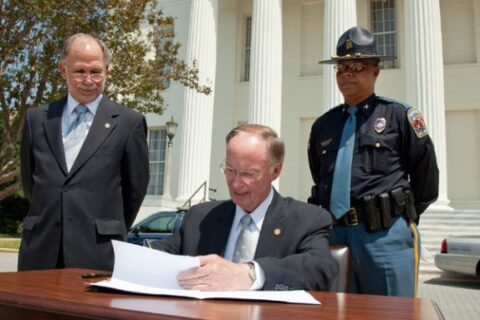
Alabama Governor Signs Bill That Makes State’s Immigration Law Even Worse
Last week, Alabama Governor Robert Bentley publically criticized a bill intended to revise key sections of the state’s controversial immigration law (HB 56). He even announced a special legislative session to address his issues with the bill—namely, a provision that requires school officials to check the immigration status of enrolling students and that of their parents and a provision that requires Alabama’s Department of Homeland Security to publically post the names of undocumented immigrants on their website. The day after his announcement, however, Governor Bentley backpedaled his criticisms, declared the legislature didn’t have the “appetite to address further revisions,” and signed the bill (HB 658) into law. Read More

Michigan Pushes Plan to Welcome Immigrants and their Revitalizing Power to State
While some states pushed for punitive immigration measures over the last year—measures designed to drive immigrants away —others, like those in Michigan, were busy putting together a plan that welcomes immigrants and their revitalizing power to the state. This month, leaders in Michigan—including state Rep. Rashida Tlaib (D-Detroit) and U.S. Rep. Hansen Clarke (D-Detroit)—helped launch “Welcoming Michigan,” a statewide initiative that seeks to welcome immigrants and their entrepreneurial talents to Michigan. Read More

Alabama Governor Rejects Changes to State’s Extreme Immigration Law, Starts Special Legislative Session
Today, Alabama Governor Robert Bentley announced his disapproval of a bill intended to change parts of the state’s extreme immigration law (HB 56) and initiated a special legislative session to address the problems. Yesterday, on the last day of the state’s regular legislative session, the Alabama Senate… Read More

Administration Takes Step Toward More Entrepreneur-Friendly Immigration Policy
BY TEJAS SHAH*. While the U.S. economy continues to recover at a sluggish pace, the administration continues to emphasize immigration reform’s critical role in promoting innovation and entrepreneurship in the U.S. This week, Cecilia Munoz, the Domestic Policy Council Director at the White House, spoke at a forum hosted by The Hamilton Project of the Brookings Institution about the administration’s commitment to immigration reform and easing pathways for foreign investors in the United States. Sadly, however, talented and dynamic foreign entrepreneurs seeking authorization to direct, operate, manage, or work for their investment vehicles often face tedious barriers. Easing these barriers would benefit our economy and enhance our ability to out-compete other countries in the modern global economy. After all, with out foreign entrepreneurs, we wouldn’t have such U.S. companies as Yahoo, Google, and Intel. Read More
All gifts are matched dollar for dollar
No one should face the immigration system alone