Economics

Immigration Reform Fattens State Economies, Too
“Should the United States be pro-immigrant?” asked Tax Watchdog Grover Norquist. “That’s like asking whether McDonald’s should make hamburgers. It’s made the United States work for several hundred years. It’s what’s made us different, what’s made us more successful,” said Norquist during a recent call summarizing a new report from Regional Economic Models, Inc. (REMI) on the economics of immigration reform. Read More

White House Report Outlines the Economic Benefits of Immigration Reform
As Republicans in the House of Representatives search for a way forward on immigration reform, they should keep in mind a critical point: overhauling the U.S. immigration system would help jump start the sluggish U.S. economy. In other words, any Member of Congress who has expressed a desire to cut the federal budget deficit, create new jobs and businesses, boost wages, and increase U.S. economic output should be for immigration reform—not against it. Conversely, those who stand against reform should carefully consider the price that will be paid by the U.S. economy, and U.S. workers, if reform does not occur. Read More

Local Welcoming Initiatives Help Build a Nation of Neighbors
While attention has been focused on federal immigration efforts these last few months, states and cities continue to encourage and promote immigration as well. From well-established programs like Welcoming America and its many state-level affiliates, Cities of Migration, the Building Resilient Regions research group, and the Center for the Study of Immigrant Integration, to new programs like the Welcoming Cities and Counties initiative, the impetus to invite immigrants into our communities continues to grow. Read More

Immigrants Boost Economic Vitality through the Housing Market
Abundant research shows that immigration is a net benefit to the United States’ economy. It leads to higher wages, business formation, job creation, and greater innovation – nationally and locally. Foreign workers who immigrate to the U.S. help alleviate labor force gaps left by a workforce increasingly nearing and entering retirement age. Furthermore, immigrants help fulfill growing healthcare needs of an aging population. In addition to these positive benefits of immigration, the favorable effect immigrant home-buyers have on the housing market is another important economic impact. Indeed, new research from the Americas Society/Council of the Americas and the Partnership for a New American Economy describes how the 40 million immigrants residing in the United States added $3.7 trillion to housing wealth in the U.S. The research, prepared by Jacob Vigdor at Duke University, uses county-level data on population and housing from the U.S. Census Bureau and American Community Survey from 1970 to 2010. The results show that immigration led to a boost in home values, particularly in neighborhoods hit hardest by the U.S. housing bust. Read More

Busting the Myth of the “Job Stealing” Immigrant
Some critics of the immigration bill now winding its way through the Senate claim that it would increase unemployment among native-born workers—especially minorities—by adding more immigrants to an already tight job market. In fact, both the legalization and “future flow” provisions of the bill would empower immigrant workers to spend more, invest more, and pay more in taxes—all of which would create new jobs. Contrary to the simplistic arithmetic of immigration restrictionists, employment is not a “zero sum” game in which workers compete for some fixed number of jobs. All workers are also consumers, taxpayers, and—in many cases—entrepreneurs who engage in job-creating economic activity every day. Read More
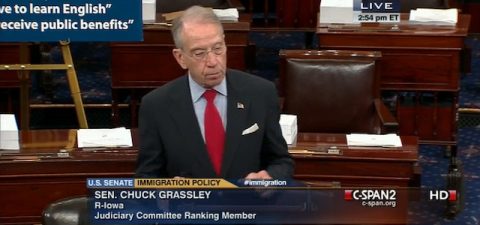
Border Security Amendments To Delay Legalization Harm Immigration Bill Efforts
During The first full day of debate after the Senate approved a motion to proceed to S. 744, the Border Security, Economic Opportunity, and Immigration Modernization Act, several Senators sought to make the debate all about border security. In the process, they proposed amendments that tie border security increases to the start of the legalization program in ways that make legalization a virtually unattainable goal. One of these amendments is from Sen. John Cornyn (R-TX). His RESULTS amendment ties the fate of unauthorized immigrants who are already living in the United States, and who have applied for legalization, to the success of highly stringent border-enforcement measures in deterring future unauthorized immigration. However, applicants for legalization have no control over the ability of the federal government to maintain the integrity of U.S. borders, so there is no logical reason to link their legal status to border-enforcement metrics. The RESULTS amendment also mistakenly views immigration reform as a two-step process: enforcement, followed by legalization. However, the various components of immigration reform must be implemented simultaneously to maximize their effectiveness. The amendment breaks apart what should by a single, integrated revamping of U.S. immigration policy. Finally, the RESULTS amendment contains no mechanism for judging the feasibility or cost-effectiveness of the border-security measures and metrics that it would mandate. Read More

Three Ways Immigration Reform Would Make the Economy More Productive
By David Dyssegaard Kallick, Director of the Fiscal Policy Institute’s Immigration Research Initiative. A report just released by the Fiscal Policy Institute, Three Ways Immigration Reform Would Make the Economy More Productive shows that legalization of undocumented immigrants, done right, would do three things to increase economic productivity in the United States. Read More

Congressional Opponents of Immigration Reform Demand Endless Increases in Border Security
Not surprisingly, the issue of border security is emerging as the biggest stumbling block to passage of the immigration reform bill now moving through the Senate. Conservative opponents of reform are refusing to support any measure that would grant legal status to unauthorized immigrants already in the country without first achieving that most nebulous of goals: “securing the border.” Yet the calls of these critics for “enforcement first” conveniently overlook the fact that the United States has been pursuing an “enforcement first” approach to border security for more than 20 years—and it has yet to work. Read More

Medicare’s Health and Well-Being Depends on Immigrants
Immigrants’ access to affordable health care is one of the most contested issues in the current immigration reform debate. Most advocates of comprehensive immigration reform point to the need to ensure that aspiring citizens have opportunities to access appropriate health care since such access will impact their ability to learn, to work, and to contribute to their communities. On the other end of the spectrum, anti-immigration groups tend to inaccurately emphasize that newly legalized immigrants would represent an excessive fiscal burden. This prediction is based on a misleading characterization of immigrants as “takers”—in other words, as disproportionate consumers of public resources. Several studies have shown that this is just not the case. In fact, non-citizens use public benefit programs at a lower rate than similar low-income native-born citizens. With regard to medical expenditures in particular, immigrants tend to use less health care than their U.S.-born counterparts. Read More

Experts from Left and Right Agree on Economic Power of Immigration Reform
In recent years, study after study has demonstrated a simple yet economically powerful truth about broad-based immigration reform: workers with legal status earn more than workers who are unauthorized—and these extra earnings generate more tax revenue, as well as more consumer spending, which creates more jobs. As a new report from the Center for American Progress (CAP) points out, this fact implies that states with appreciable unauthorized populations stand to gain economically from immigration reform that includes a legalization program for the unauthorized. Moreover, a new open letter to Congressional leaders released by the conservative American Action Forum illustrates that it is not only liberal advocacy groups like CAP which recognize the economic potential of immigration reform. Read More
All gifts are matched dollar for dollar
No one should face the immigration system alone