Children

Unaccompanied Children Deserve Fair Representation in Immigration Courts
News stories and NGO reports continue to document the plight of “unaccompanied children,” and their complex legal issues were brought to the attention of Congress when Attorney General Eric Holder told the House Judiciary Committee last month that the Department of Justice needs to do more to address… Read More

Why Federal Officials Reminded Schools Not to Discriminate Against Immigrant Students
Last week, the Department of Education took steps to help ensure that undocumented students are not deterred from enrolling at K-12 public schools. The Department issued updated guidance regarding public schools’ responsibility to provide equal access to elementary and secondary education for all students regardless of immigration… Read More

An Unnecessary Pre-Emptive Strike Against Young Undocumented Immigrants
This week, the Center for Immigration Studies (CIS) issued a criticism of the Kids Act, a bill not yet released by House leadership. The thrust of their argument is that any legalization program the bill could propose would be an “amnesty,” no matter what the requirements, and that… Read More

Nativist Group Blames Students for Texas Budget Gap
In a case of creative accounting, the nativist Federation for American Immigration Reform (FAIR) is blaming students for the fiscal woes of Texas. In a new report, FAIR lumps together students who are unauthorized immigrants with U.S.-born students who have unauthorized parents and claims that they are all costing Texas taxpayers astronomical sums in educational expenditures. However, the report (titled The Fiscal Burden of Illegal Immigration on Texans) mistakenly treats the education of these students as nothing more than a “cost” attributable to unauthorized immigration. In reality, the educational expenses targeted by FAIR are an investment in the future U.S. workforce and tax base; an investment that will pay off later as students become taxpaying workers. Read More

Targeting Immigrant Taxpayers as a Matter of Course
Unfortunately, there is a new fallback position for some members of Congress when it comes to finding ways to save money. That position is eliminating the Additional Child Tax Credit for immigrant taxpayers. This has been proposed in the past by other members of Congress; however, the latest iteration is in the form of an amendment that Senator Kelly Ayotte (R-NH) proposed to “pay for a three-month extension of unemployment benefits by stopping a scheme that currently allow {sic} illegal immigrants to claim the Additional Child Tax Credit.” Read More

Supreme Court Considers Restrictive Interpretation of Child Status Protection Act
Yesterday, the Supreme Court heard oral arguments in Mayorkas v. Cuellar de Osorio, a case challenging the government’s restrictive interpretation of the Child Status Protection Act (CSPA). The CSPA provides relief for the longstanding problem of children included on a parent’s visa application who “age out” –… Read More

As Congress Looks to Next Year, Activists Keep Immigration Reform Alive
Congress takes a holiday break at the end of this week and won’t return from recess until January. This pause in the legislative calendar, however, has little meaning for immigration activists who are continuing to push Congress to act on immigration reform. While the timetable may be changing, the… Read More
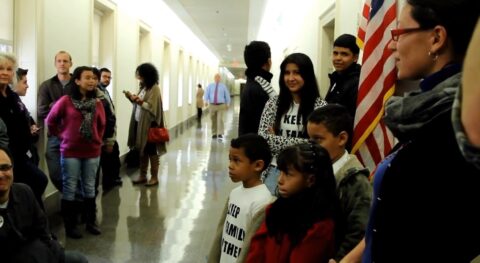
From the Mouths of Babes: Children Demand Immigration Reform
Families across the U.S. are facing the holidays separated from mothers, fathers, and siblings due to deportations and years-long waits for visas. Children—some of whose parents are undocumented immigrants—have taken to the halls of Congress this week to go to congressional offices, meet with members, and ask them to support immigration reform so that their families won’t be separated. Read More

The Punishment Should Fit the Crime for Immigrants, Too
The punishment should fit the crime. That maxim is as old as law itself, dating at least as far back as the Old Testament and Hammurabi’s Code. It’s firmly rooted in our Constitution’s Due Process Clause and the Eighth Amendment’s prohibition against excessive fines and cruel and unusual punishment. That principle—referred to as proportionality—appears in both our criminal and civil law. It forbids, for example, the imposition of a life sentence for passing a bad check. It means that the state cannot sentence juveniles for non-homicide crimes to life without parole. And it disallows extreme punitive damages awards. So what does proportionality have to say when the government tries to deport a lawful permanent resident who, a decade ago, shoplifted $200 worth of merchandise from a department store? Right now, astonishingly, nothing: immigration judges do not even consider whether a person’s banishment from the United States is a disproportionate punishment for a crime before ordering the person’s removal. But advocates are working to change this. Read More

‘Fast 4 Families’ Moves to Next Phase as New Fasters Take the Mantle
On the National Mall today, the four core fasters leading the “Fast 4 Families” ordained new fasters and ended their 22-day, water-only fast. Members of Congress, the faith community and civil and immigrant rights groups turned out to witness the four fasters passing the baton over to others who will continue the fast until House Speaker John Boehner schedules a vote on immigration reform. Read More
America's story is an immigrant story.