Employment and Wages

Immigration Reform Now a Matter of “How”
There are plenty of genuine issues worthy of debate in immigration reform—how to really create secure borders and communities, how to predict and manage future immigration flows, how to implement a fair and workable employment verification system, and how to ensure that legal immigration incorporates key values represented by family and work. But what is no longer on the table is whether we should be doing immigration reform, particularly legalization of the undocumented. Yesterday’s release of the IPC/CAP report finally puts to rest the question of whether immigration reform is good for the country. The answer—a resounding “Yes!” Read More

New Report Quantifies Benefits of Immigration Reform to U.S. Economy
Those policymakers and commentators who argue that we simply cannot afford to enact comprehensive immigration reform in the middle of an economic recession have their facts woefully wrong. According to a new report released jointly by the Immigration Policy Center (IPC) and the Center for American Progress (CAP), the economic benefits which would flow from comprehensive immigration reform would be dramatic. The report, Raising the Floor for American Workers: The Economic Benefits of Comprehensive Immigration Reform, uses a “computable general equilibrium model” to estimate that comprehensive reform which includes a pathway to legal status for currently unauthorized immigrants, as well as the creation of flexible limits on future immigration, would “yield at least $1.5 trillion in added U.S. Gross Domestic Product (GDP) over 10 years.” Moreover, comprehensive reform would “boost wages for native-born and newly legalized immigrant workers alike.” Read More

Shenandoah is a Cautionary Tale for How to Debate Immigration Reform
This week a police chief and two of his officers were charged with obstruction of justice in connection with their investigation of the beating death of Luis Ramirez, a 25-year-old undocumented Mexican immigrant, in Shenandoah, PA, last year. The two teenagers acquitted of his murder were also indicted on federal hate crime charges. While some measure of justice may eventually be served in the Ramirez case, this tragedy should serve as a cautionary tale as we move into 2010 and gear up for a new round of immigration reform debates. Policy makers and the media must understand that when the debate devolves from reasoned, fact-based discussions into fear and hate-mongering the consequences can be dire. Read More
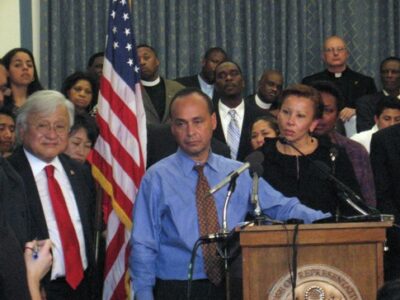
Congressman Luis Gutierrez Introduces Comprehensive Immigration Reform for America’s Security and Prosperity Act of 2009
Today, in a room filled with supporters and shouts of “Si, Se Puede,” Congressman Luis V. Gutierrez (D-IL) held a press conference to introduce the Comprehensive Immigration Reform for America’s Security and Prosperity Act of 2009 (CIR ASAP). Congressman Gutierrez introduced the immigration reform bill—which at last count had 89 original co-sponsors including the Congressional Hispanic, Black, Progressive, and Asian Pacific American Caucuses—before Congress heads home for the holidays “so that there is no excuse for inaction in the New Year.” Read More

Restrictionists Build Anti-Immigrant Agenda on Backs of American Workers
While perpetuators of the myth that “immigrants take jobs away from hard working Americans” are busy exploiting both immigrants and native-born workers, a new report by America’s Voice Education Fund shines a much needed light on the restrictionist lobby’s real agenda—deportation at any cost. Released last week, the report takes a closer look at the “anti-worker” voting records of supposedly “pro-worker” Congressional Members who, “aided by a shadow coalition of groups with an anti-immigrant agenda,” have consistently built a “deport them all” agenda on the backs of American workers. Read More
Critical Care: The Role of Immigrant Workers in U.S. Health Care
As the public debate over health care reform continues to rage, mention is seldom made of the vital role that immigrants play in the health care workforce. Read More

Nativist Group Discovers Unemployment is High
The Center for Immigration Studies (CIS) has made the rather un-astounding discovery that unemployment in the recession-plagued U.S. economy is high, especially among less-educated workers. In a new report, entitled A Huge Pool of Potential Workers, CIS dissects the latest Bureau of Labor Statistics numbers on unemployment and underemployment among the native-born, and notes that there are between seven and eight million unauthorized immigrants currently working in the United States. The report then makes the casual claim that “if the United States were to enforce immigration laws and encourage illegal immigrants to return to their home countries, we would seem to have an adequate supply of less-educated natives to replace these workers.” What the CIS report fails to mention is that the costly and destructive measures which have been proposed to “encourage” unauthorized workers to leave the country have yet to work and adversely affect native-born workers; that many unemployed natives would have to travel half way across the country to reach the low-wage jobs formerly held by unauthorized immigrants; that removing unauthorized workers from the country also means removing unauthorized consumers and the jobs they support through their purchasing power; and that none of this would aid the nation’s long-term economic recovery. Read More

Napolitano Looks for Comprehensive Way Forward
Department of Homeland Security (DHS) Secretary Janet Napolitano testified in an oversight hearing today before the Senate Judiciary Committee. While reinforcing her commitment to securing our borders and enforcing our immigration laws in smart and effective ways, Napolitano also reaffirmed her commitment to immigration reform as a way to strengthen our immigration enforcement policies—a commitment that includes, as Secretary Napolitano notes, responsibility and accountability from everyone involved: Read More

Studies Show Latinos Climb Socio-Economic Ladder of Success
As a front-page story in today’s Washington Post reminds us: “Not since the last great wave of immigration to the United States around 1900 has the country’s economic future been so closely entwined with the generational progress of an immigrant group.” The story highlights the degree to which the children of immigrants from Latin America have become crucial to sustaining the working-age population and tax base of the nation—particularly as more and more of the 75 million Baby Boomers retire. Moreover, the parents of these children most likely would not have even come to this country if not for the U.S. economy’s past demand for workers to fill less-skilled jobs—demand which was not being adequately met by the rapidly aging and better-educated native-born labor force. The Post story also casts a spotlight on the insecurities and anxieties of commentators who feel that Latino immigrants and their descendants aren’t integrating into U.S. society and moving up the socio-economic ladder “fast enough.” Although these concerns are certainly understandable, they are as unjustified now as they were a century ago when they were directed at immigrants from southern and eastern Europe. Read More

Rep. Lamar Smith’s Fairytale Economics
Writing in Politico on December 3, long-time anti-immigrant activist Rep. Lamar Smith (R-21st/Texas) claims that President Obama, who attended a forum on jobs and economic growth today, could magically create 8 million job openings for unemployed native-born workers if he would just deport the 8 million unauthorized immigrants now working in the United States. But that’s not how the U.S. economy actually works. Immigrant and native-born workers can not simply be exchanged for one another. Read More
America's story is an immigrant story.