Economic Impact
Immigrants are essential to the U.S. economy, filling roles from high-skilled tech sectors to agricultural labor and driving economic growth. They also contribute to the tax base and consumer spending. We champion reform that will maximize this effect and create a more diverse and competitive workforce.

State Lawmakers from Critical States Speak Out in Favor of DREAM Act
Washington D.C. – Today, a group of state legislators from Colorado, Massachusetts, Maine, Texas, and Utah participated in a briefing to share their support for federal legislation know as the DREAM Act. The bi-partisan DREAM Act passed the House of Representatives and awaits a final vote in the Senate in… Read More
White House to Award Latino Civil Rights Advocate, Sylvia Mendez
Each year, the White House awards the Presidential Medal of Freedom—“the Nation’s highest civilian honor, presented to individuals who have made especially meritorious contributions to the security or national interests of the United States, to world peace, or to cultural or other significant public or private endeavors.” Among the recipients for the 2011 Medal of Freedom is civil rights activist Sylvia Mendez, whose story of strength and perseverance in the face of discrimination and bigotry is a tale from which everyone can take heart—especially DREAM Act students who face an uphill battle this month. Read More
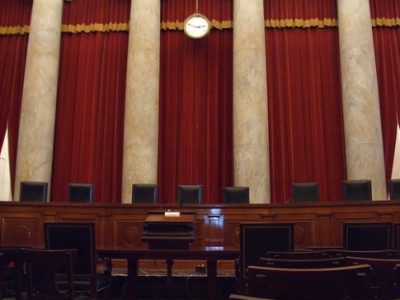
Win, Lose or….Draw? The Supreme Court Tackles Arizona’s Employer Sanctions Law
Those following the Obama Administration’s legal challenge to Arizona’s SB 1070 have likely heard about “preemption”—the legal concept governing when state laws conflict with, and are therefore superseded by, acts of Congress. The heart of the dispute over SB 1070 is whether states have a right to provide assistance that the federal government does not want. No one knows if or how the Supreme Court will ultimately answer that question. But a number of hints may emerge when the Justices issue a ruling in Chamber of Commerce v. Whiting, a case testing the legality of a different law known as the Legal Arizona Workers Act. Passed in 2007, the act imposed new requirements to prevent employers from hiring unauthorized workers, as well as harsh consequences for doing so. While the Justices’ questions during Wednesday’s oral argument offered reason for hope among immigrants’ rights advocates on one part of the law, they left the fate of the other unresolved. Read More
New DHS Data Highlights Benefits of Integration Requirements
We want legal permanent residents (LPRs) to become U.S. citizens and fully participate in civic life—and research shows they are, in fact, doing just that. DHS recently presented new data on two programs for legal permanent residence (LPR) status—one that required immigrants to learn English and U.S. history, and one that did not. They found that those who were required to learn English and history (which are also requirements for U.S. citizenship) are naturalizing at higher rates. Read More
New Report Describes Peril Immigrant Women Face in U.S. Food Industry
The Southern Poverty Law Center (SPLC) released a new report called Injustice on our Plates: Immigrant Women in the U.S. Food Industry which looks at the conditions under which immigrant women work. It documents and personalizes the stories of women who have made the dangerous journey to the U.S. seeking a better life for themselves and their families, only to end up working long hours under extremely difficult and dangerous conditions. Read More
Remembering Our Immigrant Veterans: An Incalculable Contribution
Whenever restrictionist groups calculate the cost of an immigrant, they inevitably overlook the contributions of immigrant veterans who fight and die on behalf of Americans every single day. Immigrants have voluntarily served in all branches of the U.S. military from the beginnings of our great nation. In fact, without the contributions of immigrants, the military could not meet its recruiting goals and could not fill the need for foreign-language translators, interpreters, and cultural experts. Read More
Underrepresented African Refugees and Potential Problems with DNA Testing
Earlier this month, President Obama announced the annual refugee allocations—80,000 total for Fiscal Year 2011, the same total as in 2010. However, while the total yearly allocation is the same, African refugees are being underrepresented. The 2011 ceiling for African refugees is 15,000, which is slightly lower than in 2010 and nearly 25 percent lower than the average for the previous decade (2000-2010). In reality, the number of African refugees actually admitted has fallen considerably below the ceilings due to processing problems. Why? New data documenting the underrepresentation of refugees from Africa in the U.S. looks at allegations of fraudulent African family reunification applications, DNA testing programs, and its implications for U.S. refugee and immigration policy. Read More
Experts Highlight Economic Gains from Immigration
At a forum held yesterday by the Hamilton Project of the Brookings Institution, a panel of experts sought to “distinguish economic reality from myth” in the often fact-free and emotion-laden debate over how immigration affects the U.S. economy and U.S. workers. The forum, entitled “Crossing Borders: From Myth to Sound Immigration Policy”—as well as an accompanying report, Ten Economic Facts About Immigration—served to refute the shrill and empirically baseless claims of nativist groups that immigrants are stealing jobs from Americans while draining the public treasury. Read More
Congressional Committee Attempts to Tackle AgJOBS, Again
Last week, the House Immigration Subcommittee held a hearing on immigration and farm labor. The substance of the hearing is likely to be eclipsed by the presence of Comedy Central’s Stephen Colbert, who testified about his participation in United Farm Workers’ (UFW) “Take Our Jobs” campaign. While Colbert's presence insured that it wasn’t your ordinary committee hearing, in many ways this hearing was simply more of the same rhetoric which demonstrated Congress’s inability to get beyond partisan sniping and sound bites and pass any type of immigration reform. Read More
New Census Data Underscores Growing Entrepreneurial Power of Latinos
New data released this week by the U.S. Census Bureau highlights the rapidly growing economic power of Latino-owned businesses in the United States. According to the Bureau’s 2007 Survey of Business Owners, there were 2.3 million Latino-owned businesses in the country as of 2007, which generated $345.2 billion in sales and employed 1.9 million people. Moreover, the number of Latino-owned businesses grew by 43.7 percent between 2002 and 2007, which was more than twice the national average. In other words, the Latino community tends to be highly entrepreneurial, and the businesses which Latinos create sustain large numbers of jobs. Read More
All gifts are matched dollar for dollar
No one should face the immigration system alone