Immigration Legislation
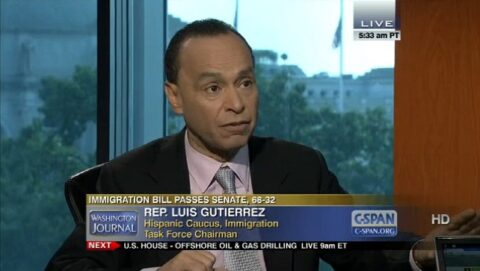
Spotlight Moves to House After Senate Approves Immigration Bill
Now that the Senate has passed a sweeping measure to improve U.S. immigration policies, the attention turns to the House of Representatives, where it is unclear exactly when or how they will take up an immigration bill. The Associated Press reported that President Obama called House Speaker John Boehner (R-OH) and House Minority Leader Nancy Pelosi (D-CA) after the Senate vote to urge them to have the House act on an immigration bill. Earlier this week, Boehner said the House would not take up S. 744 and would do its own bill instead. If the House passed a separate immigration measure, then a conference committee with members from both chambers would meet to reconcile the differences. Read More
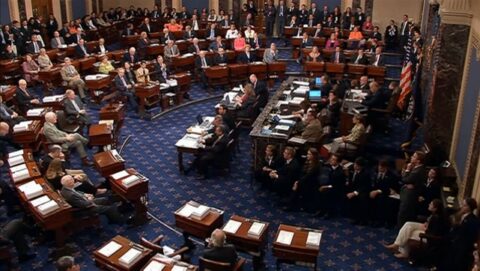
Senate Passes Landmark Immigration Reform Bill
The Senate approved a massive overhaul of the nation’s immigration policies today in a historic vote. They voted 68-32 to approve S. 744, the Gang of Eight’s immigration reform measure that the Senate Judiciary Committee passed in May. Immediately after the vote, Sen. Dick Durbin (D-IL), a member of the Gang of Eight and sponsor of the DREAM Act, tweeted, “Today, we have accomplished something great, made America a stronger nation & honored our heritage as a nation of immigrants.” Before they cast those votes, Senate Majority Leader Harry Reid reminded senators of the human side of immigration. “We’re here to talk about people, not pages of legislation,” he said. Read More

Beyond the Border Surge, What Else Is In the Senate Compromise?
On Monday, the Senate voted 67 to 27 to invoke cloture on Leahy 1183, an amendment to substitute the current version of the Senate’s immigration reform bill, S. 744, with a revised version of the bill that includes a host of amendments that have been referred to as the Corker/Hoeven compromise—or, more simply, the border surge. Thirty hours from that vote—sometime Wednesday morning—the Senate will actually vote on whether to adopt Leahy 1183. The cloture vote is a strong indicator of passage of the amendment and, many predict, of the bill overall. Read More

Nativist Group Fears an Immigration Tsunami Under Senate Immigration Bill
Throughout its history, the United States has benefited in innumerable ways from immigration. Men and women from every corner of the globe, with every conceivable skill set and educational background, have come here and added value to the U.S. economy and U.S. society. Likewise, the arrival of every new “wave” of immigrants has elicited shrill cries from nativists afraid that all of these newcomers will swamp the nation, throw native-born workers out of their jobs, and undermine “our” way of life. The nativists never seem to learn the lessons of history in this regard, because they keep making the same baseless claims, and indulging the same irrational fears, every generation. It doesn’t matter who the newcomers are—Germans, Italians, or Mexicans; Slavs, Africans, or Arabs—the arguments are always the same. Read More

Is a Border Surge the Only Way to Pass Immigration Reform and Ensure Legalization?
During the second full week of debate on S. 744, momentum towards passage increased with a positive CBO score, the defeat of several poison-pill amendments, and the announcement of a Republican border amendment that is thought to bring ten to fifteen Republicans to “yes” on final passage. A series of critical cloture votes is likely to be filed over the next few days, paving the way for a final vote next Friday. Despite this news, the mood is not jubilant, as good policy seems to be losing to pragmatic politics. Read More

CBO Gives High Marks to Senate Immigration Bill
Yesterday, the Congressional Budget Office (CBO) released its much-anticipated “scoring,” or cost estimate, of the Senate immigration bill. Overall, the numbers are good. Very good. The CBO projects 20 years ahead and predicts fiscal savings in the amount of roughly $1 trillion. In addition, the CBO explained in a separate report that the bill would have a host of economic benefits that are not captured in a strictly fiscal analysis, such as GDP growth, increased productivity, and long-term wage increases. Read More
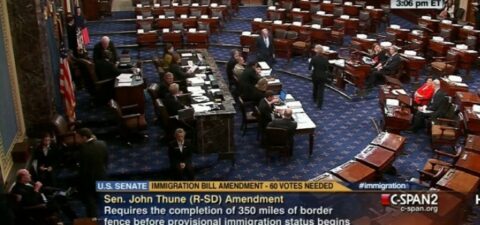
How the Senate Votes On Amendments
The Senate voted on four amendments to the immigration reform bill today, starting the ball rolling on what is likely to be a series of amendment votes over the next few days. The Senate rejected two votes requiring more enforcement at the border as a condition of implementing or completing a legalization program: Vitter 1228, which failed 36-58, and Thune 1197, which failed 39-54. Two other amendments were less divisive: Tester 1198, adding tribal governments to the Border Task Force, which passed 94-0 and Landrieu 1222, an adoption measure, which passed on a voice vote. In each case, in order to be adopted, a sixty vote threshold was required, rather than a simple majority, which has become the norm in the Senate. Needless to say, the variety of votes and rules can be confusing, leading to the need for some background on the amendment process. Read More

Busting the Myth of the “Job Stealing” Immigrant
Some critics of the immigration bill now winding its way through the Senate claim that it would increase unemployment among native-born workers—especially minorities—by adding more immigrants to an already tight job market. In fact, both the legalization and “future flow” provisions of the bill would empower immigrant workers to spend more, invest more, and pay more in taxes—all of which would create new jobs. Contrary to the simplistic arithmetic of immigration restrictionists, employment is not a “zero sum” game in which workers compete for some fixed number of jobs. All workers are also consumers, taxpayers, and—in many cases—entrepreneurs who engage in job-creating economic activity every day. Read More

House Immigration Bill Promotes Old Model Immigration Solutions
Today the House held a hearing on H.R. 2278, the "Strengthen and Fortify Enforcement Act" (the SAFE Act), which is designed, as its name suggests, to be a lopsided, enforcement-only bill that imposes additional criminal penalties, border security, and detention and deportation, while encouraging discredited policies such as self-deportation and state interference with immigration law. Instead of these old enforcement-only policies, which do not work, what is needed is a comprehensive solution that fixes our broken legal immigration system and provides a path to earned legalization. Read More
Border Security Amendments To Delay Legalization Harm Immigration Bill Efforts
During The first full day of debate after the Senate approved a motion to proceed to S. 744, the Border Security, Economic Opportunity, and Immigration Modernization Act, several Senators sought to make the debate all about border security. In the process, they proposed amendments that tie border security increases to the start of the legalization program in ways that make legalization a virtually unattainable goal. One of these amendments is from Sen. John Cornyn (R-TX). His RESULTS amendment ties the fate of unauthorized immigrants who are already living in the United States, and who have applied for legalization, to the success of highly stringent border-enforcement measures in deterring future unauthorized immigration. However, applicants for legalization have no control over the ability of the federal government to maintain the integrity of U.S. borders, so there is no logical reason to link their legal status to border-enforcement metrics. The RESULTS amendment also mistakenly views immigration reform as a two-step process: enforcement, followed by legalization. However, the various components of immigration reform must be implemented simultaneously to maximize their effectiveness. The amendment breaks apart what should by a single, integrated revamping of U.S. immigration policy. Finally, the RESULTS amendment contains no mechanism for judging the feasibility or cost-effectiveness of the border-security measures and metrics that it would mandate. Read More
America's story is an immigrant story.