Department of Homeland Security

DHS Review of Immigration Cases Expands to Half Dozen New Cities
The Washington Post and Huffington Post are reporting that ICE’s ongoing review of existing deportation cases will expand to six new cities in the coming months. Initially launched in Baltimore and Denver in 2011, the initiative will soon expand to Seattle, Detroit, New Orleans and Orlando, followed by Los Angeles, San Francisco, and New York City. The idea behind the initiative is to clear historic backlogs in the immigration courts by administratively closing cases that ICE considers to be low priority. Read More

More Evidence that Hostile Immigration Enforcement Compromises Public Safety
The priorities of immigration enforcement authorities, such as ICE and the Border Patrol, often do not align with those of local law enforcement agents. When local law enforcement officials are charged with enforcing federal immigration laws, unauthorized immigrants tend to lose trust in, cease interacting with, and often do not report crimes to law enforcement officials when they have reason to fear detainment or deportation in any encounter. So concludes a new report by the Center for American Progress entitled, “Life as an Undocumented Immigrant: How Restrictive Local Immigration Policies Affect Daily Life.” Read More

DHS Announces Temporary Protective Status (TPS) for Syrians
Due to ongoing violence in Syria, Secretary for the Department of Homeland Security Janet Napolitano announced that DHS will provide Temporary Protective Status for Syrians currently in the United States. According to the L.A. Times, “more than 10,000 people have died in the yearlong conflict, including civilians, armed dissidents and security forces, according to U.N. and Syrian government figures.” TPS is a temporary immigration status granted to individuals residing in the United States who are, in the short-term, unable to safely return to their home country because of ongoing armed conflict, an environmental disaster, or other extraordinary and temporary conditions. The Syrian government has been trying to suppress anti-government protests calling for the resignation of President Bashar al-Assad and his Ba’ath Party since the beginning of last year. Despite U.N peace efforts, the violence continues to escalate. Read More
DHS Report Finds Inadequate Information Sharing, Mission Overlap Among Agencies
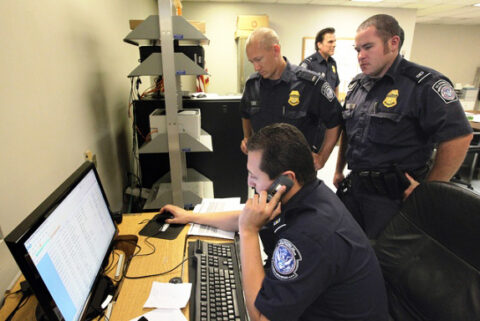
Nine years after its creation, the Department of Homeland Security (DHS) is still hampered by mission overlap and inadequate information sharing among the various agencies within the department. So concludes a recent report by the DHS Office of Inspector General, entitled Information Sharing on Foreign Nationals: Border Security. Highlights from the report include a recommendation to scrap the controversial NSEERS database, and a call for real department-wide coordination among DHS agencies. Read More

Crunching—and Clarifying—the Numbers on Prosecutorial Discretion
Late last year, the Department of Homeland Security (DHS) instructed its attorneys to review matters pending before immigration courts in search of low-priority cases warranting prosecutorial discretion. But of the approximately 300,000 immigrants now in deportation proceedings, how many stand to potentially benefit from the initiative? In recent days, immigrant advocates have fretted the figure could be as low as 1 percent—a fear based on the number of cases that had been officially suspended as of the start of last week. In truth, the actual figure presently appears closer to 10 percent. While the government bears the blame for much of the confusion, it now seems certain that advocates’ initial fears were unwarranted. Read More

Why the Scott Gardner Act is Unconstitutional…and a Bad Idea
Immigration hardliners never hesitate to claim the mantle of “states’ rights” when defending laws like Arizona SB 1070. But those wanting local cops to double as federal immigration agents were conspicuously silent at a congressional hearing on Wednesday on the Scott Gardner Act, a bill that (among other things) would require police to run extra background checks on foreign nationals arrested for drunk driving. Instead, it was pro-immigrant members of Congress who had to remind the legislative sponsors that the Constitution prohibits the federal government from imposing unfunded mandates on states—all while explaining the many reasons why the bill would make bad policy. Read More

Despite Alabama’s Cautionary Tale, Mississippi Moves Forward with Extreme “Papers, Please” Immigration Legislation
So much for Southern hospitality. Despite damning reports, bad press and mea culpas from politicians out of Alabama following passage of their extreme immigration law, HB 56, Mississippi lawmakers continued down the same destructive path this week. Mississippi’s “papers please” immigration bill, HB 488—which contains nearly all the same provisions as Alabama’s extreme immigration law, including those previously blocked by a Federal Appeals Court—passed out of two committees this week. In addition to the “papers, please” provision, Mississippi’s law also requires every public school to determine the immigration status of every enrolling student. The law also makes it illegal for any state or local governmental entity to engage in any “business transaction” with an undocumented immigrant—potentially denying basic medical care and access to utilities to families and children. The bill now goes back to the Mississippi House for debate. Read More

ICE Distorts Facts in Debate over Immigration Detainers
February was an important month in the debate over immigration “detainers,” the controversial tool used to strong-arm local jails into holding immigrants on the federal government’s behalf. In Connecticut, a class-action lawsuit was filed attacking detainers’ many legal vulnerabilities, and the Governor announced that state jails will not honor them in all cases. In Illinois, Cook County received another pointed letter from Immigration and Customs Enforcement (ICE) Director John Morton over a local ordinance enacted last year. While immigration detainers are a subject of legitimate public debate, the controversies demonstrate how ICE has resorted to making disingenuous legal claims in apparent hopes spreading the mistaken belief that immigration detainers must be honored. Read More

USCIS Convenes Summit to Consider Streamlined Path for Immigrant Entrepreneurs
By KIRSTEN SCHLENGER, MANAGING PARTNER AT WEAVER SCHLENGER MAZEL LLP. The business community has long heralded the vital role immigrant-owned startups play in creating American jobs. This month, it seems like someone at U.S. Citizenship and Immigration Services (USCIS) was listening. USCIS recently hosted its first in a series of summits dedicated to gathering expertise on how U.S. immigration law can enable foreign innovators to come to or remain in the U.S. lawfully while they start and grow businesses that benefit the U.S. economy. The informational summits, part of USCIS’s new Entrepreneurs in Residence (EIR) initiative, will result in the creation of a team of entrepreneurs and experts who are charged with designing and implementing USCIS policy that eases a path to the U.S. for talented immigrant entrepreneurs. Read More

A New Way to Measure the Burgeoning Power of the Immigrant Vote
Voter registration is a key measure of immigrant integration. After all, what could be more American than casting your ballot on Election Day? When measuring immigrant voting patterns, voter registration is typically defined as the percent of naturalized immigrants (those who have become U.S. citizens) who are registered to vote. In other words, we only look at those currently eligible to vote because they have naturalized, instead of looking at the percentage of naturalized registered voters against all immigrants, documented or undocumented. The problem with that approach is we miss a big and important picture on the potential of the immigrant voting block—that many of those not eligible now, may well be eligible in the future. Read More
America's story is an immigrant story.