Federal Courts/Jurisdiction

Understanding Justice Kennedy’s “Upside Down” Argument in U.S. v. Texas
On April 18, the United States Supreme Court heard oral arguments in United States v. Texas, a case brought by 26 states to challenge President Obama’s frozen deferred action programs, known as Deferred Action for Childhood Arrivals Plus (expanded DACA) and Deferred Action for Parents of Americans and… Read More
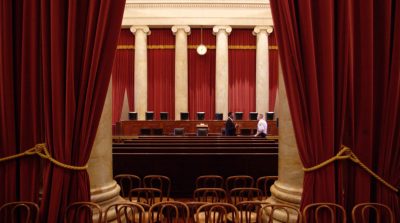
Digesting the Argument in U.S. v. Texas: What Is Lawful Presence and Why Does It Not Mean What It Sounds Like?
The oral argument in United States v. Texas shined a light on the confusion between the term “lawful presence” and what it means to have a legal immigration status in the United States. Early in the argument, Chief Justice Roberts noted that in its brief, the United States asserted… Read More
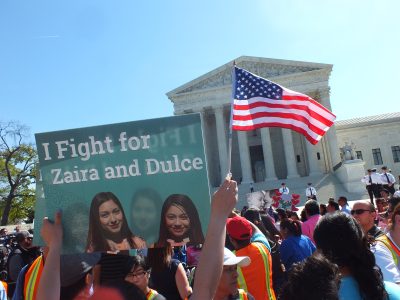
Supreme Court Considers President’s Executive Actions on Immigration While Thousands Rally Outside
The Supreme Court heard oral arguments in United States v. Texas. While lawyers presented their arguments before the eight Justices inside, on the outside families, advocates, immigrants, faith groups, and a wide range of civil rights and community organizations gathered to demonstrate support for the President’s initiatives. The… Read More

What You Need to Know About the DAPA and Expanded DACA Case Before the Supreme Court
In the spring of 2016, the U.S. Supreme Court will consider United States v. Texas, a politically charged lawsuit about the legality of some of President Obama’s executive actions on immigration. The oral argument will take place on Monday, April 18 before the eight sitting justices. The initiatives in… Read More
Defending DAPA and Expanded DACA Before the Supreme Court
This guide provides brief answers to common questions about United States v. Texas, including what is at stake in the case, how the litigation began, what the contested issues are, and the impact the case may have on our country. Read More
Ngassem v. Chertoff – Second Circuit
The Council filed an amicus brief arguing that the district court had jurisdiction over the denial of an asylee relative petition in a case brought under the Administrative Procedure Act. Case settled without a decision from the court. Read More
Ashcroft v. Abbasi (formerly Turkman v. Ashcroft) – U.S. Supreme Court
The Council, along with the National Immigration Project of the National Lawyers Guild (NIPNLG), is seeking to preserve federal court review of damages actions brought by noncitizens for abuse of authority by immigration agents. In actions brought under Bivens v. Six Unknown Named Agents of the Federal Bureau of Narcotics, 403 U.S. 388 (1971), the government routinely moves to dismiss these cases on a variety of jurisdictional grounds, including by arguing that INA § 242(g) bars the court’s review of damages claims in any case involving removal procedures, and that a remedy under Bivens is not available in immigration-related actions. In essence, the government is attempting to deprive those who have been harmed by immigration agents of any remedy in federal court. Read More

Avalos-Palma v. United States – District Court for the District of New Jersey
The American Immigration Council and National Immigration Project of the National Lawyers Guild (NIPNLG) are seeking to preserve federal court review of damages actions brought by noncitizens for abuse of authority by immigration agents. Read More
Mata v. Lynch – Supreme Court
By statute, noncitizens who have been ordered removed have the right to file one motion to reopen. 8 U.S.C. § 1229a(c)(7)(A). In most cases, these statutory motions to reopen are subject to strict filing deadlines. See 8 U.S.C. §§ 1229a(c)(7)(C)(i), (b)(5)(C)(i). However, as nine courts of appeals have recognized, the deadlines are subject to equitable tolling, a long-recognized principle through which courts can waive the application of certain non-jurisdictional statutes of limitations where a plaintiff was diligent but nonetheless unable to comply with the filing deadline. Several courts have also recognized that the numerical limitation on motions to reopen is subject to tolling. The Council continues to advocate in the remaining courts of appeals for recognition that that the motion to reopen deadlines are subject to equitable tolling and, with the National Immigration Project of the National Lawyers' Guild (NIPNLG), has filed amicus briefs in the Fourth, Fifth and Eleventh Circuits. Read More
Practice Advisory on Supreme Court’s Favorable Decision in Vartelas v. Holder
Washington, D.C.—Last week, the Supreme Court issued a decision in Vartelas v. Holder, holding that the Fleuti doctrine still applies to lawful permanent residents (LPRs) with pre-IIRIRA convictions. This means that LPRs with convictions before April 1, 1997 who travel abroad do not, upon their return, face inadmissibility if their… Read More
America's story is an immigrant story.