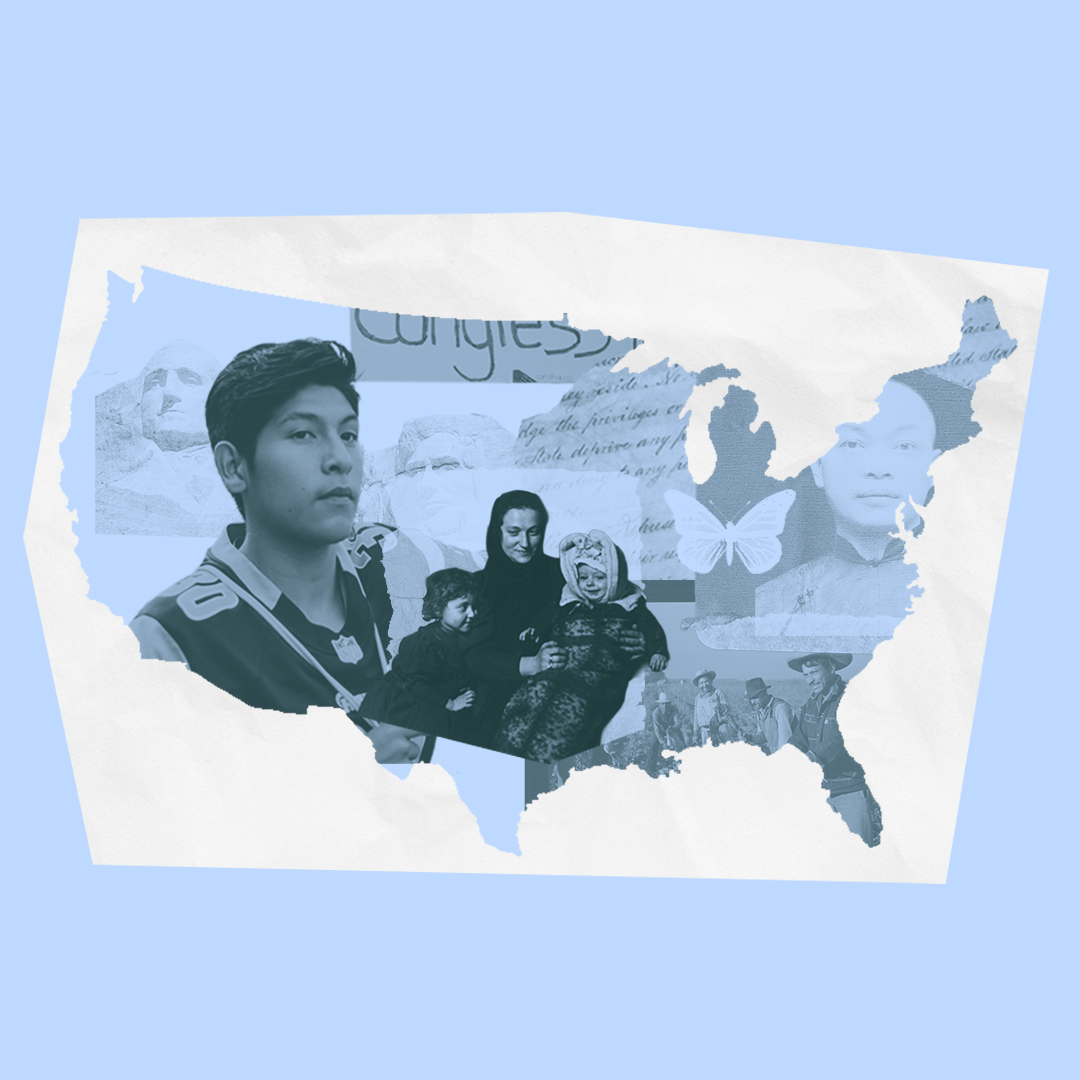
Family-Based Immigration
Through family-based immigration, U.S. citizens and lawful permanent residents can sponsor relatives for immigration. We aim to be a leading force in transforming family-based immigration policy in order to maintain family unity, foster cohesive communities, and strengthen America’s economic growth. Read more about our approach below.

Pending a Resolution of DOMA, Immigration Judges Should Exercise Discretion to Stay Removal Cases
BY BETH WERLIN AND VICTORIA NEILSON To date, five states plus the District of Columbia celebrate marriages of gay and lesbian couples and several other states honor such marriages. In addition, five countries, including Canada, permit marriages of gay and lesbian couples and at least fourteen additional countries recognize same-sex relationships for immigration purposes. Yet, because the U.S. immigration agencies rely on section 3 of the Defense of Marriage Act (DOMA)—defining marriage as a union between one man and one woman—lesbian and gay U.S. citizens and lawful permanent residents are barred from obtaining immigrant visas for their spouses, visas that are available to heterosexual U.S. citizens and residents with foreign-born spouses. Gay and lesbian noncitizens also are precluded from obtaining other immigration protections, including relief from removal, based on a marriage to a U.S. citizen or permanent resident. As a result, families are separated and spouses of U.S. citizens and lawful permanent residents are deported from the United States. Read More
Underrepresented African Refugees and Potential Problems with DNA Testing
Earlier this month, President Obama announced the annual refugee allocations—80,000 total for Fiscal Year 2011, the same total as in 2010. However, while the total yearly allocation is the same, African refugees are being underrepresented. The 2011 ceiling for African refugees is 15,000, which is slightly lower than in 2010 and nearly 25 percent lower than the average for the previous decade (2000-2010). In reality, the number of African refugees actually admitted has fallen considerably below the ceilings due to processing problems. Why? New data documenting the underrepresentation of refugees from Africa in the U.S. looks at allegations of fraudulent African family reunification applications, DNA testing programs, and its implications for U.S. refugee and immigration policy. Read More
Congressional Leaders Announce Forthcoming Immigration Bill, Support for DREAM and a White House Meeting
At a forum today in Washington, D.C., faith, civic, community and Congressional leaders gathered to rally the immigration reform faithful, endorse Sen. Reid’s (D-NV) DREAM Act amendment, announce the introduction of a forthcoming immigration overhaul bill in the U.S. Senate and a meeting with President Obama this week on immigration. Senator Robert Menendez (D-NJ) announced that he will introduce a comprehensive immigration reform (CIR) bill—one that addresses the nation’s economic and security needs— presumably during the lame duck session while Rep. Nydia Velázquez (D-NY) revealed a meeting between herself, President Obama, Sen. Menendez, and Rep. Gutierrez to discuss immigration, deportations and the DREAM Act. The forum also highlighted personal stories from legal permanent residents (LPRs)—military veterans, mothers, families—and the complications of being caught up in a broken immigration system. Read More
Balancing Family Immigration with Our Economic Needs
In his most recent book, Brain Gain: Rethinking U.S. Immigration Policy, author Darrell M. West argues that “U.S. immigration policy went seriously off course after Congress passed legislation in 1965 making family unification the overarching principle in immigration policy… We need to reconceptualize immigration as a brain gain and competitiveness enhancer for the United States.” While the book may serve as a much-needed conversation starter, West, unfortunately, fails to delve beyond the superficial. We do need to have a serious conversation about balancing family immigration with our economic needs in the context of reforming the nation’s immigration system, but West’s book ends up pitting skilled-based immigration against family-based immigration—a juxtaposition that does little to move the debate forward. Read More
New Report Demonstrates the Successful Integration of Immigrants into U.S. Society
A common refrain among anti-immigrant activists is that today’s immigrants just aren’t “assimilating” into U.S. society like the immigrants of earlier eras. However, as a new report from the Center for American Progress (CAP) points out, the “illusion of non-assimilation is created by looking only at newcomers who have not had time yet to assimilate as fully as earlier arrivers.” When socioeconomic advancement is tracked over time, it becomes clear that “the longer immigrants are here, the more they advance and the better they are integrated into our society.” The report, entitled Assimilation Today, was co-authored by renowned demographer Dowell Myers (a professor in the School of Policy, Planning, and Development at the University of Southern California) and by John Pitkin (president of Analysis and Forecasting, Inc., in Cambridge, Massachusetts). Read More
The Right Side of History: Religious Leaders Urge Immigration Reform at Hearing
At a House Judiciary Subcommittee on Immigration hearing today, a panel of conservative religious leaders made the case for common sense solutions to our immigration problems—comprehensive immigration reform (CIR) that secures our borders, follows the rule of law and provides a pathway to citizenship for the roughly 11 million undocumented immigrants currently living in the U.S. While the hearing, The Ethical Imperative for Reform of Our Immigration System, started off with ethical and biblical arguments supporting and opposing reform, it later evolved into what most immigration debates eventually boil down to—fairness, justice and the punitive aspects of a reform effort. Read More
Undocumented Youth Pin DREAMs on Congressional Action
Every year, undocumented immigrants come to the U.S. along with their young children. These kids grow up in the U.S., speak English, and hang out with their friends just like other American kids. But unlike their classmates, they cannot join the military, work, or pursue their dreams because they don’t have legal status. Every year, roughly 65,000 undocumented students graduate from high school, but many don’t apply for college, even when they’re at the top of their class, because they can’t afford it. These hard-working students are not eligible for loans or work study and must often pay high out-of-state or international tuition rates. They often live in fear of detection by immigration authorities. The DREAM Act—which would benefit these students as well as the U.S. economy—proposes to fix these problems, but not without the political will of Congress. Read More
Immigrant Women: The Silent Victims of a Broken Immigration System
Even though there are approximately 19 million foreign born women in the U.S.—accounting for 12.3% of the female population—we tend to hear very little about them. A closer look at the female immigrant population reveals many important facts—immigrant women are incredibly diverse in terms of country of origin, time in the U.S., citizenship rates, income, poverty, and labor market participation. This week, the Immigration Policy Center (IPC) released a report, Reforming America’s Immigration Laws: A Woman’s Struggle by Kavitha Sreeharsha, a senior staff attorney at Legal Momentum’s Immigrant Women Program and a fact sheet detailing the demographic makeup of immigrant women in the U.S. Read More
Ending Birthright Citizenship Won’t Solve Our Immigration Problems
The people who brought you SB1070 in Arizona are now preparing to challenge one of the fundamental principles of the U.S. Constitution—birthright citizenship. Birthright citizenship, or the principle of jus soli, means that any person born within the territory of the U.S is a citizen, regardless of the citizenship of one’s parents. This principle was established well before the U.S. Constitution, and was enshrined in the Fourteenth Amendment. It was necessary to include the citizenship clause in the Fourteenth Amendment because the Supreme Court’s Dred Scott decision of 1857 had denied citizenship to the children of slaves. Following the Civil War, the Fourteenth Amendment righted that injustice and became the foundation for civil rights law, equal protection, and due process in the United States. Read More
Divine Intervention: Why Evangelicals Matter in the Immigration Debate
In the latest faith-based immigration effort, a group of Evangelical leaders and hundreds of conservative grassroots advocates joined Senator Chuck Schumer (D-NY) yesterday to discuss the need for bipartisan support on an immigration bill. Today, a large group of Arizona faith leaders (Evangelicals, Christians, Catholics and members of the Jewish faith) planned to meet with Senator John McCain and the White House to urge immediate action on immigration reform and a repeal of Arizona’s enforcement law. This is not the first time the religious community has called for immigration reform, but the harsh Arizona law has led to greater urgency within the faith movement—especially among Evangelicals. Much like the rest of the country, religious leaders are pressing the federal government for a solution that goes beyond enforcement, arguing that family unity, legalization and integration issues must be resolved as well. Read More
America's story is an immigrant story.