Elections

All Mirth and No Matter: Arizona Governor Jan Brewer Showcases Empty Anti-Immigrant Rhetoric in Gubernatorial Debate
In a memorable performance this week, Arizona Governor Jan Brewer refused to defend previously made anti-immigrant statements regarding undocumented immigrants and beheadings during a gubernatorial debate with Attorney General and Democratic candidate, Terry Goddard. While Governor Brewer’s opening remarks meltdown is at least understandable, her inability/refusal to defend… Read More
States Pushing Anti-Immigration Legislation Forced to Run Costly Damage Control
Although anti-immigrant campaign platforms might help win a primary in a state like Arizona, supporters of harsh immigrant enforcement measures must still address the resulting economic fall out. Last week, the Arizona Governor’s Task Force on Tourism and Economic Vitality hired HMA Public Relations, a Phoenix-based marketing communications and public relations firm, to the tune of $100,000 to “develop a series of needs and goals for Arizona tourism in light of the controversy created by SB 1070”—and, boy, do they have their work cut out for them. Similarly, cities like Fremont, Nebraska—where an anti-immigrant ordinance passed in June—are also being forced to run damage control. Fremont’s City Council is currently considering a property tax increase proposal to help shoulder the projected legal fees resulting from the city's restrictive immigration ordinance. Read More
Anti-Immigrant Hysteria in Arizona Won’t End With the Primaries
The Republican Party primaries in Arizona may be over, but the anti-immigrant demagoguery upon which the winning candidates built their campaigns is unlikely to fade away anytime soon. Governor Jan Brewer and Senator John McCain both managed to reverse their declining political fortunes in large part by raising the phantom specter of immigrant violence—a cynical tactic they are likely to repeat in the midterm elections. For instance, both trumpeted the discredited claim that Phoenix is the number two kidnapping capital of the world after Mexico City, and portrayed their various and sundry proposals to “get tough” on unauthorized immigrants as sincere efforts to save Arizonans from kidnappers and other violent criminals. Read More
The Politics of Immigration: Primaries Reveal Little About What’s to Come
It’s hard to pinpoint how exactly the issue of immigration impacted a range of primary races on Tuesday. In some cases, exploiting our broken immigration system may have helped candidates win elections—as in the case of Governor Jan Brewer. In other cases, talking tough about immigration may have cost politicians their race—like Florida’s Attorney General Bill McCollum, who turned off Latino Republican voters with his pledge to bring SB1070 style legislation to the Sunshine State. Senator John McCain and Meg Whitman beat out their more extreme anti-immigrant opponents in tight primary races, but they definitely weren’t singing the praises of immigration either. However, it’s hard to predict what will happen in November’s general election based on the primary results. Many Republicans like Sen. John McCain turned hard-right in order to get their party’s nomination, yet that will likely subside in the next several months as candidates gear up for the general election. Read More
Staggering Right on Immigration in Arizona
Today, Senator John McCain (R-AZ) faces former Rep. J.D. Hayworth in what has been a hard-fought primary battle for the Republican nomination for Senate. Perhaps the central issue in the campaign has been immigration, with both candidates staggering as far to the right as possible. So far to the right, in fact, that David Catanese of Politico called the campaign “likely to leave a lasting and unsightly stain” on McCain’s legacy. Read More
The Immigration Debate Goes South: Politicians Make $600 Million Dollar Investment in their Political Futures
Today, after months of political wagering from both Republicans and Democrats, the Senate unanimously passed a $600 million dollar bill marked for border security which is now headed to President Obama’s desk for signature. While the sequence of events leading to this most recent capitulation to the enforcement-first crowd is a little dizzying, the bill’s unanimous passage was partly a product of a bluff called on the Senate floor. Although the substance of the bill could have been much worse, the mere fact that the only major immigration legislation passed thus far in the 111th Congress was another border bill shows how far we are from treating immigration as a serious issue, rather than a political game. Read More
Arizona Senators Decry DOJ Lawsuit Yet Refuse to Support Immigration Reform
Yesterday, the Department of Justice (DOJ) filed a lawsuit against the state of Arizona, challenging the state’s immigration enforcement law (SB 1070). The DOJ lawsuit—which seeks to stop the law from going into effect on July 29th—argues that Arizona’s law is unconstitutional since it claims state authority over federal immigration policy. While political opposition in Arizona to DOJ’s legal challenge has come from both parties, some of the most laughable comments have come from Arizona’s Republican Senators who have used the lawsuit as yet another opportunity to claim that the Obama administration has failed to do anything on immigration. Only Senator Lindsay Graham (R-SC) has been willing to engage the Democrats on immigration at all this year and even still, Sen. Graham back peddled after health care reform was passed. To date, ZERO Republicans are willing to step forward and play ball on an actual immigration reform bill—which makes the political finger-pointing from those unwilling to meet the President halfway all the more infuriating. Read More
1,200 National Guard Troops to the Border: A Bargaining Chip or More Political Pandering?
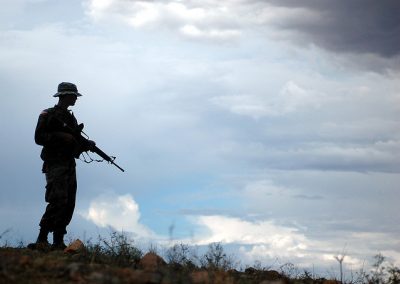
Yesterday, President Obama met with Senate Republicans to discuss, among other things, moving forward with comprehensive immigration reform. But what came out of the meeting was a letter to Senator Carl Levin, Chairman of the Armed Services Committee, requesting 1,200 troops to be sent to the U.S.-Mexican border and a $500 million request for additional border personnel and technology as part of the Emergency Supplemental Appropriations Bill. While the President’s intentions to address the real sources of violence and crime along the border—that is, drug cartels and gun traffickers, not immigrants—is duly noted, the President is being perceived as piling enforcement on enforcement and pandering to Republicans with no real forward movement on reform. Read More
Riding the Anti-Immigration Wave: The Short- and Long-Term Political Implications
Despite the mounting pressure (boycotts, legal challenges, protests) to repeal Arizona’s enforcement law (SB 1070), polls indicate that the majority of Americans support the law by almost two to one—and, at last count, as many as 17 other states are considering similar legislation. However, while it may seem advantageous for some in the GOP to use this anti-immigrant wave as political momentum for re-election, the long-term political impact may be larger and more harmful than they realize. Can the Republican Party (once the 'Party of No," then the "Party of Hell No" and now the "Party of Papers Please?") really afford to further alienate the fastest-growing U.S. voting bloc—Latinos? Read More
2010 Congressional Primaries, Immigration and an Appetite for Change
As the dust is settling from yesterday’s primary elections, many politicians and pundits will try to interpret what the American public is thinking. The reactions and responses are likely to span the ideological and political scales. Whether Democrats aren’t Democratic enough, or Republicans aren’t Republican enough, or seats held by one party should be replaced by the other, one thing is clear: Americans are frustrated with their current leaders and want new representation. Read More