Due Process and the Courts
What does the constitution say about due process?
The Fifth Amendment to the Constitution says clearly that no person shall be deprived of life, liberty, or property without the due process of law. Note that this says person, not citizen, and over the years the Supreme Court has consistently ruled that the Due Process Clause applies to all people in the United States.Do non-citizens have the right to due process in the U.S.?
Yes. The Constitution guarantees due process rights to all "persons," not just citizens. This means non-citizens, including undocumented immigrants, are entitled to fair treatment under the law. This includes the right to defend themselves in court. But recent Trump administration policies that speed up deportations and limit access to legal representation make it harder for non-citizens to get their fair day in court.- Access to legal representation Access to legal counsel is an essential part of our justice system and our democracy. In the criminal justice system, anyone facing even one day in jail gets a lawyer if they can't afford one. But immigrants facing deportation usually don't get that chance.The research is clear – the most effective way to ensure some level of due process for people navigating our complicated immigration system is for them to have trained attorney at their side.But Trump administration is now working to strip attorneys from as many people as possible, all in the name of increasing its deportation numbers. This attempt to eliminate basic due process will hurt people who already have few options.
- Fair day in court Due process guarantees that individuals have the opportunity to defend themselves in court. This includes non-citizens facing deportation.
Why is due process important?
We are seeing right now the importance of due process when it comes to President Trump's actions to carry out the so-called Alien Enemies Act, a 1798 wartime law that permits people to be deported outside of the normal framework of immigration law. President Trump has alleged that this law allows him to simply point at any person, declare them to be an alien enemy, and kick them out of the country without ever having a chance to see a judge. Thankfully, the Supreme Court said that is not true, and in a unanimous decision, ruled that people can challenge the Trump administration's invocation of the Alien Enemies Act. That is why due process is so important, because it means that no person can be rounded up and sent to another country without a chance to go to court and make the government prove their case.How is the American Immigration Council working to protect due process?
- We serve thousands of individuals in immigration detention centers through the Immigration Justice Campaign, our initiative with the American Immigration Lawyers Association. The Justice Campaign provides free legal services for immigrants who would otherwise have to navigate our complicated immigration system without a lawyer.
- We use the courts to demand a fair process for immigrants. Our litigation team is fighting back against the Trump administration’s blatant disregard for due process including filing a lawsuit challenging their illegal detention of immigrants in El Salvador’s notorious Terrorism Confinement Center (CECOT).
ICE Agrees to Release Thousands of Previously-Withheld Records
Washington, DC – Yesterday, a U.S. District Court in Connecticut approved a settlement in a Freedom of Information Act (FOIA) lawsuit challenging the refusal of Immigration and Customs Enforcement (ICE) to release tens of thousands of documents about the Criminal Alien Program (CAP), one of the agency’s largest enforcement… Read More

Former Attorney General Gets it Wrong on DOMA and Same Sex Immigration Benefits
Former Attorney General Alberto R. Gonzales is advocating in the New York Times that the Supreme Court decision in U.S. v. Windsor, which invalidated Section 3 of the Defense of Marriage Act (DOMA), should not allow the Obama administration to afford immigration benefits to married, same-sex bi-national couples. Rather, he argues, the administration is bound by a disturbing, 30-year-old Ninth Circuit case, Adams v. Howerton, which rested on discriminatory and outdated law and facts. Essentially, Mr. Gonzales is urging that the administration ignore 30 years of social progress and legal developments and return to a 20th century mentality and jurisprudence. He is mistaken. Read More

Supreme Court’s DOMA Decision Good for Economic Competitiveness
In the global economy of the twenty-first century, a globally mobile workforce is critical to remaining competitive. Yet for LGBT employees, their families, and their employers, significant barriers remain in place. The Supreme Court’s June 26 decision in United States v. Windsor finding part of the Defense of Marriage Act (DOMA) unconstitutional has clear and direct benefits for married same-sex couples, including bi-national couples. But beyond the benefits to married couples themselves, the Court’s decision is also a win for economic competitiveness. Specifically, the DOMA ruling makes U.S. businesses more globally competitive because they now can attract and retain foreign-born employees who want to stay in the United States with their same-sex spouses. Read More
USCIS Approves First Green Cards for Same Sex Couples
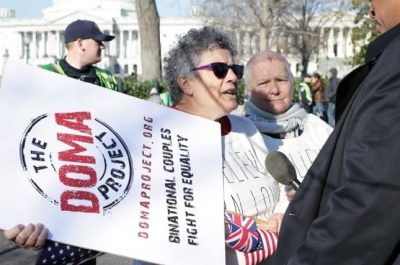
On June 26, the Supreme Court issued its decision in the case of United States v. Windsor, in which it struck down section 3 of the Defense of Marriage Act (DOMA), which defined marriage as between a man and a woman for all federal laws. This law meant that the immigration agencies would not recognize lawful, same-sex marriages for any immigration purpose. Since the Court’s decision, the Obama administration has moved rapidly to allow U.S. citizens to petition for immigration benefits for their spouses, providing hope to an estimated 28,500 bi-national same-sex couples in the United States who might otherwise be separated by our immigration laws. Read More
Supreme Court Strikes Down DOMA, Affirms Immigration Rights of Gay and Lesbian Couples
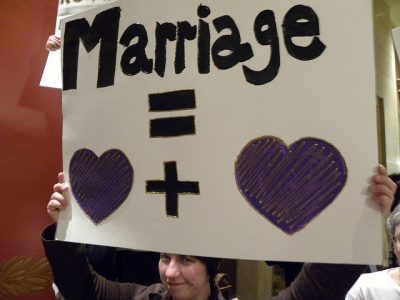
Today, the Supreme Court issued its decision in the case United States v. Windsor, striking down section 3 of the Defense of Marriage Act, or DOMA, on the basis that it violated equal protection under the due process clause of the 5th Amendment. DOMA established an exclusively heterosexual definition of “marriage,” and denied same-sex couples any federal benefits, including immigration benefits. This is a historic day for gay and lesbian marriage rights, as DOMA disqualified same-sex couples from over a thousand federal benefits, and made same-sex couples in committed relationships second-class citizens in the eyes of the federal government. Read More

House Immigration Bill Promotes Old Model Immigration Solutions
Today the House held a hearing on H.R. 2278, the "Strengthen and Fortify Enforcement Act" (the SAFE Act), which is designed, as its name suggests, to be a lopsided, enforcement-only bill that imposes additional criminal penalties, border security, and detention and deportation, while encouraging discredited policies such as self-deportation and state interference with immigration law. Instead of these old enforcement-only policies, which do not work, what is needed is a comprehensive solution that fixes our broken legal immigration system and provides a path to earned legalization. Read More
Lawsuit Seeks to Learn How Government Responds to Complaints of Misconduct by Immigration Judges
Washington, DC – The public has a right to know whether the government adequately investigates and resolves complaints alleging misconduct by immigration judges, the American Immigration Lawyers Association (AILA) said in a lawsuit filed today in federal district court in Washington, D.C. The lawsuit, filed under the Freedom of Information… Read More
Complaints Against Immigration Judges
The American Immigration Council and co-counsel Public Citizen filed a lawsuit on behalf of the American Immigration Lawyers Association (AILA) seeking information about complaints alleging immigration judge misconduct. Read More

Will Due Process Protections Be Preserved in Senate Mark-Up?
On Thursday, the Senate Judiciary Committee began its mark-up of Title III of S.744, the Border Security, Economic Opportunity, and Immigration Modernization Act. When the mark-up continues on Monday, Senators are likely to vote on amendments addressing immigration courts. These amendments will be crucial in determining whether the full Senate receives a bill that provides due process protections to immigrants in removal proceedings. Read More
Providing Noncitizens With Their Day in Court
Our legal system rests upon the principle that everyone is entitled to due process of law and a meaningful opportunity to be heard. But for far too long, immigration courts have failed to provide noncitizens with a system of justice that lives up to this standard. A noncitizen has not truly had his day in court if he is removed without ever seeing a judge, if he does not have access to counsel and necessary evidence, or if the decision in his case receives only perfunctory review. The 2013 Border Security, Economic Opportunity, and Immigration Modernization Act (“S. 744”) would take significant steps toward ensuring noncitizens have a fair hearing. This fact sheet explains some of the critical policy proposals found in S. 744 and the basis for them. A system without sufficient protections Deportation without a judge In the current system, many immigrants who are removed never see the inside of a courtroom. In fact, the majority of noncitizens are returned to their home countries through accelerated processes that do not include a hearing before a judge. Even immigrants who are entitled to hearings may not make it to court if an immigration agent convinces them to agree to be deported before their first hearing. More than 160,000 immigrants agreed to these “stipulated removal” orders between 2004 and 2010; the vast majority were unrepresented and in immigration detention. Those whose cases reach immigration court appear before overburdened judges with insufficient time and resources for the cases in front of them. Vulnerable immigrants without attorneys Read More
America's story is an immigrant story.
