 The American Immigration Council is a non-profit, non-partisan organization.
 As federal immigration arrests reach record highs, state and local leaders are grappling with how to protect communities from an increasingly indiscriminate and violent immigration enforcement system. Now, a new interactive resource from the American Immigration Council and Integrated Refugee and Immigrant Services (IRIS) helps jurisdictions identify answers to this question.
The Immigration Response Playbook provides a comprehensive public compilation of policies that state and local governments have adopted since January 2025 to protect all residents amid increased federal immigration enforcement. The playbook includes over 200 policies from 78 localities and 20 states concerning topics such as data privacy, mask bans, and federal accountability. In cataloging these policies, we found that a majority of the U.S. immigrant population live in states that have adopted new protective policies since the start of the second Trump administration.
The inspiration for the playbook stems from questions the Council and IRIS received from state and local partners asking what protections their jurisdictions could consider, as well as key learnings from the resiliency of communities in Chicago, Minneapolis, New Orleans, and other areas that faced enforcement surges. The playbook showcases a range of policy tools to help state and local leaders understand the many options at their disposal, some of which are highlighted below.
Protecting state and local resources from federal immigration enforcement overreach
In the midst of Operation Midway Blitz during fall 2025, Chicago Mayor Brandon Johnson signed an executive order establishing an “ICE Free Zone” to prohibit civil immigration enforcement activity on city property. Since then, over 30 localities across 15 states have followed Chicago’s lead and adopted similar policies that restrict use of city-owned or operated property for civil immigration enforcement including as staging areas, processing locations, and operation bases.
After the Trump administration rescinded the Sensitive Locations policy, which limited federal immigration enforcement in critical areas like healthcare facilities, places of worship, and schools, eleven states passed legislation reinstating those limits at certain locations.
Reacting to the increasing prevalence of masked and plainclothes federal immigration enforcement officers, eight states enacted new laws prohibiting face coverings and requiring visible identification for law enforcement while on duty, though five of these state laws now face legal challenges.
Demanding transparency and creating new avenues to hold federal officers accountable for misconduct
Local leaders in Boston, Chicago, Los Angeles, Seattle, and Portland directed city staff to routinely file and report on Freedom of Information Act (FOIA) requests to federal agencies, in a bid to create more transparency on any federal immigration enforcement activity in their jurisdictions.
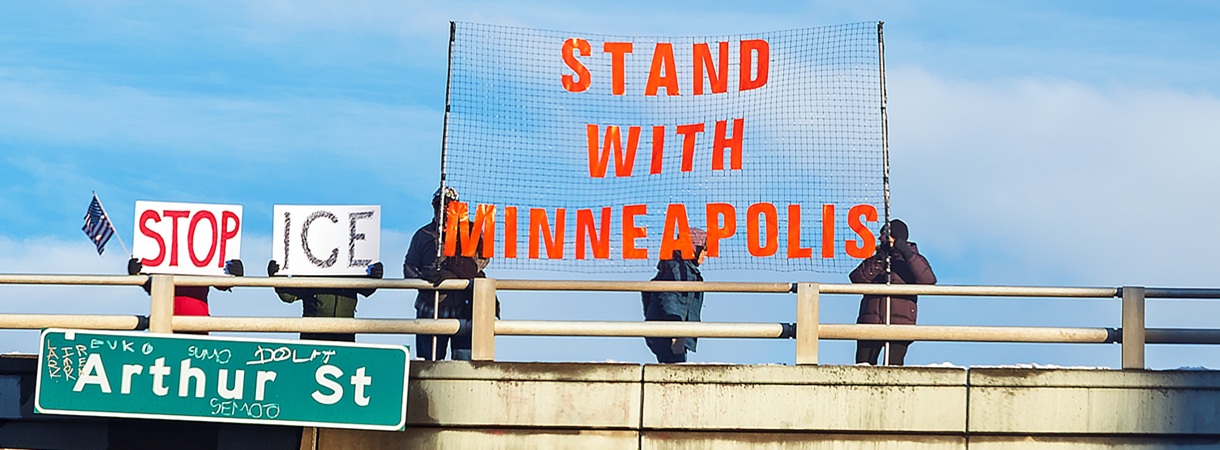
Following aggressive federal immigration enforcement operations across Chicago and the Twin Cities, the governors of Illinois and Minnesota created new commissions to investigate and document evidence of federal misconduct and the widespread community impacts of these surges.
Since January 2025, six states passed laws creating new pathways for individuals to sue law enforcement officers or agencies for alleged rights violations: Connecticut, Illinois, Maryland, Massachusetts, Oregon, and New York. Eleven states and two localities also created new reporting mechanisms for the public to submit evidence of alleged federal law enforcement misconduct or civil rights violations.
Mobilizing communities to navigate and recover from federal immigration enforcement action
Across five localities and two states, leaders announced new interdepartmental councils to coordinate planning and responses to federal immigration enforcement operations, including the Interagency Council on Immigrant and Refugee Coordination in Oregon and the Welcoming County Subcabinet in King County, WA.
Numerous state and local governments and their community partners have also launched new supports for communities impacted by immigration enforcement, including the Small Business Resilience Fund in Los Angeles, the Emergency Rent Assistance Program in Multnomah County, Oregon, and the Rapid Legal Response Initiative in New Jersey.
While the country works toward a more accountable and humane federal immigration system, the Immigration Response Playbook shows that there is a lot that state and local governments can do now to facilitate transparency and support for communities in the face of federal enforcement overreach.