Undocumented Immigration

Possible Increase in Unauthorized Immigration, Brought to You by an Improving Economy
The dynamic between the economy and the size of the unauthorized population living in the United States was brought home by a new report from the Pew Research Center, which finds that the shrinking number recorded during and immediately after the Great Recession may be slightly on the rise in light of the improving economy. In their latest estimate, Pew calculates that about 11.7 million unauthorized immigrants were living in the United States in 2012 compared to the 11.3 million estimated for 2009. But what do these numbers really mean? Read More

Dollars and Lives Lost in the Wait for Immigration Reform
Two-and-a-half months after the Senate passed immigration reform legislation (S. 744), the House of Representatives continues to dawdle. Other than giving speeches and mulling over a few backward-looking, enforcement-only bills, the House has done nothing to revamp the broken U.S. immigration system or to realistically resolve the status of the 11 million unauthorized immigrants now living in the United States. The standard excuse for this inaction is that there are too many other high-priority items on the legislative agenda right now—so immigration reform will have to wait. But while Congress waits, dollars and lives are being lost. Read More

Months After Passage, Anti-Immigrant Group Still Mischaracterizes Senate Bill
The immigration reform bill (S.744) that the Senate passed in June would fix our broken work visa programs for lower skilled, higher skilled, and agricultural workers; eliminate decades-long backlogs in our immigrant visa programs; increase job and wage protections for U.S. workers; and greatly increase our investment in border security. In addition, the bill would have fiscal and economic effects that would be overwhelmingly positive, according to the Congressional Budget Office (CBO). If enacted, the bill would help reduce the federal budget deficit by approximately $1 trillion over 20 years, would boost the U.S. economy as whole without negatively affecting U.S. workers, and would greatly reduce future undocumented immigration, according to the CBO. However, the Federation for American Immigration Reform (FAIR) released a report this week criticizing the bill. They claim S.744 offers an immediate “amnesty” for the undocumented, lacks specific metrics for measuring border enforcement, weakens the visa entry-exit system, and creates a “nebulous new system” that fails to protect Americans from illegal foreign workers. Read More
Taking the Important Leap to Citizenship
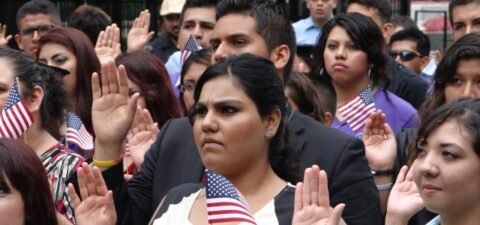
Each year on September 17, the United States observes Constitution Day and Citizenship Day, a combined event that commemorates the anniversary of the nation’s constitution and recognizes all those who are or have become U.S. citizens. It is considered a time for Americans to reflect on the importance of the rights and responsibilities of citizenship, as well as what it means to be a U.S. citizen. However, it’s also an important time to applaud those who have worked hard to become citizens, while exploring ways to remove barriers for those who are eligible, but still haven’t taken the leap. Read More

Questions About Traveling Abroad Confront DACA Recipients
Getting approved under President Obama’s Deferred Action for Childhood Arrivals (DACA) program for DREAMers carries many benefits. DACA recipients get a renewable two-year reprieve from the threat of deportation, work authorization, the ability to receive a social security number, and, in all but two recalcitrant states where the issue is being litigated, a driver’s license. Importantly, DACA recipients can also apply for permission to travel abroad. This spring, the government issued welcome guidance regarding requests for permission to travel. Nonetheless, important questions and concerns about travel linger, including risks of traveling abroad even with permission. Read More

Women Arrested Demand Action on Immigration Reform
More than 100 women blocked an intersection outside of the House of Representatives Thursday to push for House leaders to finally act on immigration reform. Capitol Police officers arrested the 104 women, including more than 20 who are undocumented, for the act of civil disobedience. More than 200 supporters witnessed the arrests and called on the House to match the women’s courage and pass legislation that will fix the U.S. immigration system. “Each one of us here today understands what incredibly high stakes we are talking about—immigration reform is not just a piece of legislation but the ability for us to take care of our families,” said Pramila Jayapal, co-chair of We Belong Together: Women for Common-Sense Immigration Campaign, at a rally before the arrests. Read More

States Drive Positive Change on Immigration While House Is Stuck in Low Gear
Despite the slow pace of immigration reform in the House of Representatives, it has been a banner year for legislation at the state level to help undocumented immigrants living in the U.S. As the National Immigration Law Center (NILC) explains in a new report, “Inclusive Policies Advance Dramatically in the States,” state legislatures approved laws allowing undocumented immigrants to obtain driver’s licenses, qualify for in-state tuition, and expand worker’s rights. And states and local governments considered measures to limit involvement with immigration enforcement. This was a sharp change from previous years when officials debated measures with provisions that mimicked Arizona’s SB-1070. In the wake of record numbers of Latino and Asian voters participating in the 2012 elections, several state legislatures by and large moved in a more positive direction as lawmakers from both parties supported pro-immigration measures. Read More

ICE Provides Critical Guidance on Limiting and Regulating the Solitary Confinement of Immigrants
Immigration and Customs Enforcement (ICE) issued much-needed guidance Tuesday on the use of solitary confinement in immigration detention facilities. As Immigration Impact reported earlier this year, ICE has been severely criticized for its excessive use of isolation of immigrant detainees. Every day, out of more than 30,000 detainees, roughly 300 immigrants are held in solitary confinement at the nation’s 50 largest detention centers overseen by ICE, according to federal data. Solitary confinement is one of most expensive forms of detention, The New York Times reported in March, and nearly half of immigrant detainees held in solitary confinement are isolated for 15 days or more – “the point at which psychiatric experts say they are at risk for severe mental harm.” About 10 percent are held for more than 75 days. And officials regularly place immigrants in isolation for breaking rules, getting into fights or for their own protection if they have vulnerabilities such as being gay or mentally ill. Read More

Why is the Obama Administration Arguing that Undocumented Immigrants Should Not Practice Law?
Today, the California Supreme Court will hear oral argument in a case that asks whether an undocumented immigrant may receive a license to practice law in California. The Committee of Bar Examiners – the entity charged with deciding who qualifies for a law license in California – supports admitting Sergio Garcia to the bar. So do some 48 organizations and 53 individuals who signed on to “friend of the court” briefs submitted to the California Supreme Court. Of the three opposing arguments filed, two came from individuals but the other came from an unexpected source: the Department of Justice. Not only did DOJ voluntarily weigh in with a hypertechnical argument that is tone deaf to the current debate over undocumented status in this country, but it took the same position in a Florida case involving a lawfully present and work-authorized recipient of Deferred Action for Childhood Arrivals (DACA), Jose Godinez-Samperio. Even if there was a good legal argument for opposing admission of an unauthorized immigrant to the bar, the rationale makes little sense in the context of an individual who is a DACA beneficiary. In both cases, however, the result DOJ seeks would lead to less socio-economic inclusion of the very immigrants the Obama administration seeks to protect. Read More
Fight for Fairness and Justice in its Many Forms Far From Over
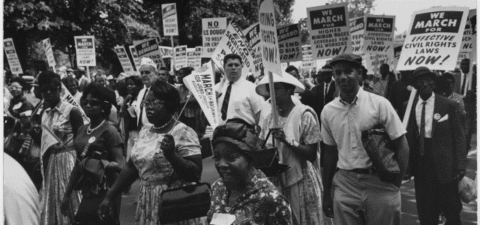
Wednesday marks 50 years since more than 250,000 people joined the March on Washington for Jobs and Freedom and pushed the government to extend civil and economic rights to African Americans. A massive rally where the Rev. Martin Luther King Jr. made his historic “I Have a Dream” speech on the steps of the Lincoln Memorial, it has been credited with spurring passage of the 1964 Civil Rights Act and the Voting Rights Act of 1965. Read More
America's story is an immigrant story.