Undocumented Immigration

Local Officials Improve Immigration Enforcement Policies as Congress Fails to Act
The county council in King County, Washington, decided this week that local law enforcement officials will stop honoring federal immigration agents’ requests to detain immigrants who are arrested for low-level crimes. They voted 5-4 for the new policy on Monday, and supporters hope the change “will build trust between local police and immigrants who don’t report crimes for fear they or a family member will be deported,” according to the Seattle Times. Read More

The Punishment Should Fit the Crime for Immigrants, Too
The punishment should fit the crime. That maxim is as old as law itself, dating at least as far back as the Old Testament and Hammurabi’s Code. It’s firmly rooted in our Constitution’s Due Process Clause and the Eighth Amendment’s prohibition against excessive fines and cruel and unusual punishment. That principle—referred to as proportionality—appears in both our criminal and civil law. It forbids, for example, the imposition of a life sentence for passing a bad check. It means that the state cannot sentence juveniles for non-homicide crimes to life without parole. And it disallows extreme punitive damages awards. So what does proportionality have to say when the government tries to deport a lawful permanent resident who, a decade ago, shoplifted $200 worth of merchandise from a department store? Right now, astonishingly, nothing: immigration judges do not even consider whether a person’s banishment from the United States is a disproportionate punishment for a crime before ordering the person’s removal. But advocates are working to change this. Read More

‘Fast 4 Families’ Moves to Next Phase as New Fasters Take the Mantle
On the National Mall today, the four core fasters leading the “Fast 4 Families” ordained new fasters and ended their 22-day, water-only fast. Members of Congress, the faith community and civil and immigrant rights groups turned out to witness the four fasters passing the baton over to others who will continue the fast until House Speaker John Boehner schedules a vote on immigration reform. Read More
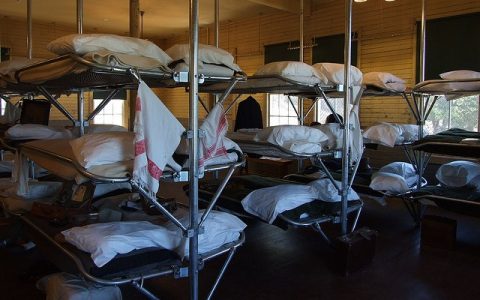
Detention Bed Mandate is Just One Example of How Immigration is Being Criminalized
For more than a century, study after study has confirmed two simple yet powerful truths about the relationship between immigration and crime: immigrants are less likely to commit serious crimes or be behind bars than the native-born, and high rates of immigration are not associated with higher rates of either violent or property crime. Unfortunately, immigration policy is frequently shaped more by fear and stereotype than by empirical evidence, which is why immigrants are so often treated like dangerous criminals by the U.S. immigration system. Whole new classes of “felonies” are created which apply only to immigrants, deportation is viewed as a just punishment for even minor crimes, and policies to end unauthorized immigration become more and more punitive rather than more rational and practical. In short, immigration itself is being criminalized. Read More
D.C. Follows 11 Other States Allowing Undocumented Immigrants to Drive Legally
As House leaders delay on passing immigration reform that would help millions of immigrants already in the U.S., Washington, D.C., officials are taking steps to improve the lives of undocumented immigrants who call the city home. Last week the D.C. Council passed a bill, written by Council member Mary Cheh, which allows undocumented residents to apply for Driver’s Licenses. D.C. Mayor Vincent Gray signed the bill yesterday. The new policy, which goes into effect May 1, sets up a system where undocumented immigrants will receive licenses that are the same but for their being marked "not valid for official federal purposes." Driver’s licenses for legal residents and citizens will not change. Read More

Understanding DACA’s Education Requirement
When the Deferred Action for Childhood Arrivals (DACA) program was first announced, it was clear that individuals would have to meet some sort of education requirement in order to obtain the program’s many benefits, including a two-year renewable reprieve from deportation, work authorization, a social security number, and—in nearly every state—the chance to apply for a driver’s license. What was unknown was how the immigration agency would address the question of individuals who were unable to finish high school. Would they be categorically excluded from DACA? Or would the agency provide an incentive for those folks to re-enroll in school? Fortunately, the government chose the latter. In doing so, it gave an estimated 400,000 people who met the DACA guidelines but didn’t finish high school a shot at getting DACA. Many of these individuals are thought to be among the 1.2 million who haven’t yet taken advantage of the program. Read More

USCIS to Offer Stay of Deportation to Certain Military Family Members
Today, USCIS issued guidance that is intended to prevent current and former members of the U.S. armed forces from being separated from their noncitizen family members. The memo indicates that the noncitizen family members may be afforded “parole in place.” “Parole in place” is a discretionary tool that… Read More

House Inaction Escalates Community’s Demands for Immigration Reform
House Speaker John Boehner (R-OH) reassured a few die-hard anti-immigration reform activists when he said he would never agree to a conference to reach agreement on a House immigration bill and the Senate’s bipartisan immigration that passed in June. But his comments fired up those who want to see Congress improve the nation’s broken immigration system. Despite some in the House dragging their feet on considering immigration reform legislation—House Majority Whip Kevin McCarthy told advocates last week there weren’t enough days for them to act on it this year—immigration advocates in Washington, D.C., and across the country continued to push for the House to act on immigration reform. Read More

How Immigrants on a Pathway to Citizenship can Revitalize Rust Belt Cities
Like Rust Belt cities such as Baltimore and Detroit, rural towns across America have experienced population declines in recent decades. Some places, however, are an exception to that trend thanks in part to the arrival of immigrants. For example, while other Iowa towns experienced population decline over the past several decades, West Liberty’s population grew because of immigration. As Steve Hanson, superintendent of West Liberty Community School District, notes, “in the last 20-30 years we would have had a population decline if we hadn’t had immigrants come in [for] jobs in the food manufacturing business. They provide a source of labor that wouldn’t have been there.” And West Liberty’s Mayor, Chad Thomas, said immigration has “kept a lot of storefronts and businesses open that probably otherwise would have closed.” Read More

Alabama’s HB 56 Anti-Immigrant Law Takes Final Gasps
Immigration advocates who have been fighting against Alabama’s HB 56, the punitive immigration measure often called the “show me your papers” law, declared victory after the state agreed not to pursue key provisions of the 2011 legislation. The agreement is part of a settlement of long-running lawsuits filed by the U.S. Department of Justice (DOJ) and a coalition of civil rights groups against HB 56. Alabama. The Supreme Court earlier this year refused to hear the state’s appeal of a previous federal court’s ruling that gutted the law. Read More
America's story is an immigrant story.