Immigration Reform

Pressure Mounts on House To Tackle Immigration Reform
As July comes to a close and August recess begins, prospects for immigration reform in the House of Representatives are looking up. While some saw the pronouncements from House Judiciary Chairman Bob Goodlatte (R-VA) and Speaker John Boehner (R-OH) that the House would not take up the Senate bill as a death knell, it looked more like a bargaining position by the end of the month. “We’re doing it differently in the House,” Goodlatte told Fox Business. Members are still divided about what immigration measure they should consider. Options range from several piecemeal bills—possibly including a limited version of the DREAM Act that House Majority Leader Eric Cantor (R-VA) is crafting with Goodlatte—or a comprehensive measure on which seven members are still working. So while the House is not going to meet Boehner’s original goal of passing some form of immigration reform by the end of July, the issue is far from dead. Read More

Why Citizenship Matters in Immigration Reform
As the August recess approaches, the debate surrounding immigration reform and citizenship will shift away from Washington and into town hall meetings and events in local communities. In anticipation of this, today the AFL-CIO hosted an event on citizenship featuring among others, Senator John McCain (R-AZ) and Representative Xavier Becerra (D-CA). Both men emphasized the importance of recess town halls as opportunities for lawmakers to discuss immigration reform with their constituents. Sen. McCain said he plans to tour Arizona over the recess and take the pulse of his constituents. Both McCain and Becerra were optimistic however. McCain emphasized the broad public support for the pathway to citizenship, sharing polls that show that well over 70% of the American people think immigration is good for our Country and Rep. Becerra reiterated the need for full citizenship by saying “I don’t think this country is ready to go back to the 20th or 19th century where we have a second class of citizens.” Read More

How States And Local Economies Benefit From Immigrants
Detroit usurped Jefferson County, Alabama’s place last week as the largest municipality in the United States ever to file for bankruptcy. And as signs increasingly pointed toward the city’s financial issues, local leaders in Southeast Michigan have been exploring ways in which to stabilize or strengthen Detroit’s economy. One way to do that is to encourage more immigrants to settle there. New restaurants, shops, and residents already have helped to revitalize one area in Southwest Detroit called Mexicantown. And there is no doubt that immigrant entrepreneurs and innovators play an important role throughout Michigan as well. Immigrant entrepreneurs create jobs, bring in additional revenue, and contribute significantly to the state’s economy. Highly skilled immigrants are vital to the state’s innovation activities, spurring further growth. As such, local leaders and advocates recognize the importance of immigrants in their communities and support immigration through local “welcoming” and integration initiatives. Read More

Immigration Reform an Imperative for Cities and Metropolitan Areas
Metropolitan leaders from around the country made the case for immigration reform at an event hosted by the Brookings Institution’s Metropolitan Policy Program today. Over 80 percent of the U.S. population, including 95 percent of immigrants, now live in metropolitan areas; cities and towns across the country therefore have a huge stake in passing immigration reform. In fact, panelists agreed that comprehensive immigration reform is an imperative for metropolitan areas. “We need an immigration system that is keeping with the times,” stated Audrey Singer, a Senior Fellow with Brookings. Read More

Immigration Reform Fattens State Economies, Too
“Should the United States be pro-immigrant?” asked Tax Watchdog Grover Norquist. “That’s like asking whether McDonald’s should make hamburgers. It’s made the United States work for several hundred years. It’s what’s made us different, what’s made us more successful,” said Norquist during a recent call summarizing a new report from Regional Economic Models, Inc. (REMI) on the economics of immigration reform. Read More

Faith Groups Make The Religious Argument For Immigration Reform
As the focus on immigration reform turns to the House of Representatives, faith leaders continue to push for members of Congress to support a comprehensive measure to improve immigration policies. In late May, evangelical groups launched a $250,000 national ad campaign that featured pastors urging people to support congressional immigration reform efforts. And after the Senate passed S. 744, four religious organizations sent letters to House members pushing them to act on comprehensive immigration legislation. Read More

Local Welcoming Initiatives Help Build a Nation of Neighbors
While attention has been focused on federal immigration efforts these last few months, states and cities continue to encourage and promote immigration as well. From well-established programs like Welcoming America and its many state-level affiliates, Cities of Migration, the Building Resilient Regions research group, and the Center for the Study of Immigrant Integration, to new programs like the Welcoming Cities and Counties initiative, the impetus to invite immigrants into our communities continues to grow. Read More
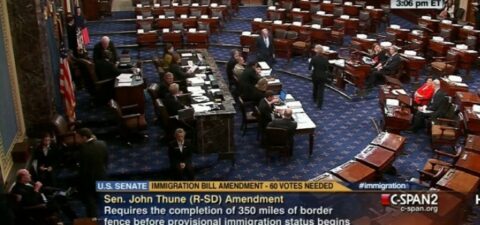
How the Senate Votes On Amendments
The Senate voted on four amendments to the immigration reform bill today, starting the ball rolling on what is likely to be a series of amendment votes over the next few days. The Senate rejected two votes requiring more enforcement at the border as a condition of implementing or completing a legalization program: Vitter 1228, which failed 36-58, and Thune 1197, which failed 39-54. Two other amendments were less divisive: Tester 1198, adding tribal governments to the Border Task Force, which passed 94-0 and Landrieu 1222, an adoption measure, which passed on a voice vote. In each case, in order to be adopted, a sixty vote threshold was required, rather than a simple majority, which has become the norm in the Senate. Needless to say, the variety of votes and rules can be confusing, leading to the need for some background on the amendment process. Read More

States Work To Improve Immigration Policies As Senate Immigration Bill Debate Begins
State legislatures are mostly winding down their 2013 legislative sessions after several states made huge strides on immigration reform. While Congress continues to debate how to overhaul the nation’s immigration system, several states have moved to make qualified undocumented immigrants eligible for in-state tuition rates and to allow undocumented immigrants to drive legally. These and other reforms at the state and local level are helpful changes to complement the national debate. Read More

Three Ways Immigration Reform Would Make the Economy More Productive
By David Dyssegaard Kallick, Director of the Fiscal Policy Institute’s Immigration Research Initiative. A report just released by the Fiscal Policy Institute, Three Ways Immigration Reform Would Make the Economy More Productive shows that legalization of undocumented immigrants, done right, would do three things to increase economic productivity in the United States. Read More
America's story is an immigrant story.