Immigration Law

Courts, State Legislators Pull Back on Restrictive Immigration Legislation
Although several states were eager to introduce their own restrictive immigration bills following Arizona and Alabama’s harsh laws, some legislators and federal judges are now pulling back on these costly bills. A federal judge in Utah this week refused to issue a ruling on the state’s immigration law in anticipation of a Supreme Court ruling on Arizona’s law while a federal judge in Nebraska struck down part of a restrictive city ordinance, finding a housing provision to be “discriminatory.” Meanwhile, legislators in Kansas and Virginia also failed to move forward on a series of restrictive immigration bills this week, due in part, as one article suggests, to the “political blowback to similar measures that have been enacted in states such as Arizona, Alabama and Georgia.” Read More

A New Way to Measure the Burgeoning Power of the Immigrant Vote
Voter registration is a key measure of immigrant integration. After all, what could be more American than casting your ballot on Election Day? When measuring immigrant voting patterns, voter registration is typically defined as the percent of naturalized immigrants (those who have become U.S. citizens) who are registered to vote. In other words, we only look at those currently eligible to vote because they have naturalized, instead of looking at the percentage of naturalized registered voters against all immigrants, documented or undocumented. The problem with that approach is we miss a big and important picture on the potential of the immigrant voting block—that many of those not eligible now, may well be eligible in the future. Read More
At Supreme Court, Arizona Gets Help from the Usual Suspects
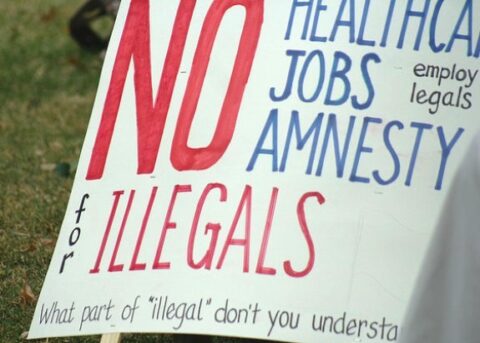
Following the filing last week of Arizona’s brief defending SB 1070, the Supreme Court has received a barrage of briefs supporting the notorious immigration law from a none-too-surprising array of suspects. As might be expected, the arguments range from the predictable (that the Obama Administration fails to enforce the immigration laws) to the provocative (that states can carry out all immigration functions short of deportation) to the preposterous (that the Constitution allows Arizona to wage war against an “invasion” of immigrants). Of course, while neither Arizona nor their lawyers can be held responsible for the arguments of outside organizations, the briefs still offer a revealing look at the identities and motivations of SB 1070’s most ardent supporters. Read More

Cato Institute Analyzes the Benefits of Immigration for the United States
The Winter 2012 issue of the Cato Journal is devoted to answering a single question: “Is Immigration Good for America?” In 13 articles, 16 scholars answer with a resounding “Yes!” The consensus is that immigrants provide a net benefit to the U.S. economy and to U.S. workers. There is also a consensus among the authors that the current immigration system, with its patchwork of arbitrary numerical caps, needlessly squanders the full economic potential of immigration. The authors call for a thorough revamping of the immigration system to make it more responsive to labor demand, to attract highly skilled professionals and entrepreneurs, and to offer a pathway to legal status for the unauthorized population. Read More

It’s Time to Improve Noncitizens’ Access to Counsel
In the United States, most immigration decisions impacting noncitizens are made by immigration officials in informal proceedings far from a courtroom. While the right to an attorney (at the noncitizens’ own expense) in immigration court proceedings is widely recognized, the right to counsel in administrative settings outside of a courtroom is often overlooked or explicitly not recognized. As a result, many noncitizens are forced to navigate the immigration process alone. For those noncitizens that are represented, the Department of Homeland Security (DHS) often restricts their access to their lawyers. Read More

Federal Judge Blocks Yet Another Provision of Alabama’s Extreme Anti-Immigrant Law
As if people needed more proof that Alabama’s extreme anti-immigrant law, HB 56, is bad for the state, a federal judge temporarily blocked enforcement of yet another provision of the law this week. U.S. District Court Judge Myron Thompson temporarily enjoined enforcement of Section 30 that, as applied, requires mobile home owners to provide proof of lawful status before renewing their registration. Judge Thompson’s ruling, in which he calls Alabama’s law “discriminatorily based,” is the latest in a series of blows to the harsh law—a law that even Alabama’s own attorney general and governor find problematic. Read More
Polls Reveal Even Conservative Voters Favor Path to Legal Status for Unauthorized Immigrants
Immigration is a hot issue in the GOP primary debates, complete with extreme anti-immigrant rhetoric and far-fetched policy proposals. Michele Bachman, for example, promised to deport every undocumented immigrant in the country—a costly and unworkable task. And she’s not the only one. Herman Cain recently “joked” that he would electrify the border fence as a deterrent for unauthorized crossers. But Republican presidential candidates have it wrong when it comes to anti-immigrant rhetoric and their base. Recent polls suggest that a majority of conservative voters actually favor a path to legal status for unauthorized immigrants. In fact, several polls found that the majority of Americans prefer a path to legalization for unauthorized immigrants currently in the U.S. Read More
Thousands Rally for Repeal of Alabama’s Extreme Anti-Immigrant Law
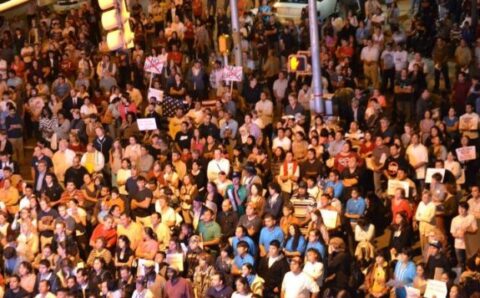
Thousands gathered outside the historic 16th Street Baptist Church in Birmingham, Alabama yesterday to demand the repeal of the state’s harsh anti-immigration law, HB 56. Religious, community and civil rights leaders, as well as a special Congressional delegation, urged state legislators to bring an end to Alabama’s immigration law—a law which continues to slow state businesses, separate families and drive immigrants from the state. The Congressional delegation also held an ad hoc hearing at Birmingham City Hall to hear how the controversial law is effecting state residents, especially the Latino and immigrant communities where, according to Rep. Luis Gutierrez, “the feeling of danger and despair is palpable.” One Congressional member, Rep. Al Green of Texas, commented that the law "deserves to be placed on the trash heap of history." Read More

Federal Appeals Court Enjoins Two Provisions of Alabama’s Extreme Immigration Law
Today, the U.S. Court of Appeals for the 11th Circuit temporarily blocked two controversial provisions of Alabama’s extreme immigration law, HB 56. A federal appeals court enjoined the provision requiring public school to determine the immigration status of enrolling students and the status of their parents as… Read More

Tell Me Again How Alabama’s Immigration Law is a “Victory for the State?”
Almost immediately after Judge Sharon Blackburn failed to enjoin key provisions of Alabama’s draconian immigration law (HB 56) last week, Alabamans began to feel the sting of the law’s harsh provisions. As immigrants leave the state, farmers, contractors, and homebuilders complain that labor shortages are and will continue to hurt their businesses. School administrators worry absent students will result in the loss of future funding. Immigrant rights groups fear the law will prevent victims from reporting crime to the police and pregnant women from going to the hospital. While Alabama Governor Robert Bentley hailed HB 56 as a “victory for the state,” the law’s intended and unintended consequences have proven to be anything but. Read More
America's story is an immigrant story.