Children

Expansion of Proposed Waiver Rule Could Help More Families Stay Together
As previously noted, the administration recently proposed a new rule that would help keep American families —the “Proposed Rule on Provisional Unlawful Presence Waivers of Inadmissibility for Certain Immediate Relatives.” This proposed rule would streamline the application process for many relatives of U.S. citizens currently eligible for a green card by minimizing the amount of time that applicants would have to be away from their families before being admitted into the United States. While the proposed rule is certainly a welcome change and would be an improvement over current procedures, there are ways in which the rule could be improved to help even more immigrants. Read More
Alabama Governor Signs Bill That Makes State’s Immigration Law Even Worse
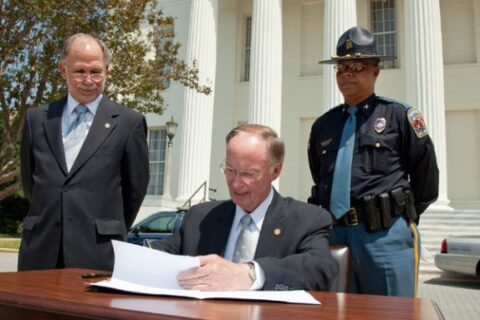
Last week, Alabama Governor Robert Bentley publically criticized a bill intended to revise key sections of the state’s controversial immigration law (HB 56). He even announced a special legislative session to address his issues with the bill—namely, a provision that requires school officials to check the immigration status of enrolling students and that of their parents and a provision that requires Alabama’s Department of Homeland Security to publically post the names of undocumented immigrants on their website. The day after his announcement, however, Governor Bentley backpedaled his criticisms, declared the legislature didn’t have the “appetite to address further revisions,” and signed the bill (HB 658) into law. Read More

Immigrants without Legal Representation Not Benefitting from Prosecutorial Discretion
After ICE Director John Morton issued a memo last June outlining how and when ICE officials should exercise prosecutorial discretion in immigration cases, many were optimistic that the memo’s implementation would relieve backlogs and help the agency focus on higher priority immigration cases. Months later, however, folks are finding that one large group of people has limited access to this review process—immigrants without legal representation. In fact, nearly half of all immigrants in removal proceedings appeared without legal representation in 2011, also known as “pro se.” While immigration attorneys often explain the effect of these prosecutorial discretion policies to their clients, pro se immigrants may be unaware that new policies are even in effect. Read More

House Judiciary Committee Sends Wrong Mother’s Day Message with Amendments to VAWA
The House Judiciary Committee sent the wrong kind of Mother’s Day message to women this week, proposing to roll back protections for victims of violence that have been in place even before the Violence Against Women Act (VAWA) was first passed in 1994. While the proposed amendments were discouraging in their own right, the fact they were targeted at immigrant women is an even sadder commentary on just how much some members of Congress will use any legislation as a vehicle for attacking and undermining the immigration system. Read More

Justice Department Says Alabama Immigration Law Disrupts Access to Public Education
While eyes remain fixed on the Alabama legislature’s effort to revise their immigration enforcement law, HB 56, the U.S. Department of Justice informed state officials in a letter last week that the state’s immigration law has resulted in significantly higher absence rates among Latino students. According to the letter, more than 13 percent of Latino schoolchildren in Alabama withdrew from classes between the start of the school year and February 2012. While the Department’s investigation is still ongoing, the letter said Alabama could lose federal funding and face additional litigation if it fails to revoke a provision of HB 56 that requires administrators to determine the immigration status of newly enrolling students. Read More

New Data Sheds Light on the Potential Power of Immigrant Voters
It is difficult to quantify the electoral power of immigrant voters. However, new data from DHS' Office of Immigration Statistics provides us with one way to gauge the electoral potential of the immigrant population. The numbers tell us how many Legal Permanent Residents (LPRs) arrived in each county of the United States since 1985. Using this data, it is possible to compare the number of post-1985 LPRs in each county against the margin of victory in the 2008 McCain-Obama contest. This helps to pinpoint where immigrants could be a potent electoral force if they naturalized and voted en masse. Read More

After Justice Department Admits Mistake, Immigrant Advocates Ask Supreme Court to Fix Prior Opinion
Of the many problems with our immigration system, one of the least known—but most frustrating—is that when the government deports immigrants whose appeals are still pending, it offers little to no help returning to the United States if they ultimately prevail in court. Immigrant advocates were thus perplexed when the Justice Department filed a Supreme Court brief in 2008 claiming to have a “policy” of helping such immigrants return to the country. Now, more than three years after the brief was filed, the current administration has conceded that no such policy existed at the time—and immigrant advocates have asked the Court to modify a portion of its ruling that relied on the government’s misstatement. Read More

Rubio Proposal Overlooks Obstacles Ahead For DREAMers
Though it has yet to be introduced in Congress, Senator Marco Rubio’s alternative to the DREAM Act received an appraisal from the Washington Post this week, which noted that it represents an effort to shake the hard-line anti-immigrant sentiment voiced by many leading conservative politicians. The editorial also noted, however, that the outlines of his proposal promote what’s tantamount to “permanent second-class status.” Read More

SB1070 Author Shares Fears About America Becoming a “Minority, Majority” Nation
On the same day the Supreme Court heard oral arguments in Arizona v. United States the Washington Post published an article featuring Michael Hethmon, general counsel for the Immigration Reform Law Institute. Hethmon is the lesser-known legal mind behind SB1070, and a variety of other anti-immigrant measures. His legal counterpart, Kris Kobach tends to get the spotlight; however Hethmon didn’t shy away from the Washington Post this week and was frank about his views on the real issues underlying SB1070. Read More

Young, Professional DREAMers Deserve Recognition
Earlier this week, numerous media outlets covered the story of Jose Godinez-Sampiero, a DREAM Act-eligible law school graduate whose application for a law license is currently pending before the Florida Supreme Court. Similar stories are playing out in California and New York, as young people brought to this country as children are now law school graduates, trying to make use of their professional degrees. The problem isn’t just for young lawyers, however, but is faced by many DREAMers, such as Dulce Matuz, an engineer turned DREAM Act advocate, who made Time Magazine’s Top 100 list this week. Read More
America's story is an immigrant story.