Over the last two decades, the federal government increasingly has utilized the criminal legal system to punish people for immigration violations. Particularly on the Southwest border, federal officials have vigorously prosecuted migrants either for entering the United States without permission or for reentering the country without permission after a prior deportation or removal order (commonly referred to, respectively, as “illegal entry” — although the statutory term is “improper entry” — and “illegal re-entry” of people previously deported; or collectively as “entry-related offenses”). Tens of thousands of migrants and asylum seekers are subjected to criminal prosecution for these crimes every year, in addition to the civil consequences they face under immigration law. Prosecutions for entry-related offenses reached an all-time high of 106,312 in Fiscal Year (FY) 2019, near the end of the first Trump administration, before 1plummeting to 14,297 in FY 2021 after the government began in March 2020 rapidly expelling most people crossing the border rather than referring them for prosecution.2 With the start of Trump’s second term in office, prosecutions for criminal violations of immigration law have risen significantly and expanded to new categories of offenses which have largely gone unprosecuted for generations.
The government’s approach to charging migrants with entry-related offenses imposes heavy costs on both the migrants themselves and the federal government. The prosecution of individuals fleeing persecution or torture harms family members with whom the individual traveled and was apprehended and can lead to family separation.3
With high conviction rates for these federal offenses, many migrants are subjected to mandatory incarceration in federal prison for months or longer. For these individuals, a conviction can impede current and future attempts to migrate lawfully or obtain asylum. For the federal government, such prosecutions are an extremely costly use of law-enforcement resources and have no demonstrated deterrent effect on future migration.4
This overview provides basic information about entry-related offenses, including the significant costs incurred by the government conducting these prosecutions, the individuals who are subjected to them, and how the government’s rationale for carrying them out is not supported by the data.
Crimes for Which Migrants are Prosecuted
Physical presence in the United States without proper authorization is a civil violation, rather than a criminal offense; as the Supreme Court itself has observed, “as a general matter, it is not a crime for a removable [noncitizen] to remain present in the United States.”5 This means that the Department of Homeland Security (DHS) can place a person in removal (deportation) proceedings and can require payment of a fine,6 but the federal government cannot charge the person with a criminal offense unless they are apprehended while in the act of entering without permission, have previously been ordered deported and reentered in violation of that deportation order, or have been ordered deported and willfully failed to depart. Likewise, a person who enters the United States lawfully and stays longer than permitted may be put in removal proceedings but cannot face federal criminal charges based solely on this civil infraction.7
Title 8 of the U.S. Code identifies federal criminal offenses pertaining to immigration and nationality, including the following two entry-related offenses:
“Illegal Entry”/8 U.S.C. § 1325, technically known as “improper entry,” makes it a crime to unlawfully enter the United States. It applies to people who do not enter with proper inspection at a port of entry, such as those who enter between ports of entry, avoid examination or inspection, or who make false statements while entering or attempting to enter. A first offense is a misdemeanor punishable by a fine, up to six months in prison, or both.8
“Illegal Re-Entry”/8 U.S.C. § 1326 makes it a crime to unlawfully reenter, attempt to unlawfully reenter, or to be found in the United States after having been deported, ordered removed, or denied admission. This crime is punishable as a felony with a maximum sentence of two years in prison.9 Higher penalties apply if the person was previously removed after having been convicted of certain crimes: up to 10 years for a single felony conviction (other than an aggravated felony conviction) or three misdemeanor convictions involving drugs or crimes against a person, and up to 20 years for an aggravated felony conviction.10
Combined, violations of 8 U.S.C. §§ 1325 and 1326 became the most prosecuted federal offenses in some years; for example, in December 2018, they constituted 65 percent of all criminal prosecutions in federal court.11 Prosecutions for entry-related offenses subsequently declined from 2020 through 2023 when the government began expelling migrants back into Mexico rather than prosecuting them.12 After President Trump took office again in 2025, immigration prosecutions again became a major priority of the federal government.
If a person is charged with “illegal reentry” (a felony), the prosecutor often will add a charge of “illegal entry” (a misdemeanor) to the indictment. The prosecutor can then pressure the migrant to plead guilty to the lesser offense in exchange for a shorter sentence—perhaps even time served.13 This practice, known as a “flip flop” plea, poses serious due-process concerns. Prosecutors who propose this type of plea deal often offer it only if the migrant agrees to waive certain rights, even beyond the right to a trial, including the right to later challenge the conviction.14 In addition, the process moves so quickly that, in many cases, charged migrants accept a plea agreement, plead guilty, and are sentenced in a matter of hours.15
Other Immigration-Related Criminal Offenses
Beyond prosecutions for entry, immigration law allows prosecutors to bring charges for several other immigration-related offenses. These offenses are not directly related to entry into the United States but can be brought against noncitizens who have failed to comply with specific obligations placed on them.
These offenses come from a World War II-era law requiring that every noncitizen register with the United States government within 30 days of arrival (8 U.S.C. § 1302). As an example, willful “failure to register” is a federal crime (8 U.S.C. § 1306(a)), and failure to carry proof of registration y can also be prosecuted as a federal crime (8 U.S.C. § 1304(e)).
Historically, the U.S. government almost never prosecuted people for these federal offenses..16 However, beginning in 2025, DHS issued a regulation vastly expanding the categories of individuals required to register, and President Trump directed the Department of Justice to enforce all immigration-related offenses.17 Following this instruction, federal prosecutors have filed charges against some undocumented immigrants for failure to register.18 Charges have also been brought against lawfully present noncitizens, including some green card holders, for failure to carry proof of their status with them at all times.19 Along the southern border in 2025, Border Patrol agents stationed at checkpoints in Arizona ticketed more than 100 people for failure to carry proof of registration with them, including green card holders and international students.20
Operation Streamline
Most entry-related prosecutions in the 21st century flowed from a partnership between the Department of Justice (DOJ) and DHS called “Operation Streamline.”21 DHS and DOJ initiated Operation Streamline in the Del Rio Sector (in and near El Paso, Texas) in 2005. The first Trump administration temporarily suspended Operation Streamline following the outbreak of the COVID-19 pandemic in 2020, and the program has not been restored to the same level in the years since.22
The initiative was intended to deter future border crossers.23 In years past, the federal government would not have subjected these individuals to prosecution. But under this initiative, the government charged first-time entrants for illegal entry, including those with no criminal histories. It also conducted group prosecutions, sometimes prosecuting as many as 80 people at once in the same hearing. Individuals could be charged, tried, convicted, and sentenced in a matter of hours with little time to speak to an attorney, particularly if there were language barriers.24 This so-called “streamlined” process deprived migrants of an individualized hearing and raises serious due-process concerns.
Individuals criminally prosecuted for entry-related offenses are entitled to a lawyer, which is provided by the U.S. government if the individual cannot afford private counsel. However, an attorney’s ability to provide quality representation in a mass prosecution setting is significantly compromised by the rushed nature of the proceedings.25
When migrants are prosecuted for crossing the border, attorneys may meet their clients for the first time on the day of the court hearing and have only minutes in a public setting to discuss their case.26 Translation services are limited, particularly for those who speak languages other than Spanish.27 Frequently, accommodations are not made for indigenous language speakers to receive needed interpretation to communicate with a public defender or to meaningfully participate in a court hearing, resulting in a lack of understanding of the proceedings or the implications of a criminal conviction.28
Soaring Numbers and Costs
The number of individuals criminally prosecuted for entry-related offenses soared after 2007 as Operation Streamline expanded. Prosecutions for illegal entry in particular jumped 252 percent in just one year between Fiscal Year (FY) 2007 and FY 2008, increasing from 14,790 to 52,087.29 Immigration-related prosecutions dipped slightly in subsequent years, but continued to dwarf the pre-FY 2005 levels (prior to the initiation of Operation Streamline) (Table 1).30
Entry-related prosecutions decreased somewhat in the first year of the first Trump administration,31 but in April 2017, former Attorney General Jeff Sessions instructed federal prosecutors to make entry-related prosecutions a high priority nationwide, including charging first-time offenders.32 By the summer of 2017, immigration-related prosecutions exceeded summer FY 2016 levels and continued to rise through the close of the year.
In April 2018, the former Attorney General doubled down by issuing a “Zero Tolerance policy” that required each U.S. Attorney’s Office to prosecute all DHS referrals of illegal entry violations.33 This policy, when applied to migrant families seeking asylum at the border, led to over 4,000 parents being separated from their children by the Trump administration, a policy which was ended in 2018 by both executive and court orders. Despite the limitation on family separation, DOJ continued to prosecute heightened numbers of migrants under the Zero Tolerance policy.34 The number of federal criminal prosecutions for illegal entry and illegal reentry skyrocketed from 53,614 in FY 2017 to 106,312 in FY 2019—an increase of 98 percent. The largest increase occurred in charges for illegal entry, which rose from 36,649 to 80,886 over the same period—an increase of 120 percent (Figure 1; Table 1).35
The Zero Tolerance policy was eventually disrupted by litigation challenging family separation and the arrival of the COVID-19 pandemic. On March 20, 2020, the Centers for Disease Control and Prevention (CDC) issued an order restricting the entry of individuals across the southern border, which became known as “Title 42,” a policy which remained in effect through May 11, 2023.36 Under Title 42, individuals encountered by the Border Patrol were rapidly expelled back to Mexico over 2.5 million times, instead of being processed for deportation or referred for prosecution.37
During the Title 42 period, the Border Patrol stopped referring most misdemeanor unlawful entry cases to federal prosecutors, while still referring many felony illegal reentry charges. In the months after Title 42 was put in place, the number of people prosecuted for unlawful entry dropped from nearly 4,000 in February 2020 to just 16 in October 2020.38 Total criminal prosecutions for unlawful entry dropped to a historic low of 261 in FY 2021.39 (Figure 1; Table 1).
The Zero Tolerance policy was formally ended on January 26, 2021, when Acting Attorney General Monty Wilkinson issued a memorandum to federal prosecutors which rescinded the policy.40 Prosecutions for both unlawful entry and illegal reentry rose during the lead-up to the end of Title 42, then rose steadily afterwards (Figure 1; Table 1).
After taking office for a second term in 2025, President Trump directed federal prosecutors to prioritize prosecution of border-related offenses.41 Following that shift, prosecutions for illegal reentry surged, reaching a record high in FY 2025 (Figure 1; Table 1). Because border crossings had fallen significantly in 2025, prosecutions for illegal entry remain below the historic levels set in 2019.
Figure 1: Number of Individuals Charged with Illegal Entry & Illegal Reentry, FY 2004-2025
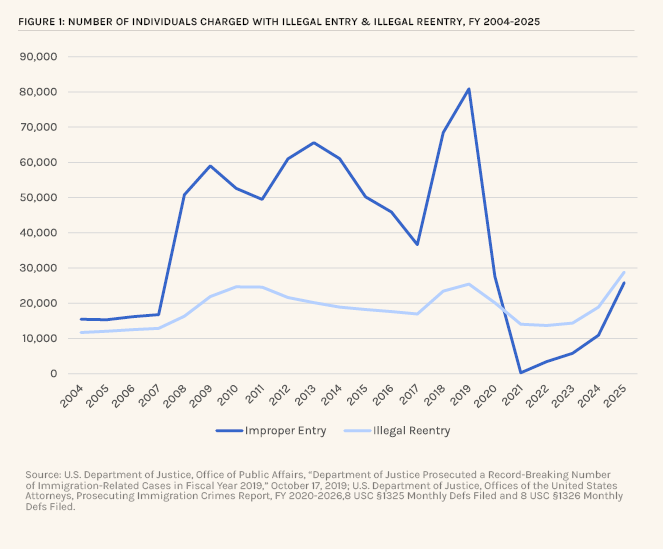
Table 1: Number of Individuals Charged with Illegal Entry & Illegal Reentry, FY 2004-2022
| Fiscal Year | Illegal Entry | Illegal Reentry | Total |
|---|---|---|---|
| 2004 | 15,461 | 11,690 | 27,151 |
| 2005 | 15,316 | 12,051 | 27,367 |
| 2006 | 16,153 | 12,480 | 28,633 |
| 2007 | 16,747 | 12,881 | 29,628 |
| 2008 | 50,804 | 16,327 | 67,131 |
| 2009 | 59,025 | 21,883 | 80,908 |
| 2010 | 52,593 | 24,676 | 77,269 |
| 2011 | 49,492 | 24,589 | 74,081 |
| 2012 | 61,016 | 21,621 | 82,637 |
| 2013 | 65,597 | 20,159 | 87,769 |
| 2014 | 61,076 | 18,890 | 79,966 |
| 2015 | 50,219 | 18,227 | 68,446 |
| 2016 | 45,915 | 17,612 | 63,527 |
| 2017 | 36,649 | 16,965 | 53,614 |
| 2018 | 68,470 | 23,426 | 91,896 |
| 2019 | 80,886 | 25,426 | 106,312 |
| 2020 | 27,630 | 20,100 | 47,730 |
| 2021 | 261 | 14,036 | 14,297 |
| 2022 | 3,436 | 13,670 | 17,106 |
| 2023 | 5,777 | 14,350 | 20,127 |
| 2024 | 10,890 | 18,883 | 29,773 |
| 2025 | 25,856 | 28,854 | 54,710 |
The expansion of criminal enforcement against migrants comes at great financial expense to the U.S. taxpayer. There is no clear accounting of the costs—which include time expended by prosecutors, use of judicial resources, the caseloads of public defenders, and expenses associated with incarceration—but they are undoubtedly massive. One conservative estimate for the incarceration of defendants charged with or convicted of entry-related offenses totaled $7 billion over the decade of 2005-2015.42 In 2025, Congress even provided $3.3 billion for prosecutions of immigration-related offenses, $5 billion to the Bureau of Prisons for imprisoning people sentences for immigration enforcement, and $11 billion to U.S. Customs and Border Protection that could be used to refer people for prosecutions.43
Judges and attorneys along the border maintain that the heavy emphasis on prosecuting entry-related offenses expends precious resources that otherwise would be devoted to prosecuting more serious crimes, such as drug smuggling and human trafficking.44
The Human Consequences of Entry-Related Prosecutions
Not surprisingly, given the practical obstacles and due-process concerns associated with group hearings, conviction rates for Operation Streamline prosecutions are extremely high, steadily increasing the population of already crowded federal prisons.45 For example in FY 2018, 82 percent of immigration cases involved prosecutions for entry-related offenses, a number which dropped to 38 percent in FY 2025 as border prosecutions fell,46 Sentencing guidelines can magnify the impact of prior minor offenses, pushing sentences higher.47
Migrants plead guilty to entry-related offenses for a variety of reasons. These can include a lack of understanding of potential defenses against a charge (and lack of time to discuss such defenses with counsel prior to a group hearing); the prospect of shorter sentences; or misunderstanding the terms or consequences of a plea agreement.48 Yet plea agreements carry serious consequences beyond incarceration.49
By accepting a plea agreement, individuals forego the right to assert defenses to the charges, to go to trial, and to appeal their criminal conviction.50 A conviction based on a plea agreement also can form the basis for placement in removal proceedings.51 Some plea agreements contain so-called “immigration waivers,” which require the defendant to forego claims for asylum or other immigration protections.52
In addition, once convicted of an entry-related offense, migrants often become a higher priority for future criminal prosecution or deportation if they are subsequently apprehended by DHS.53 It also may make it significantly more difficult for them to legally immigrate in the future.54
The Impact of Entry-Related Prosecutions on Persons Fleeing Persecution and Torture
Despite domestic and international legal obligations to protect migrants fleeing persecution and torture, the U.S. government regularly subjects individuals seeking asylum or other forms of protection in the United States to criminal prosecution and incarceration.55
Migrants who arrive at the U.S. border without proper documentation can be, and often are, subjected to fast-track deportation processes called “expedited removal”56 or “reinstatement of removal.”57 In each instance, however, the law requires that these individuals receive a preliminary screening interview with an asylum officer if they express a fear of persecution in their country of origin.
Yet along the Southwest border, the government nonetheless subjects individuals fleeing persecution and torture to criminal proceedings.58 This practice violates international law.59 The United States is a party to the 1951 Refugee Convention, which precludes nations from penalizing individuals requesting protection from persecution or torture in their country of origin.60 In 2015, the DHS Inspector General noted that the prosecution of those “who express fear of persecution or return to their home countries” under Operation Streamline was “inconsistent with and may violate U.S. treaty obligations.61
DHS, however, claims that these individuals are free to pursue protection-based claims while they serve their criminal sentences or after their release.62 Despite these claims, individuals and advocacy groups continue to report instances of DHS officials denying individuals their right to pursue asylum or protection-based relief and pressuring them to waive their fear-based claims in exchange for plea agreements.63
Criminalizing Migrants is Not an Effective Deterrent
Research strongly suggests that entry-related prosecutions do not deter future migration; rather, migration to the United States is driven primarily by factors such as the security situation and economic conditions in a migrant’s home country and whether or not a migrant has family in the United States.64 This is the case with migration from Central American countries, which is driven in large part by high levels of violence.65 Shifts in the economies of the United States and Mexico play a large role in migration trends as well.66 For example, although undocumented migration decreased in 2008 when criminal prosecutions began to rise significantly, many experts viewed the decrease in arrivals as a result of the “great recession”—the lack of economic opportunity in the United States and growing opportunities in Mexico.67 Similarly, despite prosecutions hitting record levels in 2018, migration rose even further in 2019, and prosecutions set a new record the following year.
Although DHS has long stated that the goal of Operation Streamline, and prosecutions in general, is to deter migrants from attempting to enter the United States,68 the DHS Inspector General has identified shortcomings with the data DHS gathers to assess the initiative, noting that DHS is “not fully and accurately measuring Streamline’s effect.”69
-
U.S. Department of Justice, Office of Public Affairs, “Department of Justice Prosecuted a Record-Breaking Number of Immigration-Related Cases in Fiscal Year 2019,” October 17, 2019, https://www.justice.gov/opa/pr/department-justice-prosecuted-record-breaking-number-immigration-related-cases-fiscal-year.↩︎
-
U.S. Department of Justice, Office of Public Affairs, “Department of Justice Prosecuted a Record-Breaking Number of Immigration-Related Cases in Fiscal Year 2019,” October 17, 2019, https://www.justice.gov/opa/pr/department-justice-prosecuted-record-breaking-number-immigration-related-cases-fiscal-year; U.S. Department of Justice, Offices of the United States Attorneys, Prosecuting Immigration Crimes Report, FY 2020-2022, 8 USC §1325 Monthly Defs Filed and 8 USC §1326 Monthly Defs Filed, https://www.justice.gov/usao/resources/PICReport.↩︎
-
Immigration Justice Campaign, et al., “The Separation of Family Members Apprehended by or Found Inadmissible while in U.S. Customs and Border Protection (CBP) Custody at the U.S.-Mexico Border,” DHS Civil Rights and Civil Liberties Complaint (December 8, 2017), https://www.americanimmigrationcouncil.org/advocacy/family-separation-at-the-border/.↩︎
-
Rebecca Gambler, Border Patrol: Actions Needed to Improve Oversight of Post-Apprehension Consequences (Washington, DC: U.S. Government Accountability Office, January 2017), https://www.gao.gov/assets/690/682074.pdf; U.S. Department of Homeland Security, Office of Inspector General, Streamline: Measuring Its Effect on Illegal Border Crossing, May 15, 2015, https://www.oig.dhs.gov/sites/default/files/assets/Mgmt/2015/OIG_15-95_May15.pdf.↩︎
-
Arizona v. United States, 567 U.S. 387 (2012).↩︎
-
8 U.S.C. § 1324d; 8 C.F.R. § 280.53(b)(14).↩︎
-
Arizona v. United States, 567 U.S. 387 (2012).↩︎
-
8 U.S.C. § 1325.↩︎
-
8 U.S.C. § 1326.↩︎
-
Technically, a migrant who reenters unlawfully has violated both 1325 and 1326. However, a court has ruled that, in such cases, a foreigner can only serve a single sentence as punishment. See United States v. Ortiz-Martinez, 557 D.2d 214 (9th Cir. 1977).↩︎
-
Transactional Records Access Clearinghouse, “Federal Criminal Prosecutions Sharply Lower in December,” February 20, 2018, https://tracreports.org/tracreports/crim/547/.↩︎
-
Transactional Records Access Clearinghouse, “Major Swings in Immigration Criminal Prosecutions During Trump Administration,” December 18, 2020, https://tracreports.org/immigration/reports/633/.↩︎
-
David Martin and James F. Metcalf, “Pretrial Service along the Border: A District of Arizona Perspective,” Federal Probation Journal 76, no. 2, September 2012, http://www.uscourts.gov/federal-probation-journal/2012/09/pretrial-services-along-border-district-arizona-perspective.↩︎
-
Ibid.; James M. Cole, Deputy Attorney General, “Memorandum for All United States Attorneys, Department Policy on Early Disposition or ‘Fast Track’ Programs,” U.S. Department of Justice, January 31, 2012, https://www.justice.gov/sites/default/files/dag/legacy/2012/01/31/fast-track-program.pdf.↩︎
-
Judith Greene, Bethany Carson, Andrea Black, Indefensible: A Decade of Mass Incarceration of Migrants Prosecuted for Crossing the Border (Austin, TX: Grassroots Leadership/Justice Strategies, July 2016), 38, https://www.prisonpolicy.org/scans/indefensible_book_web.pdf.↩︎
-
American Immigration Council, “The Trump Administration’s Registration Requirement for Immigrants” (Washington, DC; February 26, 2025), https://www.americanimmigrationcouncil.org/fact-sheet/the-trump-administrations-registration-requirement-for-immigrants/.↩︎
-
Ibid.↩︎
-
Jeremy Roebuck and Marianne LeVine, “Migrants criminally charged after failing to register with U.S. government,” Washington Post, May 31, 2025, https://www.washingtonpost.com/immigration/2025/05/31/trump-immigrants-registry-doj-justice/.↩︎
-
See, e.g. Jorge Santiago, “Chicago man fined $130 by ICE agents for not carrying identification,” NBC Chicago, October 15, 2025, https://www.nbcchicago.com/news/local/chicago-man-fined-130-by-ice-agents-for-not-carrying-identification/3838101/; Alexandra Markovich, “Border Patrol now targeting legal immigrants for ‘carry your papers’ law in southern Arizona,” Arizona Center for Investigative Reporting, March 4, 2026, https://azcir.org/news/2026/03/04/border-patrol-tickets-legal-immigrants-carry-your-papers/.↩︎
-
Alexandra Markovich, “Border Patrol is now using a ‘carry your papers’ law to target legal immigrants in Arizona,” Arizona Mirror, March 5, 2026, https://azmirror.com/2026/03/05/border-patrol-is-now-using-a-carry-your-papers-law-to-target-legal-immigrants-in-arizona/.↩︎
-
Transactional Records Access Clearinghouse, “Criminal Prosecutions for Illegal Border Crossers Jump Sharply in April,” June 4, 2018, https://tracreports.org/immigration/reports/515/. Although immigrants theoretically can be prosecuted for “illegal entry” anywhere in the United States, prosecutors are usually reluctant to bring these cases far from the border where it is more difficult to establish precisely how and when the migrant entered. This is less true for reentry cases, because once a migrant has been deported or ordered removed it does not matter how they reentered—their presence in the United States, along with the deportation order, is enough to convict under Section 1326. Most of the criminal reentry cases are also filed along the Southwest border, but a significant number are filed elsewhere—including Florida and Tennessee.↩︎
-
Ryan Devereaux, “Mass Immigration Prosecutions Are Currently on Hold. What Comes Next is Uncertain,” The Intercept, March 18, 2020, https://theintercept.com/2020/03/18/immigration-border-prosecution-coronavirus/.↩︎
-
U.S. Department of Homeland Security, Office of Inspector General, Streamline: Measuring Its Effect on Illegal Border Crossing, May 15, 2015, 3-7, https://www.oig.dhs.gov/sites/default/files/assets/Mgmt/2015/OIG_15-95_May15.pdf.↩︎
-
Joanna Lydgate, Assembly-Line Justice: A Review of Operation Streamline (Berkeley, CA: University of California, Berkeley Law School, January 2010), https://www.law.berkeley.edu/files/Operation_Streamline_Policy_Brief.pdf.↩︎
-
Ibid.↩︎
-
Ibid., 4.↩︎
-
Human Rights First, Punishing Refugees and Migrants: The Trump Administration’s Misuse of Criminal Prosecutions, January 2018, 23,https://humanrightsfirst.org/library/punishing-refugees-and-migrants-the-trump-administrations-misuse-of-criminal-prosecutions/; KINO Border Initiative, “The Immigration Prosecution Factory,” November 14, 2017, https://www.kinoborderinitiative.org/immigration-prosecution-factory/.↩︎
-
Ibid.↩︎
-
Mark Motivans, Immigration, Citizenship, and the Federal Justice System, 1998-2018 (Washington, DC: Bureau of Justice Statistics, August 2019), 21, https://www.bjs.gov/content/pub/pdf/icfjs9818.pdf.↩︎
-
Transactional Records Access Clearinghouse, “Criminal Immigration Prosecutions Down 14% in FY 2017,” December 6, 2017, https://tracreports.org/whatsnew/email.171205.html.↩︎
-
Ibid. While the precise cause is unclear, the significant surge of unaccompanied children and asylum-seeking families from Central America in 2014, along with the Obama administration’s prioritization of immigration enforcement against noncitizens who presented a public safety risk, could have contributed to a decline in prosecutions at the border.↩︎
-
The Attorney General also urged prosecution of other immigration violations that were not entry-related. See Memorandum from the Attorney General to All Federal Prosecutors re: “Renewed Commitment to Criminal Immigration Enforcement,” April 11, 2017, https://www.justice.gov/opa/press-release/file/956841/download.↩︎
-
U.S. Department of Justice, “Attorney General Announces Zero-Tolerance Policy for Criminal Illegal Entry,” April 6, 2018, https://www.justice.gov/opa/pr/attorney-general-announces-zero-tolerance-policy-criminal-illegal-entry.↩︎
-
American Immigration Council, “A Look Back at the Family Separation Policy,” October 30, 2025, https://www.americanimmigrationcouncil.org/report/family-separation-policy/.↩︎
-
U.S. Department of Justice, Office of Public Affairs, “Department of Justice Prosecuted a Record-Breaking Number of Immigration-Related Cases in Fiscal Year 2019,” October 17, 2019, https://www.justice.gov/opa/pr/department-justice-prosecuted-record-breaking-number-immigration-related-cases-fiscal-year.↩︎
-
American Immigration Council, “A Guide to Title 42 Expulsions at the Border” (Washington, DC: May 25, 2022), https://www.americanimmigrationcouncil.org/research/guide-title-42-expulsions-border.↩︎
-
Transactional Records Access Clearinghouse, “Major Swings in Immigration Criminal Prosecutions during Trump Administration,” December 18, 2020, https://tracreports.org/immigration/reports/633/.↩︎
-
Ibid.↩︎
-
U.S. Department of Justice, Offices of the United States Attorneys, Prosecuting Immigration Crimes Report, FY 2020-2022, 8 USC §1325 Monthly Defs Filed and 8 USC §1326 Monthly Defs Filed, https://www.justice.gov/usao/resources/PICReport.↩︎
-
Memorandum from Acting Attorney General Monty Wilkinson to All Federal Prosecutors re: “Rescinding the Zero-Tolerance Policy for Offenses Under 8 U.S.C. § 1325(a),” January 26, 2021, https://www.justice.gov/ag/page/file/1360706/download; Michael Balsamo and Colleen Long, “DOJ rescinds ‘zero tolerance’ immigration rule,” Associated Press, January 26, 2021, https://apnews.com/article/latin-america-immigration-only-on-ap-mexico-0072e62b21009f1e86244031c6c0380b.↩︎
-
President Donald J. Trump, Executive Order 14,165, “Securing Our Borders,” January 20, 2025.↩︎
-
Judith Greene, Bethany Carson, Andrea Black, Indefensible: A Decade of Mass Incarceration of Migrants Prosecuted for Crossing the Border (Austin, TX: Grassroots Leadership/Justice Strategies, July 2016), 143, https://www.prisonpolicy.org/scans/indefensible_book_web.pdf.↩︎
-
National Immigrant Justice Center, “Congress Should Reject More Family Separations & Mass Incarceration,” August 5, 2025, https://immigrantjustice.org/blog/new-explainer-the-waste-and-severe-harm-of-immigration-prosecutions/; American Immigration Council, “What’s in the Big Beautiful Bill? Immigration and Border Security Unpacked” (Washington, DC: July 2025), https://www.americanimmigrationcouncil.org/fact-sheet/big-beautiful-bill-immigration-border-security/. .↩︎
-
Joanna Lydgate, Assembly-Line Justice: A Review of Operation Streamline (Berkeley, CA: University of California, Berkeley Law School, January 2010), 7-8, https://www.law.berkeley.edu/files/Operation_Streamline_Policy_Brief.pdf; Alistar Graham Robertson, et al., “Operation Streamline: Costs and Consequences,” Grassroots Leadership, September 2012, 8-9, https://static1.squarespace.com/static/631d11c512478973b80f3f07/t/641b46771330266529a7cfc9/1679509111377/GRL_Sept2012_Report+final.pdf.↩︎
-
Judith Greene, Bethany Carson, Andrea Black, Indefensible: A Decade of Mass Incarceration of Migrants Prosecuted for Crossing the Border (Austin, TX: Grassroots Leadership/Justice Strategies, July 2016), 2, https://www.prisonpolicy.org/scans/indefensible_book_web.pdf.↩︎
-
U.S. Sentencing Commission, 2018 Annual Report and Sourcebook of Federal Sentencing Statistics, 128, https://www.ussc.gov/sites/default/files/pdf/research-and-publications/annual-reports-and-sourcebooks/2018/2018-Annual-Report-and-Sourcebook.pdf; U.S. Sentencing Commission, 2025 Annual Report and Sourcebook of Federal Sentencing Statistics, https://www.ussc.gov/about/annual-report-2025.↩︎
-
Judith Greene, Bethany Carson, Andrea Black, Indefensible: A Decade of Mass Incarceration of Migrants Prosecuted for Crossing the Border (Austin, TX: Grassroots Leadership/Justice Strategies, July 2016), 85-86, https://www.prisonpolicy.org/scans/indefensible_book_web.pdf.↩︎
-
Joanna Lydgate, Assembly-Line Justice: A Review of Operation Streamline (Berkeley, CA: University of California, Berkeley Law School, January 2010), 7, 12, 13, https://www.law.berkeley.edu/files/Operation_Streamline_Policy_Brief.pdf.↩︎
-
Judith Greene, Bethany Carson, Andrea Black, Indefensible: A Decade of Mass Incarceration of Migrants Prosecuted for Crossing the Border (Austin, TX: Grassroots Leadership/Justice Strategies, July 2016), 38, 68, https://www.prisonpolicy.org/scans/indefensible_book_web.pdf.↩︎
-
Ibid.↩︎
-
Ibid., 7.↩︎
-
Human Rights First, Punishing Refugees and Migrants: The Trump Administration’s Misuse of Criminal Prosecutions, January 2018, 19-20, https://humanrightsfirst.org/library/punishing-refugees-and-migrants-the-trump-administrations-misuse-of-criminal-prosecutions/.↩︎
-
U.S. Government Accountability Office, Border Patrol: Actions Needed to Improve Oversight of Post-Apprehension Consequences, January 2017, https://www.gao.gov/products/GAO-17-66.↩︎
-
Joanna Lydgate, Assembly-Line Justice: A Review of Operation Streamline (Berkeley, CA: University of California, Berkeley Law School, January 2010), 13, https://www.law.berkeley.edu/files/Operation_Streamline_Policy_Brief.pdf; INA §212(a)(2)(B).↩︎
-
Human Rights First, Punishing Refugees and Migrants: The Trump Administration’s Misuse of Criminal Prosecutions, January 2018, 8-16, https://humanrightsfirst.org/library/punishing-refugees-and-migrants-the-trump-administrations-misuse-of-criminal-prosecutions/.↩︎
-
American Immigration Council, A Primer on Expedited Removal (Washington, DC: February 2025), https://www.americanimmigrationcouncil.org/research/primer-expedited-removal. During the expedited removal process, if an individual expresses a fear of return, an asylum officer determines whether the person has a “credible fear” of persecution in his or her country of origin. If the asylum officer makes a positive “credible fear” finding, the individual is placed in removal proceedings where he or she can apply for asylum or any other form of relief from removal in a hearing before an immigration judge. If the asylum officer does not find a credible fear, the individual’s ability to seek further review is extremely limited. These claims proceed exclusively before the asylum officer and the immigration courts.↩︎
-
American Immigration Council, Removal Without Recourse: The Growth of Summary Deportations from the United States (Washington, DC: April 2014), https://www.americanimmigrationcouncil.org/research/removal-without-recourse-growth-summary-deportations-united-states. If a person has been deported under a prior removal order and has unlawfully returned to the United States, he or she may be subjected to “reinstatement of removal.” In that process, if a fear is expressed, an asylum officer determines whether the person has a “reasonable fear” (a higher standard than demonstrating “credible fear”) of persecution or torture in his or her country of origin. If the officer finds that a person has a reasonable fear, the person receives a hearing before an immigration judge to assess eligibility for withholding of removal or protection under the U.N. Convention Against Torture—more limited forms of protection than asylum that do not lead to permanent residence and do not permit petitioning for family members. Whether or not the officer finds a reasonable fear, individuals subject to reinstatement orders may seek further review of those orders and/or reasonable fear determinations in the appropriate court of appeals.↩︎
-
Human Rights First, Punishing Refugees and Migrants: The Trump Administration’s Misuse of Criminal Prosecutions, January 2018, 8-16, https://humanrightsfirst.org/library/punishing-refugees-and-migrants-the-trump-administrations-misuse-of-criminal-prosecutions/. Some observers even report that immigrants who request asylum at a port of entry are pushed back and essentially forced to try to cross between the ports of entry, at which point they can be charged with the criminal offense of “illegal entry.”↩︎
-
Ibid.↩︎
-
“Convention and Protocol Related to the Status of Refugees,” United Nations, Article 31 (1951), 29, http://www.unhcr.org/3b66c2aa10.pdf.↩︎
-
U.S. Department of Homeland Security, Office of Inspector General, Streamline: Measuring Its Effect on Illegal Border Crossing, May 15, 2015, 2, https://www.oig.dhs.gov/sites/default/files/assets/Mgmt/2015/OIG_15-95_May15.pdf.↩︎
-
Ibid., 17.↩︎
-
Human Rights First, Punishing Refugees and Migrants: The Trump Administration’s Misuse of Criminal Prosecutions, January 2018, 20, https://humanrightsfirst.org/library/punishing-refugees-and-migrants-the-trump-administrations-misuse-of-criminal-prosecutions/.↩︎
-
Jonathan T. Hiskey, et al., Understanding the Central American Refugee Crisis: Why They Are Fleeing and How U.S. Policies are Failing to Deter Them (Washington, DC: American Immigration Council, February 2016), https://www.americanimmigrationcouncil.org/research/understanding-central-american-refugee-crisis.↩︎
-
Ibid.↩︎
-
Joanna Lydgate, Assembly-Line Justice: A Review of Operation Streamline (Berkeley, CA: University of California, Berkeley Law School, January 2010), 5-6, https://www.law.berkeley.edu/files/Operation_Streamline_Policy_Brief.pdf.↩︎
-
Francisco Alba, “Mexico: The New Migration Narrative,” Migration Policy Institute, April 2013, https://www.migrationpolicy.org/article/mexico-new-migration-narrative.↩︎
-
See Hearing on Declining Deportations and Increasing Criminal Alien Releases—The Lawless Immigration Policies of the Obama Administration Before the Senate Committee on the Judiciary, Subcommittee on Immigration and the National Interest, 109th Congress (May 19, 2016) (written testimony of Border Patrol Acting Chief Ronald Vitiello), https://www.dhs.gov/news/2016/05/19/written-testimony-cbp-senate-judiciary-subcommittee-immigration-and-national.↩︎
-
U.S. Department of Homeland Security, Office of Inspector General, Streamline: Measuring Its Effect on Illegal Border Crossing, May 15, 2015, https://www.oig.dhs.gov/sites/default/files/assets/Mgmt/2015/OIG_15-95_May15.pdf.↩︎