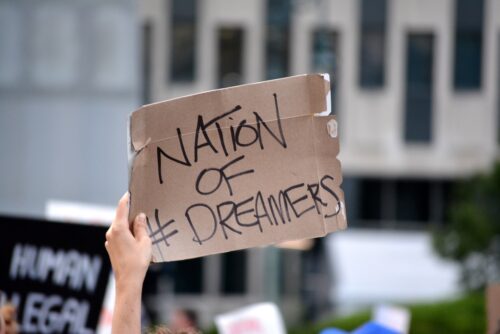
The Dream Act1 is proposed legislation that would permanently protect certain noncitizens who came to the United States as children but are vulnerable to deportation.
The first version of the Development, Relief, and Education for Alien Minors (DREAM) Act was introduced in 2001.2 Because the bill focused on undocumented youth, noncitizens who could benefit from its protections have been referred to as “Dreamers.” Over the past 25 years, 23 standalone Dream Act bills have been introduced in Congress. While the various versions of the bill have contained some key differences,3 they all would have provided a pathway to legal status for undocumented people who came to this country as children.
Some versions of the Dream Act have garnered as many as 48 cosponsors in the U.S. Senate and 205 in the House of Representatives.4 However, despite bipartisan support for each version, none have become law.5 To date, the 2010 bill came closest when it passed the House but fell just five votes short of the 60 needed to proceed in the Senate.6
This fact sheet provides an overview of the most recent version of the Dream Act and similar bills that include versions of the Dream Act introduced in the 119th Congress.
Current Federal Legislative Proposals
There are three versions of the Dream Act currently before the 119th Congress: the Dream Act of 2025 (S. 3348) and two versions of the Dream Act that are incorporated into larger bills, including the American Dream and Promise Act of 2025 (H.R. 1589) and the Dignity for Immigrants while Guarding our Nation to Ignite and Deliver the American Dream Act or “DIGNIDAD” (Dignity) Act of 2025 (H.R. 4393).
The Dream Act of 2025 was introduced on December 4, 2025 in the Senate by Senators Dick Durbin (D-IL) and Lisa Murkowski (R-AK).7 Senator Durbin and Senator Lindsey Graham (R-SC) introduced nearly identical legislation in the last four sessions of Congress.
In the House, the American Dream and Promise Act of 2025 was introduced on February 26, 2025 by Representative Sylvia Garcia (D-TX-29)8 and the DIGNIDAD (Dignity) Act of 2025 was introduced on July 15, 2025 by Representative Maria Elvira Salazar (R-FL-27).9
All three bills would provide a path to citizenship for Dreamers.
The most recent versions of the Dream Act, the American Dream and Promise Act, and the Dignity Act also provide a path to citizenship for “Documented” Dreamers—minor children who entered the United States as derivatives on their parent’s temporary work visas but who are at risk of “aging out” of their temporary legal status when they turn 21.10 After aging out, they face the difficult choice of departing the United States or facing potential deportation. All three bills protect Documented Dreamers who were admitted as derivatives on the following temporary work visas: E-1 (treaty traders), E-2 (treaty investors), H-1B (specialty occupations) and L-1 (intracompany transferees, executives or managers).11 However, this does not include all Documented Dreamers as the children of other workers under temporary work statuses such as R-1 (religious workers) and O-1 (extraordinary ability) are currently not included.
The American Dream and Promise Act and the Dignity Act also provide a path to citizenship to recipients of protections under two humanitarian programs: Temporary Protected Status (TPS) and Deferred Enforced Departure (DED).12 The Dream Act extends this pathway to TPS holders, but not DED beneficiaries.
What Would the Dream Act Do?
All three current versions of the Dream Act would provide current, former, and future undocumented high school graduates and GED recipients a pathway to U.S. citizenship through college, work, or the armed services.13 The bills outline a three-step process, summarized below.
Step 1: Conditional Permanent Residence
An individual would be eligible to obtain conditional permanent resident (CPR) status, which includes work authorization, if the person has Deferred Action for Childhood Arrivals (DACA)14 or meets all the following requirements:
- Came to the United States as a child.
- Has been admitted to an institution of higher education, has graduated high school or obtained a GED, or is currently enrolled in secondary school or a program assisting students to obtain a high school diploma or GED.15
- Has served or is serving in the Armed Forces or was honorably discharged (only Dream Act of 2025).16
- Has not participated in the persecution of another person.17
- Has not been convicted of certain crimes.
Under all the bills, the Secretary of the Department of Homeland Security (DHS) can issue waivers of certain criminal offenses. All allow waivers of certain grounds of inadmissibility for humanitarian purposes for family unity while the American Dream and Promise Act and the Dignity Act also allow a waiver if it is otherwise in the public interest.18 In addition, the Dream Act of 2025 adds a new requirement where the applicant must show they have no existing tax liability, or that they are in the process of repayment with the Internal Revenue Service.19
Step 2: Lawful Permanent Residence
Anyone who obtains CPR status could obtain lawful permanent residence (LPR status or a “green card”) by satisfying one of the following requirements.20
- Higher education: the person has obtained a degree from an institution of higher education or completed two years toward a bachelor’s or higher degree program.21 The American Dream and Promise Act and the Dignity Act also allow other educational attainment to meet this requirement, such as a post-secondary credentials from a career and technical education school.22
- Military service: the person completed at least two years,23 or in the case of the Dignity Act three years, of military service with an honorable discharge, if discharged. The Dream Act of 2025 requires service in the Armed Forces, while the American Dream and Promise Act and the Dignity Act allow service in any of the Uniform Services.24
- Work: the person demonstrated employment over a total period of three years, or in the case of the Dignity Act four years, and at least 75 percent of that time the individual had employment authorization.
Individuals who cannot meet one of these requirements could apply for a “hardship waiver” under all three bills albeit with some differences. Under the American Dream and Promise Act and the Dignity Act, a waiver is available if the applicant is a person with a disability; a full-time caregiver; or for whom removal would cause hardship to themselves or a spouse, parent, or child who is a national or lawful permanent resident of the United States.25 In the Dream Act of 2025, a waiver is available under the similar criteria, but with key differences: the caregiver must be a minor child and removal would have to result in extreme hardship to the applicant’s qualifying relatives.26 All three bills also require the person to speak, read, and write in basic English and pass a U.S. history and civics exam.27
Both the American Dream and Promise Act and the Dignity Act allow DHS to establish a special procedure for DACA recipients to bypass CPR status and apply directly for LPR status.28
Step 3: Naturalization
After maintaining LPR status for five years, an individual can generally apply to become a U.S. citizen through the standard naturalization process.
Who Would Benefit from the Dream Act, American Dream and Promise Act, and Dignity Act?
The three bills differ in how many people would qualify for CPR status due to variations in their requirements for length of stay in the U.S. and age at arrival.
Under each bill, some people would become immediately eligible for CPR status when the bill became law, and an additional group of approximately 340,000 people would have the possibility of eventually becoming eligible by meeting the educational and/or age requirements.29
Estimated number of Dreamers who would qualify for CPR status30
| Bill | Immediately eligible | Total potentially eligible |
|---|---|---|
| Dignity Act | 2,269,330 | 2,610,718 |
| American Dream and Promise Act | 2,269,330 | 2,610,718 |
| Dream Act | 2,139,203 | 2,478,855 |
What are the Key Differences between the Dream Act, American Dream and Promise Act, and Dignity Act?
The three bills have some significant differences around qualification requirements for conditional resident status, which are compared below.
| Eligibility | Dream Act (2025) | American Dream and Promise Act (2025) | Dignity Act (2025) |
|---|---|---|---|
| Age of arrival | 17 years old or younger31 | 18 years old or younger32 | 18 years old or younger33 |
| Has been continuously physically present since: | Four years prior to bill enactment34 | January 1, 202135 | January 1, 202136 |
| Validity period of conditional permanent residence | 8 years37 | 10 years38 | 10 years39 |
| Disqualifying criminal history (convictions) | |||
| Exceptions |
|
|
|
Secondary Review Process in the American Dream and Promise Act and the Dignity Act
In addition to the criminal bars listed above, the American Dream and Promise Act and the Dignity Act contain a secondary review process that would allow DHS to deny CPR and LPR applications from individuals deemed to be threats to public safety due to alleged criminal activity.
DHS would be allowed to conduct a secondary review of an application if the person has been convicted of any misdemeanor that is punishable by more than 30 days in jail, except those related to lack of immigration status, certain cannabis-related offenses, and nonviolent civil disobedience. A person is also subject to secondary review if the person was found by a state or local juvenile court to have committed an offense and was ordered to spend time in a detention facility. If DHS determines that the person is a threat to public safety, the agency can then deny the application.66
DHS can also deny the application of a person that it determines has “voluntarily” participated in crimes committed by a gang within the past five years.67 Despite provisions in the American Dream and Promise Act and the Dignity Act limiting the use of unreliable U.S. Immigration and Customs Enforcement (ICE) “gang” databases,68 youth advocates have expressed concern that gang membership allegations often rely on flawed information and result from over-policing and racial profiling.69
The American Dream and Promise Act, unlike the Dream Act of 2025 or the Dignity Act, also repeals the 1996 law which penalizes states that grant in-state tuition to undocumented students based on residency and allows Dreamers to access federal financial aid.70
Both the American Dream and Promise Act and the Dignity Act allow eligible Dreamers deported on or after January 20, 2017, to apply for relief from outside the country.71
-
Although the first “DREAM” act was known by its acronym in all capital letters, subsequent proposals have adopted the title “Dream.” ↩︎
-
S. 1291, 107th Cong. (2001). ↩︎
-
For example, prior versions of the Dream Act have varied in their treatment of potential beneficiaries who are abroad, the treatment of close family members of potential beneficiaries, and in the duration of the conditional status to be conferred. ↩︎
-
S. 1545, 108th Cong. (2003); H.R. 3440, 115th Cong. (2017). ↩︎
-
S. 1291, 107th Cong. (2001); H.R. 1582, 107th Cong. (2001); H.R. 1918, 107th Cong. (2001); S. 1545, 108th Cong. (2003); H.R. 1684, 108th Cong. (2003); S. 2075, 109th Cong. (2005); H.R.5131, 109th Cong. (2006); S. 2205, 110th Cong. (2007); H.R. 1275, 110th Cong. (2007); S. 729, 111th Cong. (2009); S. 3992, 111th Cong. (2010); H.R. 6497, 111th Cong. (2010); H.R. 5281, 111th Cong. (2010); H.R. 1842, 112th Cong. (2011); S. 952, 112th Cong. (2011); S. 1615, 115th Cong. (2017); H.R. 1468, 115th Cong. (2017); H.R. 3440, 115th Cong. (2017); S. 874, 116th Cong. (2019); H.R. 2820, 116th Cong. (2019); S. 264, 117th Cong. (2021); S. 365 118th Cong. (2023); S. 3348 119th Cong. (2025). At least three versions of the Dream Act that were included in more comprehensive bills have passed at least one chamber of Congress with bipartisan support. Those include H.R. 5281, 111th Cong. (2010) (passed the House with the support of 216 representatives); S. 744, 113th Cong. (2013) (passed the Senate with the support of 68 senators); H.R. 6, 116th Cong. (2019) (passed the House with the support of 237 representatives). ↩︎
-
H.R. 5281, 111th Cong. (2010). On December 18, 2010, cloture on the motion to agree to the House amendment was not invoked in Senate by a vote of 55 yeas to 41 nays, in which a 60-vote threshold needed. ↩︎
-
S.3348, 119th Cong. (2025). ↩︎
-
H.R. 1589, 119th Cong. (2025). ↩︎
-
H.R. 4393, 119th Cong. (2025). ↩︎
-
American Immigration Council, “Documented Dreamers: An Overview,” November 18, 2024, https://www.americanimmigrationcouncil.org/research/documented-dreamers-overview. ↩︎
-
S. 3348, 119th Cong. (2025) at Section 3(b)(1); H.R. 1589, 119th Cong. (2025) at Section 102(b)(1); and H.R. 4393, 119th Cong. (2025) at Section 2102(b)(1). ↩︎
-
American Immigration Council, “Temporary Protected Status (TPS): An Overview,” August 17, 2026, https://www.americanimmigrationcouncil.org/fact-sheet/documented-dreamers-overview/. ↩︎
-
S. 3348, 119th Cong. (2025) at Sections 3(b)(1)(D) and 5(a)(1); H.R. 1589, 119th Cong. (2025) at Sections 102(b)(1) and 104(a); H.R. 4393, 119th Cong. (2025) at Sections 2102(b)(1) and 2104(a)(1). ↩︎
-
S. 3348, 119th Cong. (2025) at Section 3(b)(4); H.R. 1589, 119th Cong. (2025) at Section 102(b)(3)(B); and H.R. 4393, 119th Cong. (2025) at Section 2102(b)(3)(B). ↩︎
-
S. 3348, 119th Cong. (2025) at Section 3(b)(1)(D); H.R. 1589, 119th Cong. (2025) at Section 102(b)(1)(D); and H.R. 4393, 119th Cong. (2025) at Section 2102(b)(1)(D). ↩︎
-
S. 3348, 119th Cong. (2025) at Section 3(b)(1)(D). ↩︎
-
S. 3348, 119th Cong. (2025) at Section 3(b)(1)(C)(ii); H.R. 1589, 119th Cong. (2025) at Section 102(b)(1)(C)(ii); and H.R. 4393, 119th Cong. (2025) at Section 2102(b)(1)(C)(ii). ↩︎
-
S. 3348, 119th Cong. (2025) at Section 3(b)(2); H.R. 1589, 119th Cong. (2025) at Section 102(c)(2); H.R. 4393, 119th Cong. (2025) at Section 2102(c)(2). ↩︎
-
S. 3348, 119th Cong. (2025) at Section 3(b)(1)(e). ↩︎
-
S. 3348, 119th Cong. (2025) at Section 5(a)(1)(C); H.R. 1589, 119th Cong. (2025) at Section 104(a)(1)(C); H.R. 4393, 119th Cong. (2025) at Section 2104(a)(1)(C). ↩︎
-
S. 3348, 119th Cong. (2025) at Section 5(a)(1)(C); H.R. 1589, 119th Cong. (2025) at Section 104(a)(1)(C); H.R. 4393, 119th Cong. (2025) at Section 2104(a)(1)(C). ↩︎
-
Both S. 3348 and H.R. 1589 also include that a person who completes at least two years, in good standing, in a program for a bachelor’s degree or higher degree in the United States meets this requirement. ↩︎
-
S. 3348, 119th Cong. (2025) at Section 5(a)(1)(C), H.R. 1589, 119th Cong. (2025) at Section 104(a)(1)(C). ↩︎
-
H.R. 4393, 119th Cong. (2025) at Section 2104(a)(1). ↩︎
-
H.R. 1589, 119th Cong. (2025) at Section 104(a)(2); and H.R. 4393, 119th Cong. (2025) at Section 2104(a)(2). ↩︎
-
S. 3348, 119th Cong. (2025) at Section 5(a)(2). ↩︎
-
S. 3348, 119th Cong. (2025) at Section 5(a)(3), H.R. 1589, 119th Cong. (2025) at Section 104(a)(2), and H.R. 4393, 119th Cong. (2025) at Section 2104(a)(3). ↩︎
-
H.R. 1589, 119th Cong. (2025) at Section 102(b)(3)(B) and H.R. 4393, 119th Cong. (2025) at Section 2102(b)(3)(B). ↩︎
-
Population estimates are based on the American Immigration Council’s analysis of the 1-year American Community Survey (ACS) from 2024, using the qualification requirements for conditional resident status listed in S. 3348, H.R. 1589, and H.R. 4393. ↩︎
-
Ibid. H.R. 1589 and H.R. 4393 produce identical estimates because both require presence since January 1, 2021, entry at age 18 or younger, and identical educational qualifications. Remaining differences, including misdemeanor thresholds and waiver provisions, are not observable in American Community Survey (ACS) data. ↩︎
-
S. 3348, 119th Cong. (2025) at Section 3(b)(1)(B). ↩︎
-
H.R. 1589, 119th Cong. (2025) at Section 102(b)(1)(B). ↩︎
-
H.R. 4393, 119th Cong. (2025) at Section 21002(b)(1)(B). ↩︎
-
S. 3348, 119th Cong. (2025) at Section 3(b)(1)(A). ↩︎
-
H.R. 1589, 119th Cong. (2025) at Section 102(b)(1)(A). ↩︎
-
H.R. 4393, 119th Cong. (2025) at Section 21002(b)(1)(A). ↩︎
-
S. 3348, 119th Cong. (2025) at Section 4(a)(1). ↩︎
-
H.R. 1589, 119th Cong. (2025) at Section 103(a)(1). ↩︎
-
H.R. 4393, 119th Cong. (2025) at Section 2103(a)(1). ↩︎
-
S. 3348, 119th Cong. (2025) at Section 3(b)(1)(C)(i). S. 3348 incorporates the inadmissibility grounds under paragraph section 212(a)(2) of the Immigration and Nationality Act (8 U.S.C. 1182(a)). ↩︎
-
S. 3348, 119th Cong. (2025) at Section 3(b)(1)(C)(iii)(I). ↩︎
-
S. 3348, 119th Cong. (2025) at Section 3(b)(1)(C)(iii)(II). ↩︎
-
H.R. 1589, 119th Cong. (2025) at Section 102(c)(1)(A). H.R. 1589 incorporates the inadmissibility grounds under section 212(a)(2) of the Immigration and Nationality Act (8 U.S.C. 1182(a)(2)). ↩︎
-
H.R. 1589, 119th Cong. (2025) at Section 102(c)(1)(B)(i). ↩︎
-
H.R. 1589, 119th Cong. (2025) at Section 102(c)(1)(B)(ii). ↩︎
-
H.R. 1589, 119th Cong. (2025) at Section 102(c)(1)(B)(iii). ↩︎
-
H.R. 4393, 119th Cong. (2025) at Section 2102(c)(1)(A). H.R. 4393 incorporates the inadmissibility grounds under section 212(a)(2) of the Immigration and Nationality Act (8 U.S.C. 1182(a)(2)). ↩︎
-
H.R. 4393, 119th Cong. (2025) at Section 2102(c)(1)(B)(i). ↩︎
-
H.R. 4393, 119th Cong. (2025) at Section 2102(c)(1)(B)(ii). ↩︎
-
H.R. 4393, 119th Cong. (2025) at Section 2102(c)(1)(B)(iii). ↩︎
-
S. 3348, 119th Cong. (2025) at Section 3(b)(1)(C)(iii). ↩︎
-
H.R. 1589, 119th Cong. (2025) at Section 102(c)(1)(B). ↩︎
-
Ibid. ↩︎
-
H.R. 1589, 119th Cong. (2025) at Section 102(c)(1)(B)(ii). ↩︎
-
Ibid. ↩︎
-
H.R. 1589, 119th Cong. (2025) at Section 102(c)(1)(B)(iii). ↩︎
-
H.R. 1589, 119th Cong. (2025) at Section 102(c)(2)(B). ↩︎
-
Ibid. ↩︎
-
H.R. 4349, 119th Cong. (2025) at Section 2102(c)(1)(B). ↩︎
-
Ibid. ↩︎
-
H.R. 4393, 119th Cong. (2025) at Section 2102(c)(1)(B)(ii). ↩︎
-
Ibid. ↩︎
-
H.R. 4393, 119th Cong. (2025) at Section 2102(c)(1)(B)(iii). ↩︎
-
H.R. 4393, 119th Cong. (2025) at Section 2102(c)(2)(B). ↩︎
-
Ibid. ↩︎
-
H.R. 1589, 119th Cong. (2025) at Section 102(c)(3)(A), (B); H.R. 4393, 119th Cong. (2025) at Section 2102(c)(3)(A), (B). ↩︎
-
H.R. 1589, 119th Cong. (2025) at Section 102(c)(3)(A), (D); H.R. 4393, 119th Cong. (2025) at Section 2102(c)(3)(A), (D). ↩︎
-
H.R. 1589, 119th Cong. (2025) at Section 102(c)(3)(E); H.R. 4393, 119th Cong. (2025) at Section 2102(c)(3)(E). For a discussion on some of these databases, see Katherine Conway, “Fundamentally Unfair: Databases, Deportation, and the Crimmigrant Gang Member,” American University Law Review 67, no. 283-311 (2017), https://aulawreview.org/au_law_review/wp-content/uploads/2017/12/06-Conway.to_.Printer.pdf. ↩︎
-
National Juvenile Justice & Delinquency Prevention Coalition, “Concerns with Juvenile Bars in the Dream Act of 2021,” March 1, 2021, https://www.hrw.org/sites/default/files/media_2021/03/Concerns%20with%20Juvenile%20Bars%20in%20the%20Dream%20Act%20of%202021.pdf. ↩︎
-
H.R. 1589, 119th Cong. (2025) at Section 105. ↩︎
-
H.R. 1589, 119th Cong. (2025) at Section 304(c); H.R. 4393, 119th Cong. (2025) at Section 2204(c). ↩︎