 The American Immigration Council is a non-profit, non-partisan organization.
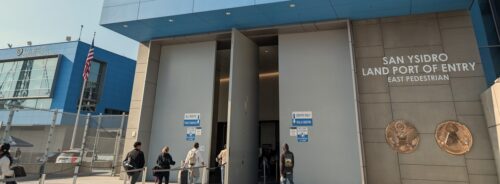
 The opportunity to ask for asylum is a right protected under both U.S. and international law. Yet, during the first Trump administration, border officials physically blocked hundreds of thousands of migrants from accessing ports of entry to seek asylum.
Under the government’s “turnback policy” (which the government calls “metering”), U.S. Customs and Border Protection (CBP) officials turned asylum seekers back into Mexico, sometimes falsely asserting that there was no capacity to inspect and process them. Some waited for years at the U.S.-Mexico border, forced to live in squalid conditions and falling victim to cartel members. Many were violently assaulted, kidnapped, raped, or murdered while waiting for their chance to exercise their right to seek asylum.
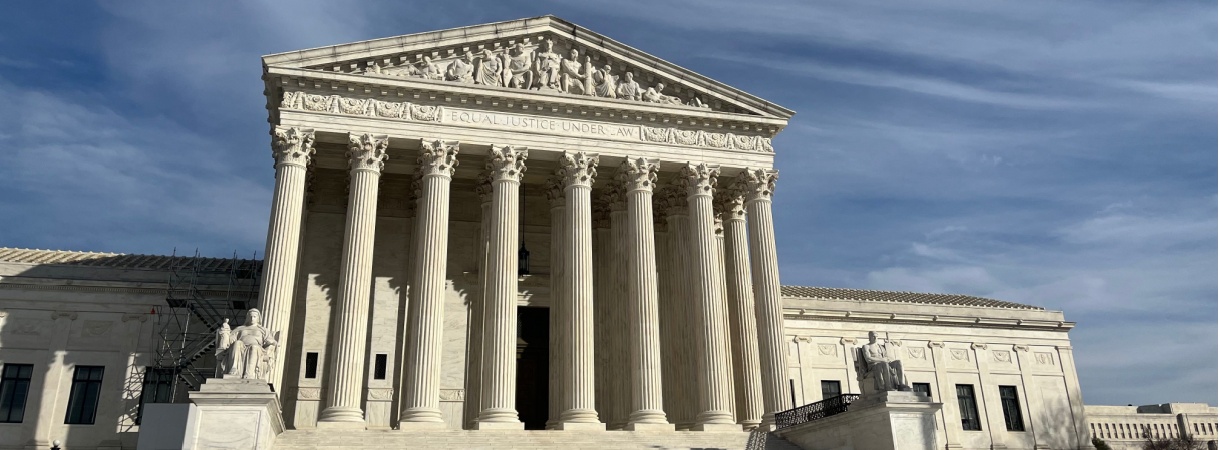
On March 24, the American Immigration Council and our partners were at the Supreme Court to defend the right to seek asylum in the case Noem v. Al Otro Lado. Although the turnback policy has not been in effect since 2021, the Trump administration asked the Supreme Court to overturn the Ninth Circuit Court of Appeals’ decision declaring the policy unlawful.
How we got to the Supreme Court
Originally filed in July 2017, the case has a long history across the last three presidential administrations. The plaintiffs are Al Otro Lado, a binational legal and humanitarian service provider based in California and Mexico, and a group of people seeking asylum who were subjected to the turnback policy. The Council is litigating this case alongside our partners at the Center for Constitutional Rights, the Center for Gender and Refugee Studies, Democracy Forward, and the Institute for Constitutional Protection and Advocacy at Georgetown Law.
2016
- For the first time in U.S. history, under President Obama, U.S. officials at ports of entry begin sporadically blocking access to inspection and asylum processing for pedestrians walking into ports of entry from Mexico to present themselves for inspection. After the 2016 election, CBP implements the practice of turning away asylum seekers at ports across the southern border.
July 2017
- The Council and our partners file suit, arguing the government is violating individuals’ right to seek asylum at ports of entry by sending them back to Mexico after they have crossed onto U.S. soil at ports.
April-June 2018
- The Trump administration issues secret guidance that formalizes the practice of turnbacks through a “metering” policy, which involves stationing CBP officers just north of the international border line, where they physically block noncitizens seeking asylum from stepping onto U.S. soil. CBP officials refuse to inspect and process asylum seekers, forcing them to wait in Mexico.
October 2018
- The Council and our partners amend the complaint to challenge the new practice of turning back asylum seekers and physically blocking their access to U.S. soil at ports of entry.
May 2019
- Litigation reveals the government’s secret policy memos directing turnbacks at the border line of asylum seekers presenting themselves at ports of entry. The government agrees that turning away asylum seekers who reach U.S. soil violates the law but claims that as long as officers succeed at blocking asylum seekers from reaching U.S. soil, turning them away from ports is not a violation.
July 2019
- The district court denies the government’s motion to dismiss the amended complaint, reasoning that turnbacks violate U.S. law.
- The government issues an interim final rule barring asylum eligibility for noncitizens who failed to first apply for asylum and receive a final denial in any country they transited through before reaching the United States (the “Asylum Transit Ban”).
September 2019
- While turnbacks are ongoing, the plaintiffs ask for a preliminary injunction to stop the government from applying the Asylum Transit Ban to people already blocked by turnbacks.
November 2019
- The court provisionally certifies a class of non-Mexican asylum seekers who were unable to apply for asylum before July 16, 2019 (the effective date of the Asylum Transit Ban) due to turnbacks.
- In the same order, the court issues a preliminary injunction blocking the government from applying the Asylum Transit Ban to this class and orders that their asylum claims be processed under pre-ban rules.
March 2020
- After the government appeals the Asylum Transit Ban preliminary injunction, a three-judge panel of the Ninth Circuit issues a preliminary ruling agreeing with the district court that turnbacks are likely unlawful.
- With the onset of the COVID-19 pandemic, the government suspends “metering” and instead replaces it with a new border regime under Title 42.
August 2020
- The district court grants the plaintiffs’ motion for full class certification, allowing the case to proceed on behalf of all asylum seekers who were or will be prevented from accessing the asylum process at ports of entry due to the turnback policy.
October 2020
- The district court grants the plaintiffs’ motion to clarify the Asylum Transit Ban preliminary injunction. In its Clarification Order, the court says the government must make all reasonable efforts to identify class members, confirms that the preliminary injunction applies even to people already denied asylum under the ban, and orders DHS and EOIR to reopen or reconsider those prior denials.
December 2020
- Plaintiffs file a motion to enforce the court’s prior orders regarding the Asylum Transit Ban preliminary injunction, arguing that the government has failed to adequately comply with both the preliminary injunction and Clarification Order.
January-February 2021
- After the government reissues the Asylum Transit Ban as a final rule, the district court blocks the government from applying the final Asylum Transit Ban rule to class members, consistent with its earlier preliminary injunction.
August 2021
- Plaintiffs file an additional motion seeking court oversight regarding the Asylum Transit Ban preliminary injunction, citing continued deficiencies in the government’s compliance with the injunction.
September 2021
- The district court grants summary judgment to the plaintiffs, ruling that turning back asylum seekers at ports of entry is unlawful. The court finds violations of the Administrative Procedure Act, the Immigration and Nationality Act, and the Fifth Amendment, emphasizing that the Immigration and Nationality Act requires officials to inspect and process people who arrive at ports of entry seeking asylum, including people who are in the process of arriving at the port but are blocked by CBP officers from stepping foot on U.S. soil. However, the district court requests more briefing from the parties before deciding the proper remedy for these violations.
November 2021
- The government rescinds the metering memos.
August 2022
- The court issues remedies decisions, formally declaring turnbacks unlawful, and converting the Asylum Transit Ban preliminary injunction into a permanent injunction, with some modifications.
October 2022
- The Biden administration appeals the district court’s decision, including both the declaratory judgment and the permanent injunction, to the Ninth Circuit.
October 2024
- A three-judge panel of the Ninth Circuit largely affirms the district court’s ruling. The court upholds the prohibition on applying the Asylum Transit Ban to class members but narrows the scope of the permanent injunction. In the course of reviewing the permanent injunction, the court affirms the district court’s declaration that turnbacks are unlawful.
May 2025
- A majority of active judges on the Ninth Circuit declines to rehear the case en banc, and the original three-judge panel issues a slightly amended opinion reaching the same result as before.
June 2025
- After the parties’ extensive efforts over four years to identify Asylum Transit Ban injunction class members, the district court grants the plaintiffs’ unopposed request for relief from judgment regarding the Asylum Transit Ban injunction, as modified by the Ninth Circuit. The court finds that the purposes of the injunction have been satisfied and that applying it prospectively is no longer equitable given the burdens on the parties and the diminishing ability to identify new class members.
July 2025
- The second Trump administration files a petition for writ of certiorari, asking that the Supreme Court review the Ninth Circuit’s ruling.
November 2025
- The Supreme Court grants the government’s petition for certiorari.
February 2026
- The Council and our partners file brief defending the Ninth Circuit’s ruling on the merits.
- Nine amicus briefs are filed in support of that ruling by a broad coalition of former government officials, members of Congress, scholars, clergy, and human rights and constitutional advocates.
March 2026
- The Supreme Court hears oral argument.
What happens next?
The Supreme Court typically hands down its rulings in June and July, before its summer recess begins.
While the turnback policy is not currently in place at the southern border, the future of the practice remains uncertain. If the Supreme Court reverses the Ninth Circuit’s decision, the U.S. government would likely be allowed to use turnbacks against noncitizens again, leading to preventable suffering and dysfunction at the border. However, it is possible there could be other legal grounds for challenging a new turnback policy.
Should the justices affirm the lower courts’ previous rulings, CBP would continue to be required to inspect and process migrants who arrive at ports of entry, regardless of which side of the U.S.-Mexico border they are standing on. This would continue the United States’ decades-long tradition of being a beacon of safety for those seeking refuge.