 The American Immigration Council is a non-profit, non-partisan organization.
 Update: The text and headline of this post were updated on June 1, 2026, to reflect recent statements made by USCIS.
On May 21, U.S. Citizenship and Immigration Services (USCIS) issued a policy memorandum (PM-602-0199) concerning green card applications filed within the United States. While the Trump administration presents the memo as a “reminder” to USCIS employees about existing law, it has also touted it as closing a “loophole” that could force more noncitizens to leave the country to apply for green cards.
After initially presenting the new policy as something that would affect most green-card applications, USCIS has stated that it will be implemented on a case-by-case basis – implying that many immigrants will still be able to remain in the U.S. while applying for green cards. However, many questions remain unanswered: what will happen to people who have already filed green card applications; who will face the most scrutiny; and whether any groups of noncitizens will, in practice, be categorically denied the chance to apply for green cards within the United States. Some of these scenarios could raise significant constitutional concerns.
Ultimately, many people could be forced to decide whether to remain in the United States with their families while risking their immigration status or leave to pursue lawful permanent resident status with the possibility of never being able to return. However, the full impact of the memo remains unclear.
What is “Adjustment of Status?”
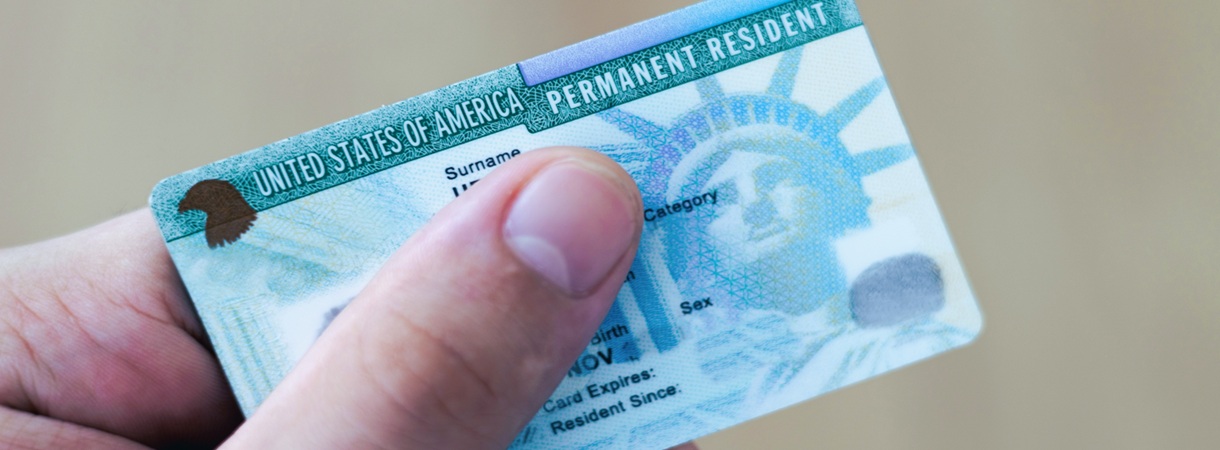
The memo focuses on “adjustment of status,” which is a process that people living in the United States, who are eligible, go through to obtain lawful permanent residency, or a green card. This contrasts with pursuing lawful permanent residency abroad through “consular processing,” which requires applying for an “immigrant visa” at a U.S. embassy or consulate. If the person is issued this visa and admitted to the United States, they will receive a green card.
Every year, about one million people obtain lawful permanent residency. Becoming a lawful permanent resident allows a noncitizen who meets the requirements to ultimately apply for U.S. citizenship. Noncitizens can obtain green cards through certain family members, employment, or for humanitarian reasons.
In FY 2023, a total of 608,260 people obtained lawful permanent residency by adjusting their status while living in the United States, while 564,660 arrived from abroad. Most noncitizens who apply for lawful permanent residence based on employment apply within the United States.
Some noncitizens cannot use consular processing at all, including youth who have been abandoned, abused, or neglected and survivors of certain crimes who are applying for lawful permanent status (known as “Special Immigrant Juvenile Status”). For many others, consular processing is theoretically an option but in practice could destroy their cases. This is especially likely for people who are relatives (including spouses and parents) of U.S. citizens, but who have lived in the United States for some period of time without an immigration status. Under current law, once they leave the country, they trigger bars that prohibit them from getting legal immigration status for several years and prevent them from re-entering the country during that time. Additionally, the State Department has implemented an indefinite pause on consular visa processing of immigrant visas for nationals of 75 countries — making adjustment of status the only viable option for them.
What does USCIS’ new guidance on adjustment of status say?
The May 21 memo sets a significantly higher bar for approving adjustment of status applications filed from within the United States than has ever been used before, though it does not explicitly instruct USCIS to deny specific categories or types of adjustment of status applications.
The memo states that requests to adjust status within the United States should be considered “extraordinary discretionary relief” and an “act of administrative grace.” The guidance suggests that these applications may be denied if the applicant cannot otherwise show that they merit a favorable exercise of discretion.
USCIS asserts that this interpretation of the law is consistent with Congress’ intent — in other words, that Congress did not want people to adjust status within the United States except in extraordinary circumstances. However, this is not a widely accepted interpretation of the law. Congress created the adjustment of status process in 1952 and has amended that section of the law more than 20 times in the decades since. At no time has Congress written this “extraordinary discretionary relief” standard into the law that USCIS is now claiming Congress intended all along. Instead, Congress has provided for the adjustment of status process to be an established and parallel way to receive a green card.
Who could the new memo impact?
Because the memo stresses discretion, it is impossible to know from just the text whether USCIS intends to apply a higher standard for all adjustment applications or a narrow subset. However, the memo does spell out some things that adjudicators are supposed to consider “highly relevant” negative factors — ones that would make it very hard for someone to merit favorable discretion and get their adjustment of status application approved.
Among these factors are overstaying the validity period for their nonimmigrant or parole status or failing to maintain a specific type of immigration status throughout their time in the United States. USCIS is suggesting that cases in which someone has overstayed their nonimmigrant admission or parole period are now unlikely to be allowed to adjust status within the United States.
On the same day as it published this new guidance, USCIS partially walked back the memo’s immediate effects by saying applicants providing “economic benefit” or serving the “national interest” may remain on their current path. While it’s still unclear how these exceptions may be implemented, they may favor certain employment-based cases.
Reading between the lines, these applicants may be at higher risk:
- Immediate relatives of U.S. citizens because they do not have to be in a lawful status at the time they file their adjustment of status applications.
- Nonimmigrants in categories in which they cannot maintain their nonimmigrant status after applying for a green card, such as O-1 extraordinary ability or R-1 religious workers.
- Applicants from one of the 75 countries where consular processing is currently not available, since they have no way to seek green cards if their adjustment of status applications are denied. Since the Trump administration has argued that people from these countries are inherently likely to be a “public charge” on the United States if allowed to settle here, it is possible that officials might find them unlikely to provide an “economic benefit” to the U.S.
What happens now to people hoping to adjust their status?
USCIS has issued conflicting messaging, which has created confusion and panic for applicants, employers, and practitioners. In its press release, the agency went further than the memo in suggesting that most temporary visa holders would need to leave the country and apply abroad for immigrant visas. The agency still has not clarified through formal policy or guidance whether this recent memo is supposed to apply to adjustment of status applications that have already been filed, or whether it will also apply to new applications. Nevertheless, there are recent reports from attorneys representing noncitizens with pending adjustment applications that their clients are being asked to demonstrate “extraordinary circumstances” per the memo.
Unfortunately, there may be significant uncertainty about the memo for the foreseeable future. The memo states that USCIS will “carefully” review the various options noncitizens have to adjust their status and that it “may” provide specific guidance as to whether those applications “may or may not warrant [an] act of grace and exception to the regular consular process.” Even if it does provide such guidance, it may not be made public. While the memo raises the bar for adjustment of status, just how much it has been raised — and who will still be allowed to stay in the U.S. to receive a green card — will not be clear until people begin to receive notices in their individual cases.
Will there be legal challenges to this policy memo?
The memo is likely to face legal challenges given that there is substantial disagreement with USCIS’ assertion that this policy is consistent with the law as enacted by Congress. The agency has also effectively changed substantive policy without providing advance notice and an opportunity to comment through rulemaking. However, the outcome of such a court case — or whether USCIS would be allowed to implement the policy while a lawsuit is underway — is not at all clear.
This overall uncertainty is likely to discourage applicants, employers, and families from pursuing adjustment of status or taking risks with immigration filings. Unfortunately, this memo represents a continuing pattern by the Trump administration to significantly narrow practical pathways to permanent residence.