 The American Immigration Council is a non-profit, non-partisan organization.
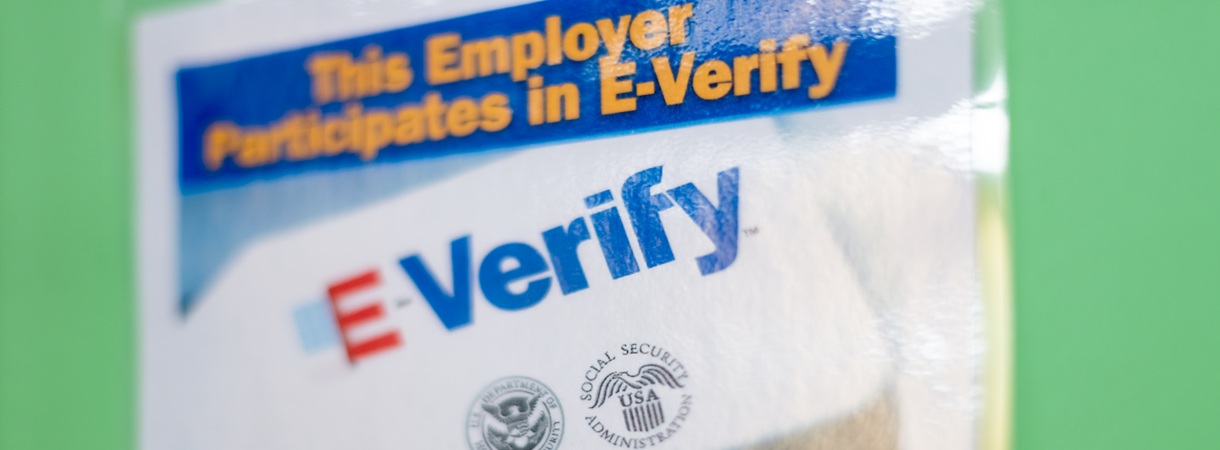
 Electronic employment verification is a central feature of modern immigration compliance in the United States. At the heart of this system is E-Verify, an online federal system that allows employers to confirm whether newly hired employees are authorized to work in the country. E-Verify, which Congress created in 1996, was launched in 1997 as a pilot program to supplement the employment verification framework established under the Immigration Reform and Control Act (IRCA) and emerged from concern that unauthorized employment was a primary driver of unlawful immigration.
E-Verify is administered by U.S. Citizenship and Immigration Services (USCIS) alongside the Social Security Administration. Although federal law generally makes E-Verify voluntary for private employers, Congress has required its use for certain federal contractors.
States, however, have increasingly enacted their own mandates, creating a patchwork of requirements in addition to federal requirements. Proponents of state E-Verify laws all make the same case: E-Verify mandates can curb unauthorized employment and stop undocumented immigrants from living in their state. Increasingly, new laws seek not only participation requirements but also enforcement mechanisms, fines, or even criminal penalties for noncompliance. In practice, this forces private businesses to participate in the enforcement of immigration law — imposing burdens that can cripple smaller businesses in these states.
How E-Verify Works Today
Under the IRCA, employers must complete Form I-9 for every new hire, examining documents that establish identity and work authorization. What became E-Verify was designed as an electronic extension of the verification process. Currently, after completing the mandatory Form I-9, participating employers submit the employee’s information through the online E-Verify system. The data is compared against federal databases. If records match, the worker is confirmed as authorized. If not, the system flags it and gives the employee an opportunity to contest the finding. E-Verify requires the employer to take certain steps within 10 federal government workdays after the system flag, beginning with notice to the worker, to complete the process. The outcome will depend on whether the employee challenges the flag, and if so, whether the “mismatch” is overcome. Today, E-Verify processes millions of cases annually.
Employers who enroll in E-Verify assume specific compliance obligations, are subjected to monitoring and audits, and must ensure proper use and compliance, otherwise they could face program termination for such actions as misuse or fraud. Employers may face fines assessed by U.S. Immigration and Customs Enforcement for things such as uncorrected paperwork violations or knowingly employing people who lack work authorization.
Nationally, as of December 2025, E-Verify is primarily used by the professional, scientific and technical services industries (26.5%), and food and beverage industries (10.7%). States with laws mandating E-Verify use, including Georgia, Florida, and Arizona, have the highest number of enrolled businesses in the nation.
State-Level Expansion and the 2026 Legislative Session
Over time, some states have moved beyond the program’s original design — with some states imposing fines for violating their E-Verify laws, unlike the federal government. North Carolina requires employers with at least 25 employees to use E-Verify. Other states, like Oklahoma, focus mandates on public employers or government contractors.
During the 2026 legislative session, more states have introduced or advanced expanded E-Verify proposals. In Idaho, lawmakers considered broadening requirements to cover public employers and certain private contractors — despite efforts that failed in 2024 and 2025 to pass universal E-Verify requirements and sparked concerns from employers. Florida legislators debated expanding existing mandates toward more universal coverage, although the bill ultimately failed.
Redundancy, Harm, and Economic Concerns
E-Verify has not proven effective at preventing the employment of undocumented immigrants, and laws that impose penalties risk suppressing business growth.
Critics also argue that many state mandates are redundant. Federal law already prohibits knowingly employing unauthorized workers. Expanding state-level E-Verify mandates can duplicate federal enforcement mechanisms while adding administrative complexity for businesses operating across multiple jurisdictions.
Additionally, E-Verify can generate errors that deny those with work authorization – including U.S. citizens and green card holders — jobs that they are qualified to fill. Authorized workers can be flagged as ineligible due to database errors or name discrepancies. Resolving these issues requires time, staff capacity, documentation, and navigation of bureaucratic processes. In stricter enforcement environments, some employers may adopt hiring practices that disproportionately affect immigrants.
From an economic standpoint, universal mandates can affect labor supply — particularly in industries such as agriculture, construction, and hospitality that rely heavily on immigrant labor. Business groups have argued that sweeping requirements, especially when paired with penalties, may intensify labor shortages, raise operational costs, and reduce competitiveness. In some states, concerns about workforce availability have slowed or reshaped proposed legislation. In response to the 2026 E-Verify bills proposed in Idaho, dairy industry leaders opposed the legislation, citing the economic impacts, redundant requirements, and need to reform legal pathways to hire temporary workers to meet labor demands. In 2025, when the Kansas legislature proposed E-Verify legislation, the Kansas Chamber, the Kansas Bar Association, and the League of Kansas Municipalities opposed the effort, naming many of the challenges listed above.
E-Verify has transformed from a limited pilot into a central — yet still contested — pillar of employment and immigration policy, reflecting broader tensions between regulatory enforcement, on-the-ground realities for employers, and the evolving American economy. These challenges help explain why E-Verify was not originally mandated nationwide. The debate around E-Verify usage and its reliability and usefulness is likely to continue.