 The American Immigration Council is a non-profit, non-partisan organization.
 After years of jockeying through the courts, on June 25, a 6-3 majority of the U.S. Supreme Court sided with the government in Mullin v. Al Otro Lado. First filed in 2017, Al Otro Lado is the Council’s long-running litigation challenging the first Trump administration’s policy of turning back people seeking asylum as they approached ports of entry on the southern border.
What was the pre-turnback status quo?
Under the Immigration and Nationality Act (INA), government officials must inspect certain noncitizens who “arrive in the United States.” And by law, a noncitizen who is “physically present in” or who “arrives in” the United States is entitled to apply for asylum. At ports of entry, the asylum process begins with the processing of a noncitizen by a Customs and Border Protection (CBP) officer. For decades, this was understood to mean that noncitizens who feared persecution had the right to walk up to a port of entry to begin the process of seeking asylum.
The Refugee Act of 1980, which enshrined the U.S.’s obligations under international treaties, is grounded in the idea that a person fleeing persecution could approach the border and ask for asylum — and that the United States cannot return them to a country where they would face harm.
What were turnbacks and how did they evolve?
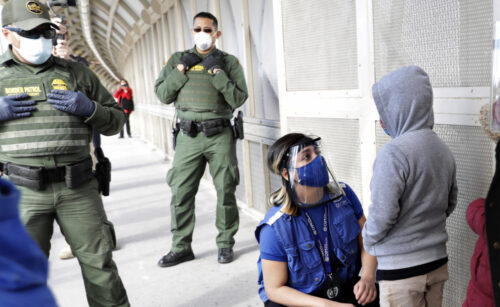
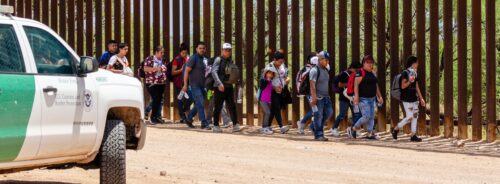
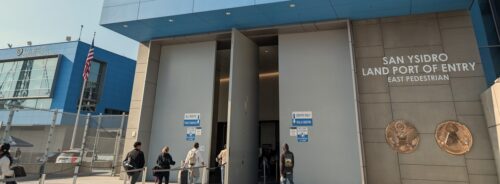
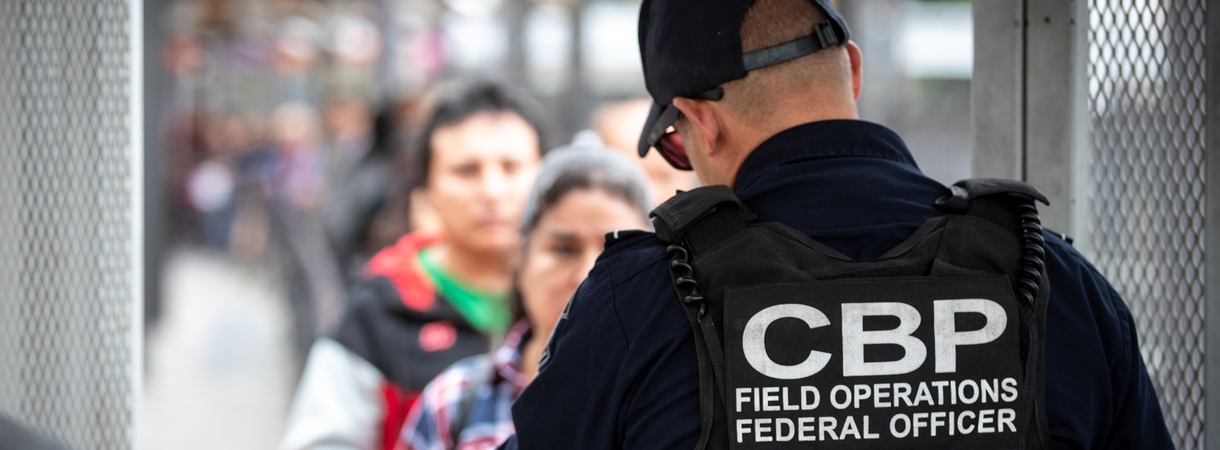
In 2016, in response to the arrival of large numbers of Haitian asylum seekers approaching the San Ysidro port of entry in California, the Obama administration began implementing a process it euphemistically dubbed “metering,” by which it returned asylum seekers to Mexico rather than processing them as required under law. The first Trump administration formalized this practice into a border-wide policy in 2018 and directed CBP officers to stand at the physical boundary line between the United States and Mexico to block access to the ports of entry (often located on the other side of a bridge or turnstiles), preventing people from setting foot on U.S. soil to begin the process of seeking asylum. The policy left asylum seekers stranded in Mexican border towns, where they faced kidnapping, assault, and extortion while they awaited the chance to present themselves at ports of entry.
In 2021, the Biden administration rescinded the metering policy and introduced new policies to manage the border and asylum seekers, including the now defunct CBP One application.
What did plaintiffs argue in their lawsuit?
The Council, with co-counsel at the Center for Gender and Refugee Studies, the Center for Constitutional Rights, Democracy Forward, and Georgetown University’s Institute for Constitutional Advocacy and Protection, has been litigating this case since 2017. We represent the binational border rights organization Al Otro Lado (AOL) and 13 people who sought to access the asylum process at ports of entry on the U.S.-Mexico border but were turned away by CBP officers without being inspected or screened for asylum.
The plaintiffs argued that the turnback policy violated the Administrative Procedure Act (APA) by unlawfully withholding or unreasonably delaying inspection and processing of asylum seekers arriving at ports of entry (under section 706(1) of the APA), among other claims.
What did the lower courts hold?
The district court found, and the Ninth Circuit affirmed, that a noncitizen stopped at the border by CBP officers “arrives in” the United States and is thus eligible to apply for asylum. By refusing to inspect and process these noncitizens (as a first step in the asylum process), the Department of Homeland Security unlawfully withheld action it was required to take under the law.
Importantly, the Ninth Circuit rested its holding on the government’s wholesale “withholding” of a mandatory duty, rather than a mere delay in carrying out that duty. In other words, if the government had taken “even minimal steps . . . such as implementing and following a waitlist system or initiating the asylum process,” the outcome of the case would have been different. But the refusal to carry out inspection and processing at all, the district court and Ninth Circuit held, violated the law. The result was a declaratory judgment that the turnback policy was illegal, on behalf of a class of present and future asylum seekers.
What happened at the Supreme Court?
Justice Alito authored the 6-3 decision reversing the Ninth Circuit decision and ruling against the asylum seekers and AOL. The majority opinion was short, and relied almost entirely on a cramped, textual analysis of the phrase “arrives in.”
According to the Court, “[a] person arrives in the United States . . . only when he enters it.” The Court raised a series of analogies, including a football running back “arriving in” the end zone only after crossing the goal line rather than being tackled a yard outside it (ignoring that the government should not be treating asylum seekers like players on an opposing football team). According to the Court, the government’s inspection and processing duties are triggered only when a noncitizen is standing on U.S. soil, and not when a CBP officer physically blocks that person from crossing the line to begin the process of requesting asylum. It stressed that because Congress used “arrives in” the United States rather than “arrives at,” the government had no obligation to process asylum seekers who make it all the way to the border but do not physically set foot on U.S. soil.
The Court rejected the asylum seekers’ argument that to require an individual to reach U.S. soil to access the asylum process would render superfluous the other half of that statutory phrase, which permits asylum claims from those who are “physically present” in addition to those who “arrive in” the country. If the statute already permits asylum claims for those who are on U.S. soil, the plaintiffs had argued, the words “arrives in” needed to have some independent meaning. While admitting that the argument had “some force,” the Court nevertheless rejected the idea that “arrives in” must mean something different than “physically present.”
The Court also held that the plaintiffs and the Ninth Circuit’s interpretation of the statute would give it “extraterritorial” impact (using U.S. law outside of the United States), which is only allowed in limited circumstances not applicable here. It rejected that the challenged conduct — the CBP officers’ physical blocking of asylum seekers — occurs on U.S. soil. And it analogized to a 1993 case in which it had held that that the United States did not violate its international treaty obligations toward refugees when it intercepted Haitians on the high seas and forced them to return.
The Court’s opinion presented a skewed version of the facts out of line with the evidence credited by the district court. It portrayed the turnback policy as a tool used to manage the flow of individuals through ports of entry during times of heavy traffic, and a mere delay in processing rather than a total shutdown of the process. In reality, the plaintiffs had shown that the turnback policy was implemented even when the ports of entry had space and resources to process asylum seekers and the lower courts agreed that the government had “withheld” its duty rather than merely delaying it.
The facts also showed that far from a simple processing delay, the turnback policy constituted a wholesale refusal of the government to carry out its duties, leaving asylum seekers with no recourse or access to a process. The majority opinion glossed over or misconstrued this extensive factual record. And based on that flawed review of the facts, the Court concluded that if the government were to bar asylum seekers from reaching the point where they could file an application, such a policy could be “quickly challenged.”
What did the dissent say?
Justice Sotomayor authored the primary dissent, joined by Justices Kagan and Jackson. In a separate dissent, Justice Jackson noted that the policy had not been in effect for years, and that the Court should not have decided the case because it was moot. Twice the length of the majority opinion and read from the bench (signaling strong disagreement), Justice Sotomayor’s dissent took apart the majority’s reasoning and its recitation of the facts. The dissent noted the majority’s fixation on the word “in” at the expense of the context of the statute as a whole, its history, and the longstanding government position that those “at the doorstep” could seek admission and apply for asylum. Even focusing on the everyday instances of “arriving in” the majority offered, the dissent posited counterexamples that would support that plaintiffs’ reading of the term to encompass those in the process of arrival but not all the way across the threshold — such as a person arriving in Washington, D.C. having only landed at the DCA airport in Virginia.
Justice Sotomayor’s dissent underscored that the Court had previously read immigration laws to avoid “creat[ing] a perverse incentive to enter at an unlawful rather than a lawful location,” but that was precisely what the AOL majority decision unleashed by allowing the government to block asylum seekers from ports of entry where they could lawfully request asylum. The dissent also tore apart the government and the majority’s capacity rationale, citing extensively from the record that CBP officials turned migrants away even when ports had capacity to process them.
Finally, Justice Sotomayor emphasized that the U.S.’s modern day obligations to those fleeing persecution arose out of the horrors of the Holocaust, including the failure of the United States and other nations to take in refugees such as those on the M.S. St. Louis, a ship carrying over 900 Jewish refugees escaping Nazi Germany in 1939. Refused permission to dock in Cuba, the ship came close enough to the coast of Florida to see the lights of Miami, but U.S. officials turned it away. Over 250 of those passengers were killed in the Holocaust. The consequences of the AOL decision “are predictable,” Justice Sotomayor wrote:
“More people will die. More people will attempt to cross the border illegally, and some will make it while others will not. More people will be forced to walk along the U. S.-Mexico border in dangerous conditions, trying to find a port that will inspect them. More people will turn back and be subjected to violence because of something they cannot or should not have to change about themselves, such as their race, religion, nationality, or political opinion.”
What are the practical impacts going forward?
The turnback policy has not been in effect for years, and the current administration has used other claims of statutory authority to prevent people from seeking asylum in the United States. The Court left open the possibility of a future legal challenge to a policy that fully blocks asylum seekers’ access to the United States, but, as the dissent noted, this may be lip service from a Court willing to allow the President to avoid duties that Congress imposed.