State and Local

DC Passes Act Limiting District’s Response to ICE’s Immigration Detainers
Today, ICE activated the Secure Communities program in Washington, DC, sparking fear in immigrant communities that the program will result in racial profiling and the deportation of non-priority immigrants as it has in other jurisdictions. With Secure Communities active, the fingerprints of all persons booked into DC jails will be sent to the FBI and will then be forwarded to DHS to be checked against federal immigration databases. If ICE decides to take action against an immigrant identified through the program, they place a detainer on the individual—a request asking DC police to hold the person for up to 48 hours so ICE can take custody. However, in a move praised by immigration advocates, the DC Council passed an emergency act today limiting the District’s response to detainer requests. Read More

Bad for Business: How Anti-Immigration Legislation Drains Budgets and Damages States’ Economies
This session, state legislatures are once again considering harsh immigration-control laws. These laws are intended to make everyday life so difficult for unauthorized immigrants that they will choose to “self-deport” and return to their home countries. Proponents of these laws claim that the departure of unauthorized immigrants will save states millions of dollars and create jobs for U.S citizens. However, experience from states that have passed similar anti-immigration measures shows that the opposite can occur: the impact of the laws can hinder prospects for economic growth, and the costs of implementing, defending, and enforcing these laws can force taxpayers to pay millions of dollars. Read More

In California, Lawmakers Mount New Challenge to Secure Communities
Last year, lawmakers in California were poised to pass a bill—known as the TRUST Act—to let local jurisdictions opt out of Secure Communities, the federal program that routes fingerprints taken at local jails to federal immigration authorities. Before final passage, however, federal officials rendered the bill moot by declaring that participation in the program was mandatory. Now, lawmakers are considering a revised version of the bill that would minimize the impact of Secure Communities by limiting the ability of local governments to detain immigrants on the federal government’s behalf. Read More
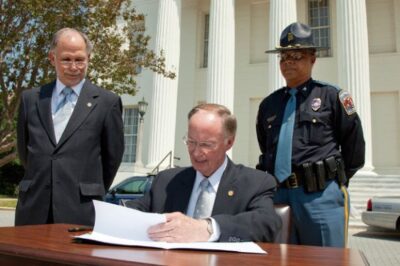
Alabama Governor Signs Bill That Makes State’s Immigration Law Even Worse
Last week, Alabama Governor Robert Bentley publically criticized a bill intended to revise key sections of the state’s controversial immigration law (HB 56). He even announced a special legislative session to address his issues with the bill—namely, a provision that requires school officials to check the immigration status of enrolling students and that of their parents and a provision that requires Alabama’s Department of Homeland Security to publically post the names of undocumented immigrants on their website. The day after his announcement, however, Governor Bentley backpedaled his criticisms, declared the legislature didn’t have the “appetite to address further revisions,” and signed the bill (HB 658) into law. Read More

Alabama Governor Rejects Changes to State’s Extreme Immigration Law, Starts Special Legislative Session
Today, Alabama Governor Robert Bentley announced his disapproval of a bill intended to change parts of the state’s extreme immigration law (HB 56) and initiated a special legislative session to address the problems. Yesterday, on the last day of the state’s regular legislative session, the Alabama Senate… Read More

Justice Department Says Alabama Immigration Law Disrupts Access to Public Education
While eyes remain fixed on the Alabama legislature’s effort to revise their immigration enforcement law, HB 56, the U.S. Department of Justice informed state officials in a letter last week that the state’s immigration law has resulted in significantly higher absence rates among Latino students. According to the letter, more than 13 percent of Latino schoolchildren in Alabama withdrew from classes between the start of the school year and February 2012. While the Department’s investigation is still ongoing, the letter said Alabama could lose federal funding and face additional litigation if it fails to revoke a provision of HB 56 that requires administrators to determine the immigration status of newly enrolling students. Read More
Changes to Alabama’s Extreme Immigration Law Not Enough, Critics Say
Following numerous protests, lawsuits, damaging economic reports and problems enforcing the law, Alabama Rep. Micky Hammon of Decatur proposed a bill (HB 658) that tweaks key provisions of the state’s immigration enforcement law, HB 56. Last week, the Alabama House approved those changes, some of which scaled back provisions of the law and others which actaully expanded existing provisions. While Rep. Hammon claims the tweak bill “removes confusing language and makes the law easier to enforce,” opponents assert that no amount of tweaking can fix this broken law and that the only solution is a full repeal. HB 658 is now pending in the state Senate which is expected to take up the bill this week. Read More

Study Shows Self-Deportation is Irrational Behavior and a False Premise
Proponents of “attrition through enforcement” would have you believe that, given the right conditions, unauthorized immigrants will choose to leave the U.S. and return to their home countries. The Myth of Self Deportation, by Alexandra Filindra, questions the assumptions behind the attrition strategy and concludes that self-deportation is not rational because unauthorized immigrants have invested too much in the U.S. to return home. Read More

SB1070 Author Shares Fears About America Becoming a “Minority, Majority” Nation
On the same day the Supreme Court heard oral arguments in Arizona v. United States the Washington Post published an article featuring Michael Hethmon, general counsel for the Immigration Reform Law Institute. Hethmon is the lesser-known legal mind behind SB1070, and a variety of other anti-immigrant measures. His legal counterpart, Kris Kobach tends to get the spotlight; however Hethmon didn’t shy away from the Washington Post this week and was frank about his views on the real issues underlying SB1070. Read More

Nebraska Upholds Bill that Provides Prenatal Care to Undocumented Women
In a move that brought together an unusual group of allies, Nebraska’s Republican-controlled legislature recently upheld a bill that allows undocumented pregnant women to access state-funded prenatal care, overriding a veto by Republican Governor Dave Heineman. Nebraska Right to Life, Nebraska Catholic Conference, Planned Parenthood, and Nebraska Appleseed actually came together to support LB599, a bill the governor worked hard to kill. Why would Gov. Heineman, a man who describes himself as the one of the most pro life governors in America, oppose a bill that helps protect unborn children? Because, as the New York Times put it, he believes “government-financed health care for poor women is an acceptable thing, unless the women were in violation of immigration laws, in which case it was a terrible waste of taxpayer dollars.” Read More
America's story is an immigrant story.