Interior Enforcement
Mandatory E-Verify is Not All It’s Cracked Up to Be
Today, the House Immigration Subcommittee held a hearing on the E-Verify system, a tool to help employers electronically verify that their employees have permission to work in the United States. Although E-Verify remains largely voluntary—except for federal contractors, employers in certain states that have made it mandatory, and a few other exceptions—some members of Congress and immigration restrictionists have decided that expanding E-Verify and making it mandatory will flush unauthorized workers out of the workforce, create jobs for unemployed U.S. citizens, and resolve our immigration problems. While everyone agrees that high unemployment levels must be addressed, simplistic measures like mandating E-Verify are not going to open up jobs for millions of unemployed workers. Read More
Mandatory E-Verify without Legalization Would Hamper Economic Recovery and Cost U.S. Workers Jobs
Since 1986, controlling illegal immigration by regulating who is entitled to work in the United States has been a key component of U.S. immigration policy. The ritual of showing proof of one’s identity and work authorization and filling out an I-9 form is part of every new hire’s paperwork haze. Read More
E-Verify: Burdens Businesses and Displaces U.S. Workers
Washington D.C. – Today, the House Immigration Subcommittee held its second hearing of the new session. Ironically, the hearing was titled “E-Verify – Preserving Jobs for American Workers.” Some members of Congress persist in their belief that expanding E-Verify and making it mandatory is a magic-bullet solution to our immigration… Read More
Deeper into the Shadows
Before the onset of the Great Recession, immigrant labor was cited as a boom to the U.S. economy. In towns and cities across the country, immigrant labor—documented or otherwise—filled positions in growing businesses and industries where demand outpaced the supply of native-born workers. Since the onset of the economic downturn in 2008 and the rise in U.S. unemployment, some analysts and politicians—looking for a convenient scapegoat—have turned on that immigrant workforce and their employers, arguing that deporting eight million undocumented immigrant workers will create eight million new jobs for the native-born. This over-simplified equation ignores the complicated and inter-dependent roles that immigrants play in our economy. A 2010 study by the Fiscal Policy Institute on the economic contributions of immigrants in the 25 largest metropolitan areas in the United States makes the point well: The results were clear: immigrants contribute to the economy in direct relation to their share of the population. In the 25 largest metropolitan areas combined, immigrants make up 20 percent of the population and are responsible for 20 percent of economic output. Together, these metro areas comprise 42 percent of the total population of the country, 66 percent of all immigrants, and half of the country’s total Gross Domestic Product. Read More
Study Shows 287(g) Program Fails to Prioritize Serious Criminals
This week the Migration Policy Institute released a new study on ICE’s 287(g) program, Delegation and Divergence: A Study of 287(g) State and Local Immigration Enforcement. The study, which assesses the implementation, enforcement outcomes, costs, community impacts of the program generally, and provides an in-depth study in seven jurisdictions: Cobb County, GA; Frederick County, MD; Gwinnett County, GA; Los Angeles County, CA; Prince William County, VA; Las Vegas, NV; and the state of Colorado, found that 287(g) program is not living up to its promise. In fact, the study finds that ICE’s allows jurisdictions to “operate the 287(g) program in fundamentally different ways across the country.” Read More
After the Raid is Over: Marshalltown, Iowa and the Consequences of Worksite Enforcement Raids
For many years, large-scale worksite raids constituted a major element of federal immigration enforcement. While the large-scale and well-publicized worksite raids have tapered, immigration enforcement has continued to increase, and the number of deportations and detentions is at an all-time high. The ever-expanding arsenal of ICE enforcement policies, together with harsh state and local laws and policies, have harmful side effects that go far beyond the unauthorized population. Policies meant to target unauthorized immigrants also impact their family members, employers, and neighbors. A large number of the people affected are U.S.-citizen children. Latinos, Asians, and others who “sound” or “appear” to be foreign may be the victims of mistakes (such as the U.S. citizens who have been mistakenly deported), or may experience civil rights violations, discrimination, or profiling. In states and localities with anti-immigrant laws and policies, negative attitudes towards immigrants and nasty rhetoric might be enough to cause lawfully present people to leave. Read More

How Expanding E-Verify Hurts the Economy and American Workers
By Tyler Moran, National Immigration law Center. The Government Accountability Office (GAO) recently released a report, Employment Verification: Federal Agencies Have Taken Steps to Improve E-Verify, but Significant Challenges Remain. GAO’s verdict on E-Verify (a program to verify the employment eligibility of new hires) is in: this program is not yet ready for prime time. According to GAO, risks posed by mandatory E-Verify range from encouraging employers to skirt the rules to job losses for native born and immigrant work-authorized people alike. Policymakers who want to roll out this flawed program as quickly as possible should heed the report’s warning that “significant challenges remain” with E-Verify. Read More
A Framework for Effective Immigration Worksite Employer Enforcement
Immigration enforcement is an extremely important national priority. Effective control of our nation’s borders is essential to our national security. The regulation and control of those who enter the country, along with the prosecution of those who violate immigration laws once they are here, is fundamental to our integrity as a nation of laws. Read More
Win, Lose or….Draw? The Supreme Court Tackles Arizona’s Employer Sanctions Law
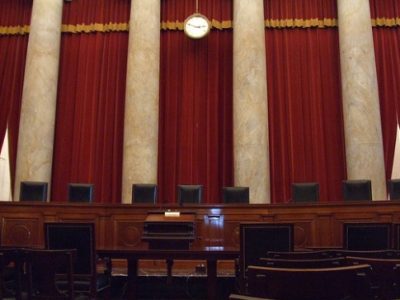
Those following the Obama Administration’s legal challenge to Arizona’s SB 1070 have likely heard about “preemption”—the legal concept governing when state laws conflict with, and are therefore superseded by, acts of Congress. The heart of the dispute over SB 1070 is whether states have a right to provide assistance that the federal government does not want. No one knows if or how the Supreme Court will ultimately answer that question. But a number of hints may emerge when the Justices issue a ruling in Chamber of Commerce v. Whiting, a case testing the legality of a different law known as the Legal Arizona Workers Act. Passed in 2007, the act imposed new requirements to prevent employers from hiring unauthorized workers, as well as harsh consequences for doing so. While the Justices’ questions during Wednesday’s oral argument offered reason for hope among immigrants’ rights advocates on one part of the law, they left the fate of the other unresolved. Read More
Reading the Morton Memo: Federal Priorities and Prosecutorial Discretion
On June 30, 2010, the Deputy Assistant Secretary for Immigration and Customs Enforcement (ICE), John Morton, issued a memo to the agency that reflected the Obama administration’s oft repeated intent to focus removal efforts on serious offenders. Morton noted: In light of the large number of administrative violations the agency is charged with addressing and the limited enforcement resources the agency has available, ICE must prioritize the use of its enforcement personnel, detention space, and removal resources to ensure that the removals the agency does conduct promote the agency's highest enforcement priorities, namely national security, public safety, and border security. Coupled with last year’s announcement that ICE would not engage in the kind of major worksite raids that became common during the Bush administration, the “Morton Memo” potentially marks a new phase in the enforcement of immigration law. Moreover, the memo gives us insight into the Obama administration’s approach to prosecutorial discretion in immigration enforcement. Read More
America's story is an immigrant story.