Integration

DNC Live: National Hispanic Leadership Agenda
Yesterday the National Hispanic Leadership Agenda (NHLA)--a nonpartisan association of Hispanic organizations and leaders--announced a bold new policy agenda at the DNC, calling upon elected officials, candidates, political parties, the media and the general public to consider and adopt the NHLA platform. The Hispanic Policy Agenda addresses prime policy issues facing Hispanics in six main issue areas: Education Civil rights Immigration Economic Empowerment Health Government Accountability NHLA Chair and President of the Mexican American Legal Defense Fund (MALDEF), John Trasvina, began by introducing the purpose of the National Hispanic Leadership Agenda as being the establishment of a set of principles and priorities that the candidates need to adopt if they want to gain the support of the Latinos. "We need to make sure that the truth is spoken about immigration and the needs of the Latino community and we don't let others define what we are," said Trasvina. Read More
DNC Live: Janet Murguia Concludes NDN Immigration Forum
Janet Murguia, CEO of President of National Council of La Raza was the final speaker at NDN's Immigration Reform and the Next Administration forum event at the DNC. Murguia wanted to add another dimension to the conversation by pointing out that as a Latina, she and her fellow Latinos care about a lot of issues--yet immigration is the single issue that crosses across the community and is mobilizing Latinos across the country. Read More

Olympic Win Highlights Immigration Challenges
On Tuesday night, Henry Cejudo nabbed an Olympic gold medal for the U.S. and realized the dream that his mother, Nelly Rico, carried with her as she crossed the border from Mexico over twenty years ago. Rico—an undocumented immigrant—encouraged her children to work hard and aim high. Now her son is an American hero and the youngest American wrestler to win a gold in the Olympics. Read More
Immigrants Integrate as Census Predicts Minority Boom
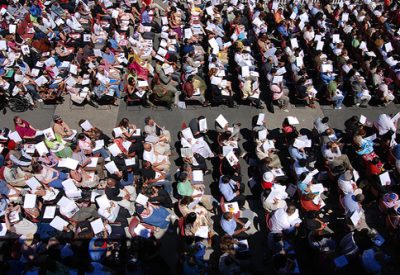
Over five hundred immigrants gathered on July 4, 2007 to take the oath of citizenship. Last week the US Census Bureau projected that minorities will grow to become a majority by the year 2042. A recent New York Times article pointed out that the main reason for the accelerating change is significantly higher birthrates among immigrants. While some fear that demographic shifts threaten American identity, research and experience has shown that today’s immigrants integrate into American society just as generations of immigrants before them. Immigrants are learning English, buying property, intermarrying, becoming U.S. citizens, and otherwise weaving themselves into the fabric of this nation. Read More
Extremists Hijack Immigration Debate: Increased Reports of Hate Crimes and Discrimination Aimed at U.S.- and Foreign-Born Latinos
Information and examples on how the immigration debate has spurred discrimination, hate, and violence. Read More
Thinking Ahead About Our Immigrant Future: New Trends and Mutual Benefits in Our Aging Society
By Dowell Myers, Ph.D. There are two stories now being told about immigration and the future of America. Each has some basis in fact, although one is based on newer trends and is more optimistic than the other. These stories differ in their answers to three crucial questions: whether immigration to the United States is accelerating out of control or is slowing; how much immigrants are assimilating into American society and progressing economically over time; and how important immigrants are to the U.S. economy. The pessimistic story—in which immigration is portrayed as increasing dramatically and producing a growing population of unassimilated foreigners—draws upon older evidence. But more recent data and analysis suggest a far more positive vision of our immigrant future. Immigration has not only begun to level off, but immigrants are climbing the socio-economic ladder, and will become increasingly important to the U.S. economy as workers, taxpayers, and homebuyers supporting the aging Baby Boom generation. Read More
From Newcomers to Americans: An Integration Policy for a Nation of Immigrants
By Tomás R. Jiménez, Ph.D. The United States long has been a nation of immigrants, but its policies are out of step with this reality. Public policies with regard to the foreign-born must go beyond regulating who is admitted and under what circumstances. The nation needs an immigrant-integration policy that effectively addresses the challenges and harnesses the opportunities created by today’s large immigrant population. It is not in the best interests of the United States to make integration a more difficult, uncertain, or lengthy process than it need be. Facilitating the successful and rapid integration of immigrants into U.S. society minimizes conflicts and tensions between newcomers and the native-born, and enables immigrants to more quickly secure better jobs, earn higher incomes, and thus more fully contribute to the U.S. economy. Read More
Serving the Under-Served: Banking for Undocumented Immigrants
In recent years, there has been a great deal of controversy over the efforts of some banks to offer financial services to individuals without Social Security numbers, many of whom are undocumented immigrants. More and more banks now allow people to open checking and savings accounts and to apply for credit cards and home mortgages using an Individual Taxpayer Identification Number (ITIN) issued by the Internal Revenue Service (IRS) or an identification card issued by a foreign consulate in the United States. In February of 2007, for instance, Bank of America announced a pilot program in Los Angeles offering credit cards to individuals who lack either a social security number or a credit history, provided that they have ITINs. Read More
Unequal Access: Immigrants and U.S. Health Care
By Sarita A. Mohanty, M.D., M.P.H.Despite the important role that immigrants play in the U.S. economy, they disproportionately lack health insurance and receive fewer health services than native-born Americans. Some policymakers have called for limits on immigrants’ access to health insurance, particularly Medicaid, which are even more stringent than those already in place. However, policies that restrict immigrants’ access to some health care services lead to the inefficient and costly use of other services (such as emergency room care) and negatively impact public health. The future economic success of the United States depends on a healthy workforce. Therefore, policies must be devised that improve, rather than restrict, immigrants’ access to quality health care. Read More
Diversity and Transformation: African Americans and African Immigration to the United States
Successive generations of African immigration have continuously transformed the African American community and the sociopolitical climate of the United States. Read More
America's story is an immigrant story.