Immigration Enforcement
Featured Content

Restoring Credibility and Humanity
- Interior Enforcement
- May 12, 2026
A new framework for U.S. immigration enforcement that prioritizes public safety, fairness, accountability, and humane, proportionate consequences. Read More
Read More

New Reports Expose Subculture of Cruelty Within the U.S. Border Patrol
There is a subculture of cruelty within the Border Patrol—and, more broadly, within the entire machinery of the U.S. deportation regime. From the ranks of frontline Border Patrol agents to the guards in private, for-profit detention facilities, the abuse of detainees is widely tolerated and even accepted. This is the central finding to emerge from the second wave of the Migrant Border Crossing Study (MBCS). Wave II of the MBCS is currently housed in the Center for Latin American Studies at the University of Arizona and the Department of Sociology at George Washington University. The survey is a study of 1,110 randomly selected, recently repatriated migrants who were surveyed in six Mexican cities between 2009 and 2012. The results of this study are being released in a series of three reports titled Bordering on Criminal: The Routine Abuse of Migrants in the Removal System. Read More
Bordering on Criminal: The Routine Abuse of Migrants in the Removal System
This two-part series highlights the findings of the Migrant Border Crossing Study—a binational, multi-institution study of 1,110 randomly selected, recently repatriated migrants surveyed in six Mexican cities between 2009 and 2012. The study exposes widespread mistreatment of migrants at the hands of U.S. officials in the removal system. Part I: Migrant Mistreatment While in U.S. Custody This report focuses on the mistreatment of unauthorized migrants while in U.S. custody. Overall, we find that the physical and verbal mistreatment of migrants is not a random, sporadic occurrence but, rather, a systematic practice. One indication of this is that 11% of deportees report some form of physical abuse and 23% report verbal mistreatment while in U.S. custody—a finding that is supported by other academic studies and reports from non-governmental organizations. Another highly disturbing finding is that migrants often note they are the targets for nationalistic and racist remarks—something that in no way is integral to U.S. officials’ ability to function in an effective capacity on a day-to-day basis. Read More

As Congress Looks to Next Year, Activists Keep Immigration Reform Alive
Congress takes a holiday break at the end of this week and won’t return from recess until January. This pause in the legislative calendar, however, has little meaning for immigration activists who are continuing to push Congress to act on immigration reform. While the timetable may be changing, the… Read More
From the Mouths of Babes: Children Demand Immigration Reform
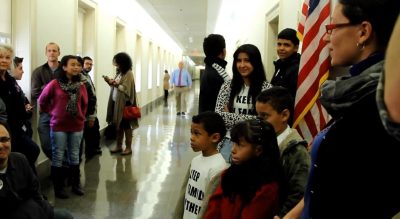
Families across the U.S. are facing the holidays separated from mothers, fathers, and siblings due to deportations and years-long waits for visas. Children—some of whose parents are undocumented immigrants—have taken to the halls of Congress this week to go to congressional offices, meet with members, and ask them to support immigration reform so that their families won’t be separated. Read More

Local Officials Improve Immigration Enforcement Policies as Congress Fails to Act
The county council in King County, Washington, decided this week that local law enforcement officials will stop honoring federal immigration agents’ requests to detain immigrants who are arrested for low-level crimes. They voted 5-4 for the new policy on Monday, and supporters hope the change “will build trust between local police and immigrants who don’t report crimes for fear they or a family member will be deported,” according to the Seattle Times. Read More

The Punishment Should Fit the Crime for Immigrants, Too
The punishment should fit the crime. That maxim is as old as law itself, dating at least as far back as the Old Testament and Hammurabi’s Code. It’s firmly rooted in our Constitution’s Due Process Clause and the Eighth Amendment’s prohibition against excessive fines and cruel and unusual punishment. That principle—referred to as proportionality—appears in both our criminal and civil law. It forbids, for example, the imposition of a life sentence for passing a bad check. It means that the state cannot sentence juveniles for non-homicide crimes to life without parole. And it disallows extreme punitive damages awards. So what does proportionality have to say when the government tries to deport a lawful permanent resident who, a decade ago, shoplifted $200 worth of merchandise from a department store? Right now, astonishingly, nothing: immigration judges do not even consider whether a person’s banishment from the United States is a disproportionate punishment for a crime before ordering the person’s removal. But advocates are working to change this. Read More

‘Fast 4 Families’ Moves to Next Phase as New Fasters Take the Mantle
On the National Mall today, the four core fasters leading the “Fast 4 Families” ordained new fasters and ended their 22-day, water-only fast. Members of Congress, the faith community and civil and immigrant rights groups turned out to witness the four fasters passing the baton over to others who will continue the fast until House Speaker John Boehner schedules a vote on immigration reform. Read More

Will New USCIS Memos Confuse House Judiciary Committee Again?
One of the significant lessons of 2013 is that good immigration policy matters to the American public. It’s unfortunate, then, that the House Judiciary Committee is choosing to end its year focusing not on immigration reform, but on how best to take the President to task for making use of executive authority. Read More

Keeping CBP In Line With Proposed Reforms
In May 2010, Congress submitted a request to the Department of Homeland Security (DHS) for a review of U.S. Customs and Border Protection’s (CBP) policy on the use of force by border patrol agents. Drawing on recommendations from a hard-hitting report by DHS’s Office of Inspector General, as well as an internal review and an independent evaluation by the Police Executive Research Forum (PERF), CBP announced compliance with a handful of proposed reforms to its use of force policy. Read More
Report: ICE Officers Fail to Report Some Sex Abuse Claims
Immigration and Customs Enforcement (ICE) officers failed to report numerous allegations of sexual abuse over the last four years, according to a recent report from the Government Accountability Office (GAO). Between October 2009 to March 2013, ICE headquarters received reports of 215 allegations of sexual abuse and assault, but a GAO audit of 10 of those facilities found an additional 28 allegations—40 percent more than the 70 allegations reported by these facilities. Read More
America's story is an immigrant story.