Employment and Wages
Mandatory E-Verify is Not All It’s Cracked Up to Be
Today, the House Immigration Subcommittee held a hearing on the E-Verify system, a tool to help employers electronically verify that their employees have permission to work in the United States. Although E-Verify remains largely voluntary—except for federal contractors, employers in certain states that have made it mandatory, and a few other exceptions—some members of Congress and immigration restrictionists have decided that expanding E-Verify and making it mandatory will flush unauthorized workers out of the workforce, create jobs for unemployed U.S. citizens, and resolve our immigration problems. While everyone agrees that high unemployment levels must be addressed, simplistic measures like mandating E-Verify are not going to open up jobs for millions of unemployed workers. Read More
How Reuters, Northeastern University Stifle Immigration Debate by Suppressing Labor Analysis
On January 20, Reuters published a news article with the following headline: “Exclusive: Over a Million Immigrants land U.S. jobs in 2008-10.” The article, which reported on data exclusively provided to Reuters by the Center for Labor Market Studies (CLMS) at Northeastern University in Boston, appeared just a few days before the House Immigration Subcommittee held its first hearing of the new Congress criticizing the Obama Administration on worksite enforcement. The article was also quoted in testimony by Mark Kirkorian of the Center for Immigration Studies as proof that the native-born are losing out to immigrants in the work force. The CLMS “study,” however, which supports the flawed restrictionist theory that America can deport its way out of unemployment, actually backfired during the hearing. Read More
How Reuters, Northeastern University Stifle Immigration Debate by Suppressing Labor Analysis
On January 20, Reuters published a news article with the following headline: “Exclusive: Over a Million Immigrants land U.S. jobs in 2008-10.” The article, which reported on data exclusively provided to Reuters by the Center for Labor Market Studies (CLMS) at Northeastern University in Boston, appeared just a few days before the House Immigration Subcommittee held its first hearing of the new Congress criticizing the Obama Administration on worksite enforcement. The article was also quoted in testimony by Mark Kirkorian of the Center for Immigration Studies as proof that the native-born are losing out to immigrants in the work force. The CLMS “study,” however, which supports the flawed restrictionist theory that America can deport its way out of unemployment, actually backfired during the hearing. Read More

How Expanding E-Verify Hurts the Economy and American Workers
By Tyler Moran, National Immigration law Center. The Government Accountability Office (GAO) recently released a report, Employment Verification: Federal Agencies Have Taken Steps to Improve E-Verify, but Significant Challenges Remain. GAO’s verdict on E-Verify (a program to verify the employment eligibility of new hires) is in: this program is not yet ready for prime time. According to GAO, risks posed by mandatory E-Verify range from encouraging employers to skirt the rules to job losses for native born and immigrant work-authorized people alike. Policymakers who want to roll out this flawed program as quickly as possible should heed the report’s warning that “significant challenges remain” with E-Verify. Read More
New Study Finds Low-Skilled Immigration Has Negligible Impact on Wages of Native-Born
Earlier today, Public Policy Professor at Georgetown University Harry J. Holzer presented his new report, Does Low-Skilled Immigration Hurt the US Economy? Assessing the Evidence. Contrary to the myth that “immigrants steal American jobs,” Prof. Holzer concludes that low-skilled immigration likely has little to no effect on most U.S. workers, though changes in immigration policy would obviously alter the effect. While admitting that wage depression is an issue for low-skilled native-born workers, Holzer insisted that immigration contributed very little, if at all, to this effect, and that “we’ve been scapegoating [low-skilled] immigrants for little reason.” Read More
Win, Lose or….Draw? The Supreme Court Tackles Arizona’s Employer Sanctions Law
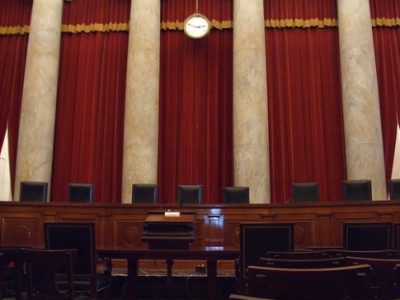
Those following the Obama Administration’s legal challenge to Arizona’s SB 1070 have likely heard about “preemption”—the legal concept governing when state laws conflict with, and are therefore superseded by, acts of Congress. The heart of the dispute over SB 1070 is whether states have a right to provide assistance that the federal government does not want. No one knows if or how the Supreme Court will ultimately answer that question. But a number of hints may emerge when the Justices issue a ruling in Chamber of Commerce v. Whiting, a case testing the legality of a different law known as the Legal Arizona Workers Act. Passed in 2007, the act imposed new requirements to prevent employers from hiring unauthorized workers, as well as harsh consequences for doing so. While the Justices’ questions during Wednesday’s oral argument offered reason for hope among immigrants’ rights advocates on one part of the law, they left the fate of the other unresolved. Read More
New Report Describes Peril Immigrant Women Face in U.S. Food Industry
The Southern Poverty Law Center (SPLC) released a new report called Injustice on our Plates: Immigrant Women in the U.S. Food Industry which looks at the conditions under which immigrant women work. It documents and personalizes the stories of women who have made the dangerous journey to the U.S. seeking a better life for themselves and their families, only to end up working long hours under extremely difficult and dangerous conditions. Read More
Experts Highlight Economic Gains from Immigration
At a forum held yesterday by the Hamilton Project of the Brookings Institution, a panel of experts sought to “distinguish economic reality from myth” in the often fact-free and emotion-laden debate over how immigration affects the U.S. economy and U.S. workers. The forum, entitled “Crossing Borders: From Myth to Sound Immigration Policy”—as well as an accompanying report, Ten Economic Facts About Immigration—served to refute the shrill and empirically baseless claims of nativist groups that immigrants are stealing jobs from Americans while draining the public treasury. Read More
Congressional Committee Attempts to Tackle AgJOBS, Again
Last week, the House Immigration Subcommittee held a hearing on immigration and farm labor. The substance of the hearing is likely to be eclipsed by the presence of Comedy Central’s Stephen Colbert, who testified about his participation in United Farm Workers’ (UFW) “Take Our Jobs” campaign. While Colbert's presence insured that it wasn’t your ordinary committee hearing, in many ways this hearing was simply more of the same rhetoric which demonstrated Congress’s inability to get beyond partisan sniping and sound bites and pass any type of immigration reform. Read More
New Census Data Underscores Growing Entrepreneurial Power of Latinos
New data released this week by the U.S. Census Bureau highlights the rapidly growing economic power of Latino-owned businesses in the United States. According to the Bureau’s 2007 Survey of Business Owners, there were 2.3 million Latino-owned businesses in the country as of 2007, which generated $345.2 billion in sales and employed 1.9 million people. Moreover, the number of Latino-owned businesses grew by 43.7 percent between 2002 and 2007, which was more than twice the national average. In other words, the Latino community tends to be highly entrepreneurial, and the businesses which Latinos create sustain large numbers of jobs. Read More
America's story is an immigrant story.