Due Process and the Courts
What does the constitution say about due process?
The Fifth Amendment to the Constitution says clearly that no person shall be deprived of life, liberty, or property without the due process of law. Note that this says person, not citizen, and over the years the Supreme Court has consistently ruled that the Due Process Clause applies to all people in the United States.Do non-citizens have the right to due process in the U.S.?
Yes. The Constitution guarantees due process rights to all "persons," not just citizens. This means non-citizens, including undocumented immigrants, are entitled to fair treatment under the law. This includes the right to defend themselves in court. But recent Trump administration policies that speed up deportations and limit access to legal representation make it harder for non-citizens to get their fair day in court.- Access to legal representation Access to legal counsel is an essential part of our justice system and our democracy. In the criminal justice system, anyone facing even one day in jail gets a lawyer if they can't afford one. But immigrants facing deportation usually don't get that chance.The research is clear – the most effective way to ensure some level of due process for people navigating our complicated immigration system is for them to have trained attorney at their side.But Trump administration is now working to strip attorneys from as many people as possible, all in the name of increasing its deportation numbers. This attempt to eliminate basic due process will hurt people who already have few options.
- Fair day in court Due process guarantees that individuals have the opportunity to defend themselves in court. This includes non-citizens facing deportation.
Why is due process important?
We are seeing right now the importance of due process when it comes to President Trump's actions to carry out the so-called Alien Enemies Act, a 1798 wartime law that permits people to be deported outside of the normal framework of immigration law. President Trump has alleged that this law allows him to simply point at any person, declare them to be an alien enemy, and kick them out of the country without ever having a chance to see a judge. Thankfully, the Supreme Court said that is not true, and in a unanimous decision, ruled that people can challenge the Trump administration's invocation of the Alien Enemies Act. That is why due process is so important, because it means that no person can be rounded up and sent to another country without a chance to go to court and make the government prove their case.How is the American Immigration Council working to protect due process?
- We serve thousands of individuals in immigration detention centers through the Immigration Justice Campaign, our initiative with the American Immigration Lawyers Association. The Justice Campaign provides free legal services for immigrants who would otherwise have to navigate our complicated immigration system without a lawyer.
- We use the courts to demand a fair process for immigrants. Our litigation team is fighting back against the Trump administration’s blatant disregard for due process including filing a lawsuit challenging their illegal detention of immigrants in El Salvador’s notorious Terrorism Confinement Center (CECOT).
Providing Noncitizens With Their Day in Court
Our legal system rests upon the principle that everyone is entitled to due process of law and a meaningful opportunity to be heard. But for far too long, immigration courts have failed to provide noncitizens with a system of justice that lives up to this standard. A noncitizen has not truly had his day in court if he is removed without ever seeing a judge, if he does not have access to counsel and necessary evidence, or if the decision in his case receives only perfunctory review. The 2013 Border Security, Economic Opportunity, and Immigration Modernization Act (“S. 744”) would take significant steps toward ensuring noncitizens have a fair hearing. This fact sheet explains some of the critical policy proposals found in S. 744 and the basis for them. A system without sufficient protections Deportation without a judge In the current system, many immigrants who are removed never see the inside of a courtroom. In fact, the majority of noncitizens are returned to their home countries through accelerated processes that do not include a hearing before a judge. Even immigrants who are entitled to hearings may not make it to court if an immigration agent convinces them to agree to be deported before their first hearing. More than 160,000 immigrants agreed to these “stipulated removal” orders between 2004 and 2010; the vast majority were unrepresented and in immigration detention. Those whose cases reach immigration court appear before overburdened judges with insufficient time and resources for the cases in front of them. Vulnerable immigrants without attorneys Read More
Moncrieffe v. Holder: Implications for Drug Charges and Other Categorical Approach Issues
Washington, D.C.—Last week, the Supreme Court issued a decision in Moncrieffe v. Holder, holding that a state drug conviction is not an aggravated felony when the statute of conviction extends to the social sharing of a small amount of marijuana. The case has important implications not only… Read More
Eleventh Circuit Holds that Filing Limitations on Motions to Reopen Are Subject to Equitable Tolling
For Immediate Release Washington, D.C. – Over the last two weeks, the Eleventh Circuit issued two decisions holding that the time and numerical limitations on motions to reopen are subject to equitable tolling. Noncitizens ordered removed in the Eleventh Circuit now may seek, under certain circumstances, to reopen… Read More
Court Says ICE Failed to Satisfy FOIA Requirements in Council’s Suit to Compel Disclosure of Records on Access to Counsel
Court Says ICE Failed to Satisfy FOIA Requirements in Council’s Suit to CompelDisclosure of Records on Access to Counsel A federal district court recently issued an opinion addressing U.S. Immigration and Customs Enforcement’s (ICE) failure to comply with its obligations under the Freedom of Information Act (FOIA). Read More
Immigration Reform is an LGBT Issue
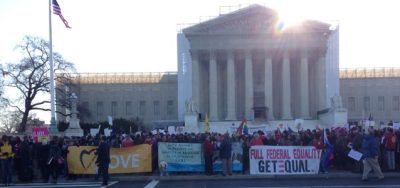
By Victoria Neilson, Legal Director, Immigration Equality. This week the U.S. Supreme Court is hearing oral arguments in two cases, Hollingsworth v. Perry and United States v. Windsor, that will forever change the course of the struggle for lesbian, gay, bisexual, and transgender (LGBT) equality. While we are hopeful that the Court will strike down the Defense of Marriage Act (DOMA) thereby clearing the way for the federal government, including U.S. Citizenship and Immigration Services and the Department of State, to honor our marriages, no one can predict with any certainty what the Court will do. Read More

How the Supreme Court Decision on DOMA Will Impact Immigration Law
Family unity is one of the driving forces in our immigration system. United States citizens and lawful permanent residents can obtain immigrant visas for their spouses. Many foreign nationals who come to the United States on employment-based visas bring their spouses and children with them. And some waivers and forms of relief from removal are available only to those with close relatives living in the United States. Read More

Hearing and Report Highlight Lack of Due Process in Immigration System
This week, Senator Christopher Coons of Delaware presided over a public hearing to discuss what so many of us know: the immigration courts are failing to provide a fair, efficient, and effective system of justice. Many of the concerns raised by Senator Coons, as well as some of the witnesses, during Wednesday’s Senate Judiciary Committee hearing, “Building an Immigration System Worthy of American Values,” are discussed in more detail in a report issued by the American Immigration Council this week, Two Systems of Justice: How the Immigration System Falls Short of the Ideals of Justice. Read More

Two Systems of Justice: How the Immigration System Falls Short of American Ideals of Justice
There is a growing consensus that our immigration system must be updated. Severe visa backlogs hurt U.S. businesses, undocumented workers are frequently exploited, and record levels of deportations tear families apart. While much energy is now focused on addressing these problems, one issue that is frequently overlooked is the structure and quality of justice accorded immigrants who are caught in the enforcement net. In reforming our immigration system, we must not forget that the immigration removal system—from arrest to hearing to deportation and beyond—does not reflect American values of due process and fundamental fairness. The failure to provide a fair process to those facing expulsion from the United States is all the more disturbing given the increasing “criminalization” of the immigration enforcement system. Although immigration law is formally termed “civil,” Congress has progressively expanded the number of crimes that may render an individual deportable, and immigration law violations often lead to criminal prosecutions. Further, local police now play an increasingly active role in immigration enforcement. Consequently, even relatively minor offenses can result in a person being detained in immigration custody and deported, often with no hope of ever returning to the United States. This special report is a product of the Immigration Policy Center and the Legal Action Center of the American Immigration Council. It lays out the the incongruency of America's criminal justice system and its immigration justice system, and provides recommendations for how these problems could be fixed. Read the report here. Read the policy recommendations here. Read More

Budget Cuts Led ICE To Release Immigrants From Detention
Along with every other government agency, on March 1, U.S. Immigration and Customs Enforcement (ICE) officials had to begin making mandatory cuts to their budget as a result of sequestration. ICE’s choice to shift some of its detainees from expensive detention facilities to non-detention alternatives was questioned yesterday by Members of Congress, but more importantly the decision demonstrates that alternatives to detention are a feasible choice—regardless of sequestration. Read More

Including LGBT Immigrants in Immigration Reform Helps Protect Vulnerable Individuals
Roughly 11 million unauthorized immigrants live in the United States, and their backgrounds and stories are incredibly diverse. DREAM activists helped to change the picture of the 11 million by shining light on young people affected by our broken immigration system, while grassroots movements are highlighting the stories of families. But a new report from the Williams Institute adds another facet to this picture: an estimated 267,000 undocumented adults identify as LGBT. Even more compelling, the report highlights the other struggles LGBT individuals face when dealing with the legal immigration system. Read More
America's story is an immigrant story.