Business and the Workforce
Immigrants not only bring diverse skills and perspectives to the U.S. workforce, they often fill employment gaps in crucial fields. We advocate for expanded work visas and related programs so our labor force can continue to benefit from immigrant workers and remain competitive in the global economy
House Bill Would Expand Work Visa Program to Include Foreign Entrepreneurs
The Star-Ledger July 31, 2012 More startup competition could be setting up shop next door if a bill introduced in the House makes visas available to foreign entrepreneurs who start businesses here. U.S. House Judiciary Committee Chairman John Conyers (D-Mich.) and Rep. Jason Chaffetz (R-Utah) on Thursday introduced the… Read More
Absurd U.S. Immigration Policies Amount To Economy Sapping Talent Drain
Forbes July 30, 2012 Global demand for advanced degree holders, combined with U.S. immigration policies, is causing America to lose some of the world’s brightest minds. After funding their studies and awarding them degrees, America forces some 50,000 highly educated foreign-born workers out of the country each year. This… Read More
Opinion: Why New York Still Welcomes Immigrants
The Wall Street Journal July 27, 2012 Many states across the U.S. have passed restrictive immigration measures in recent years. But New York under Gov. Andrew Cuomo is bucking the trend. “We are a state of immigrants,” he declared in his 2012 State of the State address. “While other… Read More
Patent Pending: How Immigrants Are Reinventing The American Economy
This report, “Patent Pending: How Immigrants Are Reinventing The American Economy” examines the contribution of foreign-born inventors to the American economy. From more efficient ways to purify seawater to metals that can be molded like plastic, the report highlights several immigrant inventors behind some of the most cutting-edge technologies. Read More
Report: Not Coming To America
Our new report, “Not Coming to America: Why the US is Falling Behind in the Global Race for Talent” is a first-ever comparative study of the immigration reforms other countries employ to boost their economies and lure the high and low-skilled workers needed for continued economic growth. The report… Read More
Immigrant Workers in the U.S. Labor Force
The Brookings Institution and New American Economy published “Immigrant Workers in the U.S. Labor Force,” a study analyzing the differences in both the occupations and education levels of immigrant and native-born workers in the American economy and found that even when working the same sectors, immigrants and native-born gravitate… Read More

The Politics of Skill: Rethinking the Value of “Low-Skilled” Immigrant Workers
The political discourse surrounding the incorporation of immigrants into the U.S. labor market tends to sort immigrant workers into two broad and mutually exclusive categories: high-skilled workers who are valued by many for their contribution to economic growth, and low-skilled workers who are viewed by some as causing a glut in the U.S. labor market and thereby displacing low and middle-income native-born workers. For the most part, these categories are structured around formal education. Workers possessing a level of formal education equal or superior to the median in the United States are on one side of this divide, while workers with less formal education than that threshold are on the other. Most current proposals favor expanding immigration opportunities for those immigrants with high levels of formal education. Read More
Always in Demand: The Economic Contributions of Immigrant Scientists and Engineers
With the U.S. economy in the midst of a prolonged slump, it’s hard to believe that any industry would actually benefit from having more workers. But that is precisely the case when it comes to those industries which depend upon highly skilled scientists and engineers. The United States has long faced a dilemma in this respect: the U.S. economy is capable of absorbing more high-tech professionals than the U.S. educational system produces. That is one reason so many U.S. scientists and engineers are immigrants. In “STEM” occupations (science, technology, engineering, and mathematics), the foreign-born account for 26.1 percent of workers with PhDs and 17.7 percent of those with master’s degrees. Even more U.S. scientists and engineers would be immigrants if not for the arbitrary limits imposed by the U.S. immigration system, particularly the inadequate supply of green cards and H-1B visas. Given that STEM professionals tend to create jobs through their innovative work, such limits are economically self-defeating. Immigrant scientists and engineers create new jobs. Read More
Lamar Smith Introduces New Agricultural Twist to His Anti-Immigrant Agenda
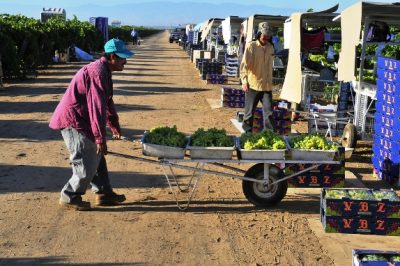
Rep. Lamar Smith (R-TX), Chairman of the House Judiciary Committee, has added a novel new twist to his anti-immigrant agenda: letting more immigrant workers into the country. In defiance of logic, the man who believes that immigrants merely steal jobs from U.S. citizens now wants to import migrant agricultural workers. At a hearing today of the House Subcommittee on Immigration Policy and Enforcement, Rep. Smith rolled out his latest legislative proposal, called the “American Specialty Agriculture Act” (H.R. 2847). The bill would create a new “H-2C” visa for temporary agricultural workers to replace the existing H-2A program, and would allow growers to bring in up to 500,000 of these workers each year. Read More
Report: New American Fortune 500
Our report on “The ‘New American’ Fortune 500” explores the impact that immigrants have on our national economic development. The report includes the latest research on the business contributions immigrants have made throughout all sectors of the economy. Some of the key findings in the report include: More than 40% of… Read More
America's story is an immigrant story.
